


The Local newsletter is your free, daily guide to life in Colorado. For locals, by locals.
Historically, as the days grow longer and the ski lifts stop spinning, the Denver housing market picks up. Often, that’s in April or even May. This winter’s unseasonably high temps and dearth of snow, however, may have inspired buyers and sellers to jump into listing and making offers earlier than usual. After a very slow January, inventory and demand rose significantly in February and March. That timeline shift is just one of many potential complicating factors to be aware of this year.
“Denver metro real estate in 2026 so far feels ‘unpredictably predictable,’ just like our weather…snow one day, sunshine the next,” says Michelle Schwinghammer, a broker associate with West & Main Homes and Denver Metro Association of Realtors Market Trends Committee member. “Fluctuating rates, economic uncertainty, affordability pressures, and global events are keeping buyers and sellers on their toes.”

Here’s what experts say about the Denver housing market in 2026—and the questions buyers and sellers should be asking right now.
Jump Ahead:
- What’s the lock-in effect?
- What do I need to know about HOAs?
- Will I be able to get insurance?
- Do I need a real estate agent?
- What pandemic effects are still lingering?
Read More: The 25 Best Neighborhoods in Denver in 2026
What’s the lock-in effect in the 2026 housing market?
Normally, the difference between three and six is three. But when you’re talking about interest rates on mortgage loans, it can be tens or even hundreds of thousands of dollars. That’s why people who bought or refinanced a house between 2020 and early 2022 aren’t eager to let go of their historically low rates. First-time homebuyers are slower to upgrade; baby boomers who move out of state are holding onto second properties; and older owners who might otherwise downsize are staying put. “The entire system is supply-constrained,” says Pete Thrasher, a former broker and associate chair in the Leeds School of Business at the University of Colorado Boulder.
The simplest way to shake folks loose would be to lower interest rates, but given recent economic markers like strong job reports and higher than ideal inflation, geopolitical tensions, and energy market upheaval, significant cuts in 2026 don’t seem likely. “It’s the uncertainty that lenders bake into their rates,” Thrasher says. Until local homeowners get uncomfortable enough to move on from their three percent mortgages, shoppers may continue turning to a classic housing demand solution: new builds outside Front Range city centers.
What do I need to know about HOAs in Colorado?
It may seem counterintuitive, given Coloradans’ libertarian bent, but we actually have the country’s second-highest percentage of occupied homes in community associations (43 percent, behind Florida, at 44 percent). “Colorado has really grown up during this period of time when [due to affordability challenges], the government shifted a lot of those responsibilities—said, ‘Hey, someone else needs to manage the streets or the trees,’ ” says Devon Schad, board president of the Rocky Mountain chapter of the Community Associations Institute, a nonprofit advocacy group for HOAs. “The cities have kind of stepped away and turned that over to homeowners associations.”
The state’s 10,000-plus associations have memberships that range from one to 31,338 units. The largest, the Highlands Ranch Community Association, offers its residents four recreation centers, kids camps and STEM classes, and an 8,200-acre wilderness area where a herd of bison will be moving in next month. It also strictly polices garage sale sign placement and requires public-facing fences to be stained with a custom shade called Highlands Ranch Fence Brown.
For people considering buying into an HOA, research is key. Start by reading up on what services—from group cable deals to pool access to snow removal—are provided and what might be restricted. (Can you put your spare bedroom on Airbnb? Are basketball hoops allowed?) Then, Schad says, dig into the financials. “If [the HOA] hasn’t been keeping up, there could be a chance that you get assessed,” Schad says. “If they don’t have enough in the bank and they’ve got to put a new roof on the clubhouse…someone’s going to have to pay for it.” Look for cracked pavement, neglected landscaping, or other signs of deferred maintenance, and ask to see the reserve study, which many HOAs have even though they aren’t legally required in Colorado. These documents analyze assets that may need to be repaired or replaced and estimate timelines and costs. “You can see how much percentage of funding they’re at for their reserve and where they should be,” Schad says.
A good association, Schad says, maintains or increases its residents’ home values and builds real community. “It’s a great entrée for young individuals to get involved civically at such a local level,” Schad says. “It’s almost like small government, right? Neighbors get to make their own decisions for their own communities.”
Will I be able to get insurance in Colorado?
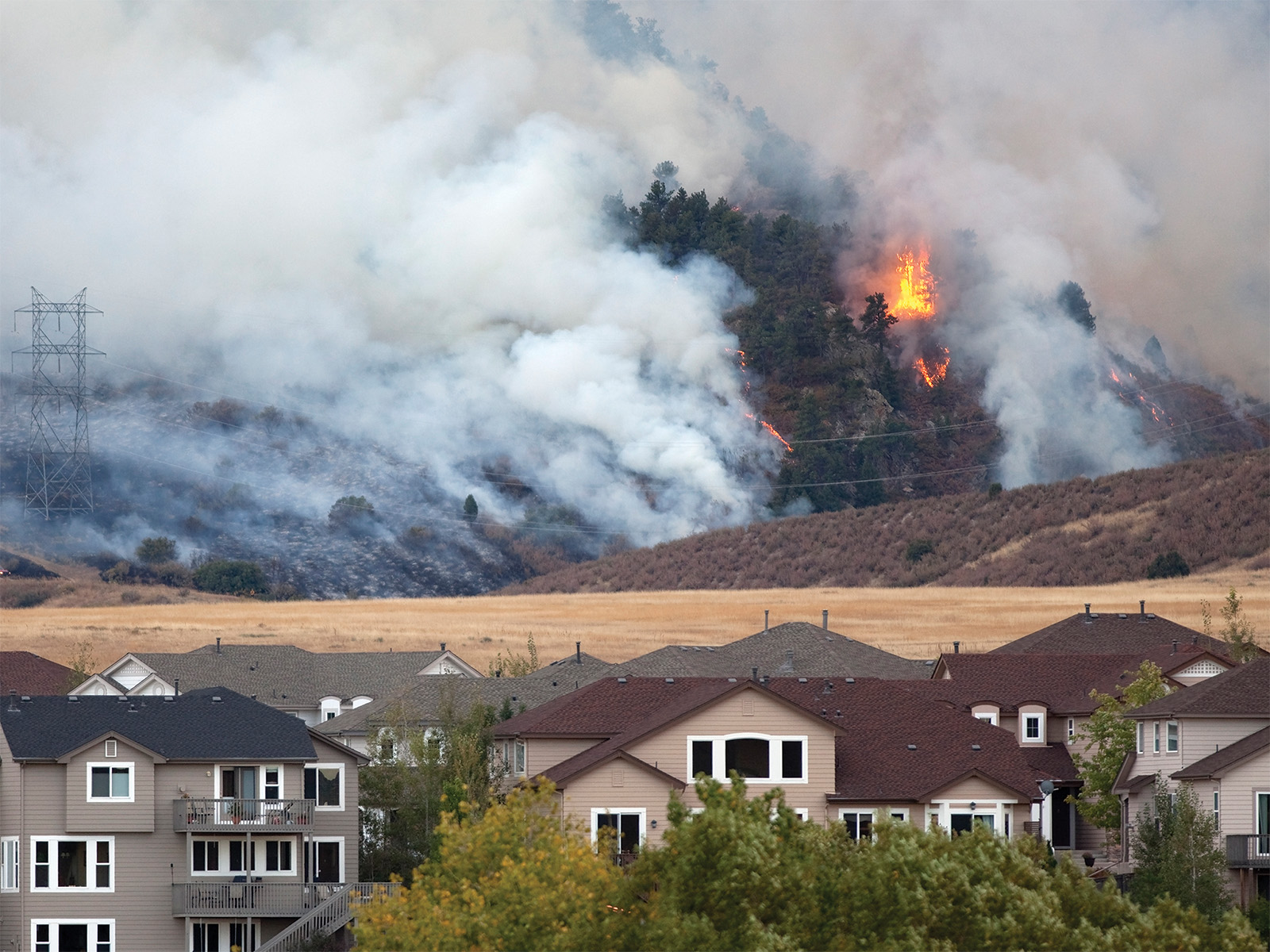
Technically, every residence in the state is now guaranteed property coverage, thanks to the Colorado FAIR plan, which was signed into law in May 2023. But as John Putnam, a retired insurance expert in Colorado Springs, puts it, “this coverage is very expensive and not what I would call good coverage.” (The FAIR plan’s website is even more blunt, labeling it a “last resort” and requiring proof of rejection from three standard insurance companies.) More Coloradans are being forced to consider it, however, as our dual catastrophes—hail and wildfire—get more catastrophic.
In eight of the 11 years from 2013 to 2023, insurance companies lost money on homeowners insurance in Colorado. See: events like 2023’s record- and window-shattering hail storms (a 5.25-inch-diameter stone fell in Yuma County) and the 2020 wildfire season, which featured the three largest blazes in state history. In response, the average homeowners insurance premium has risen 65 percent over the past five years, and some companies are refusing to cover certain ZIP codes entirely.
“More insurance companies are going to what’s called a risk-scoring method of trying to evaluate what your exposure is to loss,” says Putnam, who worked as a claims representative and owned an independent agency during his 57-year career. “For decades, insurance has used credit scores as a rating device. Now they’re using catastrophe scores. And the catastrophe scores all depend on where you live.” As demonstrated by 2021’s Marshall Fire, which consumed more than 1,000 homes in Louisville and Superior, wildfire risk is no longer contained to what we’d traditionally classify as the wildland-urban interface.
Before potential buyers start looking at houses, Putnam suggests talking to an insurer about coverage and premiums in their target neighborhoods or consulting the Colorado State Forest Service’s Wildfire Risk Viewer. The free online interface isn’t exactly the same system insurers use, but it gives a sense of the risk factors at addresses throughout the state. If you decide you’re willing to accept higher premiums to live in a higher-risk area, look for mitigation measures such as brush removal—both in the property you’re considering and the surrounding community.
“If you mitigate and your neighbor doesn’t, it’s not going to make much of a difference,” Putnam says. Thanks to recent state legislation, your neighbors should be incentivized to take preventive cautions: Starting July 1, insurance companies will be required to provide homeowners with their wildfire risk score and an explanation, which policyholders can use to implement mitigation efforts that could bring down their costs.
Do I need a real estate agent in 2026?
Enterprising types have long gotten around paying real estate agents’ commissions by DIYing their home purchases or sales. But it’s not quite as simple as learning to unclog your own drain on YouTube: There’s lots of deadline-sensitive paperwork, and you’ll still need to involve other professionals, such as a real estate attorney and title company.
New software platforms like Ownli, which launched in 43 states in March, are trying to lower the barriers to self-representation in the real estate market. For a flat rate of $1,999 for sellers and $999 for buyers, Ownli guides users through the process. (The industry standard is a five to six percent commission, split between brokers on each side, of the purchase price—e.g., $25,000 to $30,000 on a $500,000 house.) The platform has a proprietary home search feature with all active listings; contract generation; data-driven pricing recommendations; and a marketplace with lenders, inspectors, insurance providers, and title companies.
“You’ve got a calendar you are able to follow along with dates and deadlines; we make it really simple for the consumer,” says Denver-based founder Blake O’Shaughnessy, who was a broker for more than a decade before developing Ownli. “This business has always been so fragmented. We try to take out those pain points and make it less agent-dependent and more software-dependent.”
Just as amateur plumbing projects aren’t for everyone, O’Shaughnessy acknowledges neither is Ownli. “While I would love it if first-time homebuyers or those in the super luxury market used it,” O’Shaughnessy says, “our model is for those who have some familiarity with the home-buying process, are tech-savvy, and are hoping to make every dollar count.”
Read More: Denver’s Top Real Estate Producers
What pandemic effects are still lingering in the Denver housing market?
Talk to enough local experts, and it becomes clear Denver has the real estate equivalent of long COVID. “COVID changed everything,” says Michelle Schwinghammer, a broker associate with West & Main Homes. In particular, Schwinghammer says people who bought in the frenzied spring of 2022 are in a difficult position, should they be looking to sell. “2022 started with low inventory, rates in the low threes, and multiple offers everywhere. To win their deal, there’s a good chance they paid well over list price just to get the home,” Schwinghammer says. In a market that has been resilient but flat since then, those homes are probably worth closer to the original list price than the bid-up price those buyers likely paid. Plus, says Blake O’Shaughnessy, the Denver-based founder of the real estate software platform Ownli, “you’ve had sellers who are still chasing those COVID highs in pricing, and so there’s been this stagnation, where nothing was really selling because expectations weren’t meeting reality.”
Another pandemic-born quirk? “Buyers too often assume a home that hasn’t received an offer in two weeks has a problem,” Schwinghammer says of the mindset that developed during the extremely fast-moving market of the COVID years. “These assumptions are wrong and cause buyers to habitually overlook perfectly good homes.” Like so many of us, however, the market is slowly but surely recovering. “It was a disruptive force in what real estate was, and we’re coming out of that,” Schwinghammer says. “The good news is, the bottom didn’t fall out, but it is adjusting.”