


The Local newsletter is your free, daily guide to life in Colorado. For locals, by locals.
As in most sectors, artificial intelligence is bringing the good, the bad, and the downright creepy to the real estate industry. One of the most visible uses is AI staging, which fills listing photos of empty rooms with beige sofas, fake art, and, in the case of a rental in a Washington, D.C., suburb that went viral this past February, a demonic flesh monster crawling out of a bathroom mirror.
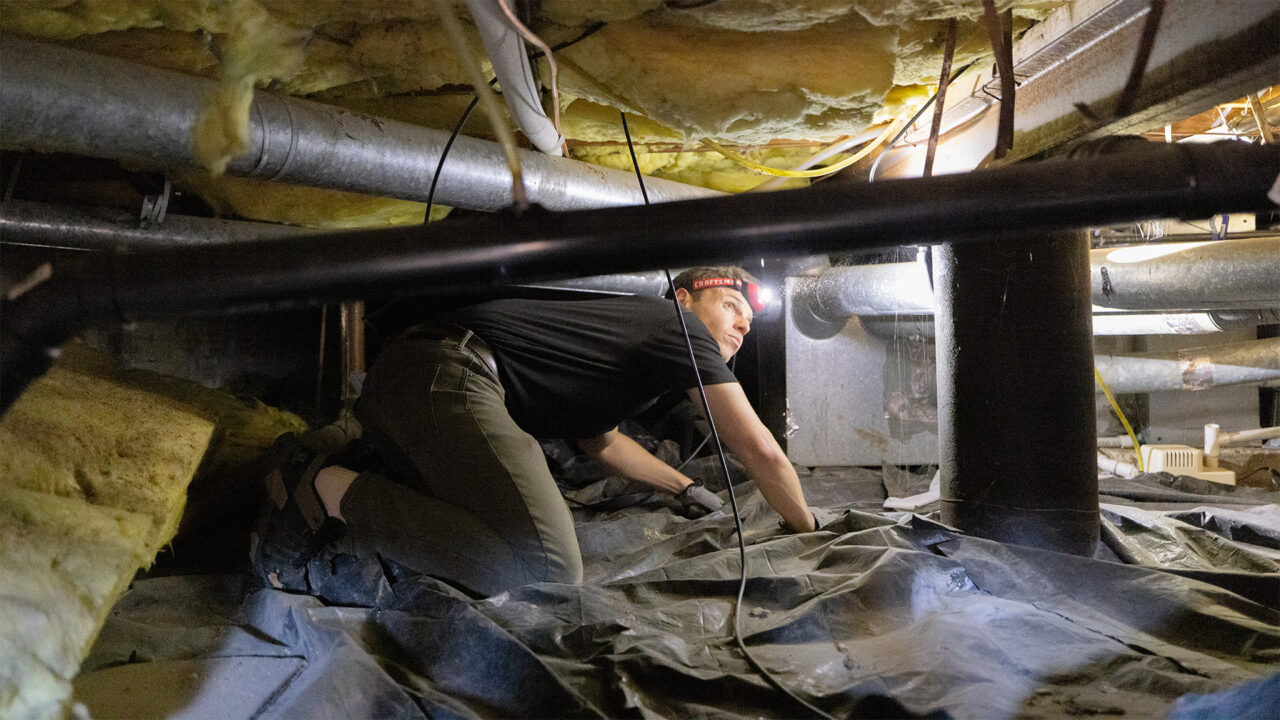
A new AI offering from Colorado’s Alpine Building Performance is decidedly less terrifying—and more practical. In March, the decade-old home inspection company released a free tool, called Alpine Intelligence, that helps predict what issues a home might have. “Our AI inspection forecaster is meant to help agents go from a reactive to a proactive state,” says Alpine Building Performance founder and owner Andrew Sams, who developed the ChatGPT-powered application with business partner Mason Minor.

The idea for Alpine Intelligence predates the AI technology used to bring it to life, spurred by the madness of the pandemic housing boom. “People were going under contract almost sight unseen. They’d spent five minutes in the home, and they were offering $60,000 above asking,” Sams says. “Agents were reaching out and saying, ‘Hey, we know you’re busy, but is there any way you could come to a showing with us, because we’re putting in these offers, and we don’t know—are we going to get to the inspection and be like, Oh, this home’s a mess?’ Of course, we were slammed, so we couldn’t do that.”
Even in today’s cooler climate, buyers under contract still sometimes have only days after the inspection to decide if they want to move forward, back out, or ask for concessions from the seller. So being able to research the cost of, say, replacing aluminum wiring in advance can be an advantage. “[The pandemic craziness] made me think, you know, a lot of what you see in an inspection is really characteristic of when it was built and where it’s located; there’s a predictive analytics element,” Sams says. “We basically built a custom knowledge database.”
Although Alpine Intelligence can be used by anyone, anywhere who uploads a home’s MLS data and additional information like permit histories and property disclosures, the tool is especially suited to evaluate the Front Range inventory it was trained on. “Classic, pre-1930s homes in your core Denver neighborhoods—Congress Park, Cheesman Park, Highland—have a lot of brick masonry foundations. So we see mortar deterioration and brick spalling and deterioration,” Sams says. “Or, if it’s pre-1940s, it has an 87 percent chance of lead-based paint.”
Of course, that means there’s a 13 percent chance the home doesn’t have lead paint—which is why traditional inspections are still necessary. “It’s definitely not meant to replace the inspection, but really to help the agent set expectations,” Sams says. “If a buyer is looking at 1950s homes in City Park and encounters an issue that’s characteristic of a 1950s home in City Park and decides to terminate on that deal, they could just run into it again at the next house.” In this use case, anyway, AI knowledge could equal real power.
Read More: Buying or Selling a Home in Denver This Year? Here Are 5 Questions You Should Ask.