

The Local newsletter is your free, daily guide to life in Colorado. For locals, by locals.
If you’re new to Denver, you might assume that the Mile High City is a cherry hot spot. For more than 50 years, the city has hosted the Cherry Blossom Festival, and the fruit features prominently in the names of Denver locales. We’ve got the Cherry Creek neighborhood, Cherry Hills Village, Cherry Creek State Park, and even beloved restaurants like the Cherry Cricket and Cherry Tomato.
But in fact, Japanese cherry trees—the kind whose fleeting, pink-and-white displays draw thousands of admirers to Washington, D.C.’s National Mall every spring—are fairly rare in Denver, says Panayoti Kelaidis, senior curator and director of outreach at Denver Botanic Gardens. “We have a few at the gardens, and there are some here and there around the city,” Kelaidis says—but many of the spring blooms that Denverites might call “cherry trees” are actually crabapple, apricot, or plum. (As for the Cherry Blossom Festival, it’s a celebration of Japanese culture, not botany, though people get mixed up often enough that the event’s FAQ prepares visitors not to expect any live blooms.)
So where did all the “cherry” names in Denver come from? They likely derive from the chokecherry, a hardy native shrub that has flourished along Cherry Creek and other local waterways for hundreds of years, and whose red or purple berries are still harvested by the Arapaho people. The chokecherry’s clustered white flowers, while pretty, don’t turn heads the way Japanese cherry blossoms do. Nor do those of hardier tart cherry trees, though as Colorado Gardener notes, those are a good choice for home gardeners across the Front Range, and their fruit is perfect in a pie.
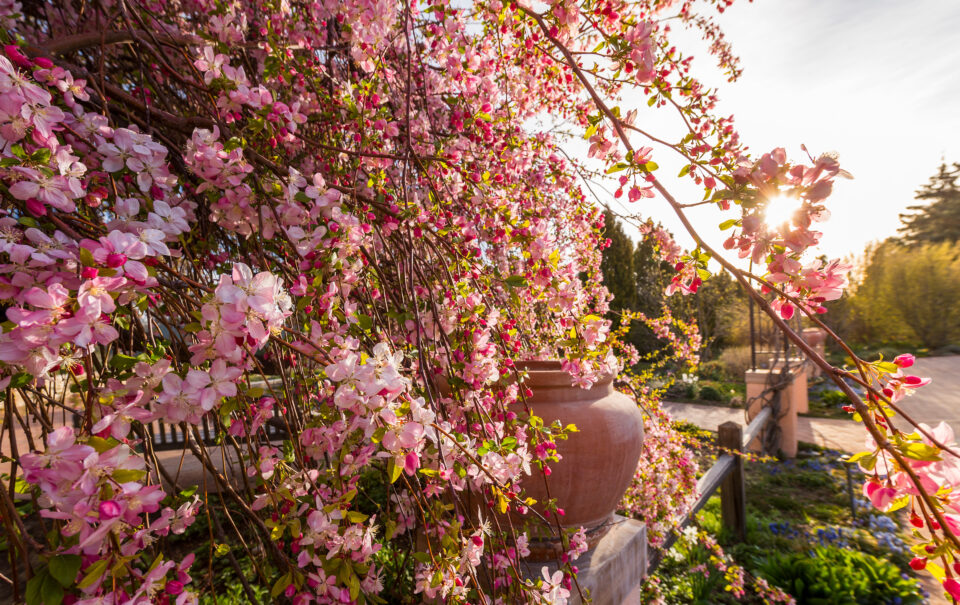
That’s not to say Denver doesn’t have gorgeous flowering trees. Every March, Kelaidis strolls through the south end of Civic Center Park, gazing up at its lush, softly fragranced pink crabapples. “Three years out of four, crabapples are fabulous here,” he says—and their blossoms can last a long time, often from late March through mid-May. Much of Civic Center is closed for construction this spring, but you can still peep some blooms on the park’s north end.
Visitors to the Botanic Gardens will see 42 varieties of crabapple, and after this unusually mild winter, Kelaidis expects them to start budding by mid-to-late March. That’s not to mention his other favorite, the American plum: “When they come into bloom—oh my heavens, the smell is enchanting,” he says. “I always sneak off to one of the plum thickets around Denver and cut a few branches to take home.”
Below, find nine places to wander among flowering trees this spring. Unless otherwise noted, they’re free and open to the public from dawn to dusk.
Cherry Creek State Park
There may not have been much powder on our peaks this winter, but you can bet on a little snow in late spring and summer at Cherry Creek State Park: soft, pillowy drifts of white cottonwood fluff, that is. Head to the Wetlands Preserve at the south end of the park to admire these trees while you stroll along the Wetland Loop trail. “Because the Wetlands is so well-preserved and open only to foot traffic, you’ll see the most biodiversity of trees, plants, and wildlife in that area,” says ranger Michael Walther. The park can hit capacity on warm, sunny weekends, so plan your visit accordingly. Open daily, 5 a.m.–10 p.m.; $10 for a daily vehicle pass
Littleton Crabapple Route
At the urging of a nature-loving mayor in the 1970s, Littletonians began planting thousands of crabapple trees along streets and in front yards. More than 40 years later, in 2014, the town declared itself the Flowering Crabapple Capital of Colorado—a tongue-twister title that’s still well-deserved, thanks to the vibrant, seven-mile Crabapple Route. One writer who explored the route at peak color (and helpfully mapped its connections to four hike-and-bike trails) noted that the heavenly scent carries “hints of apple, cinnamon, or clove.” Expect the show to start by late March or early April.
Hudson Gardens
Also in Littleton, this 30-acre wonderland includes a water lily pond, an apiary buzzing with bees, a nature playground where kids can roam free, and flowering trees aplenty. “We have a couple magnolias that are almost ready to bud now,” says Pat Dillon, grounds and facilities supervisor. A cucumber magnolia near the administration building will soon put its yellow-green flowers on display. In March and April, head to Bob’s Pond to see flowering cherries and crabapples. The rose garden will also boast pink, red, white, and yellow blooms, likely peaking in June and July. On the east side of the Inn, in the gardens’ southeast corner, is Dillon’s favorite flowering tree at Hudson: a redbud, whose cheerful magenta flowers are edible. “They’re hard to establish here, but once they get going, they are beautiful,” he says.
Denver Botanic Gardens
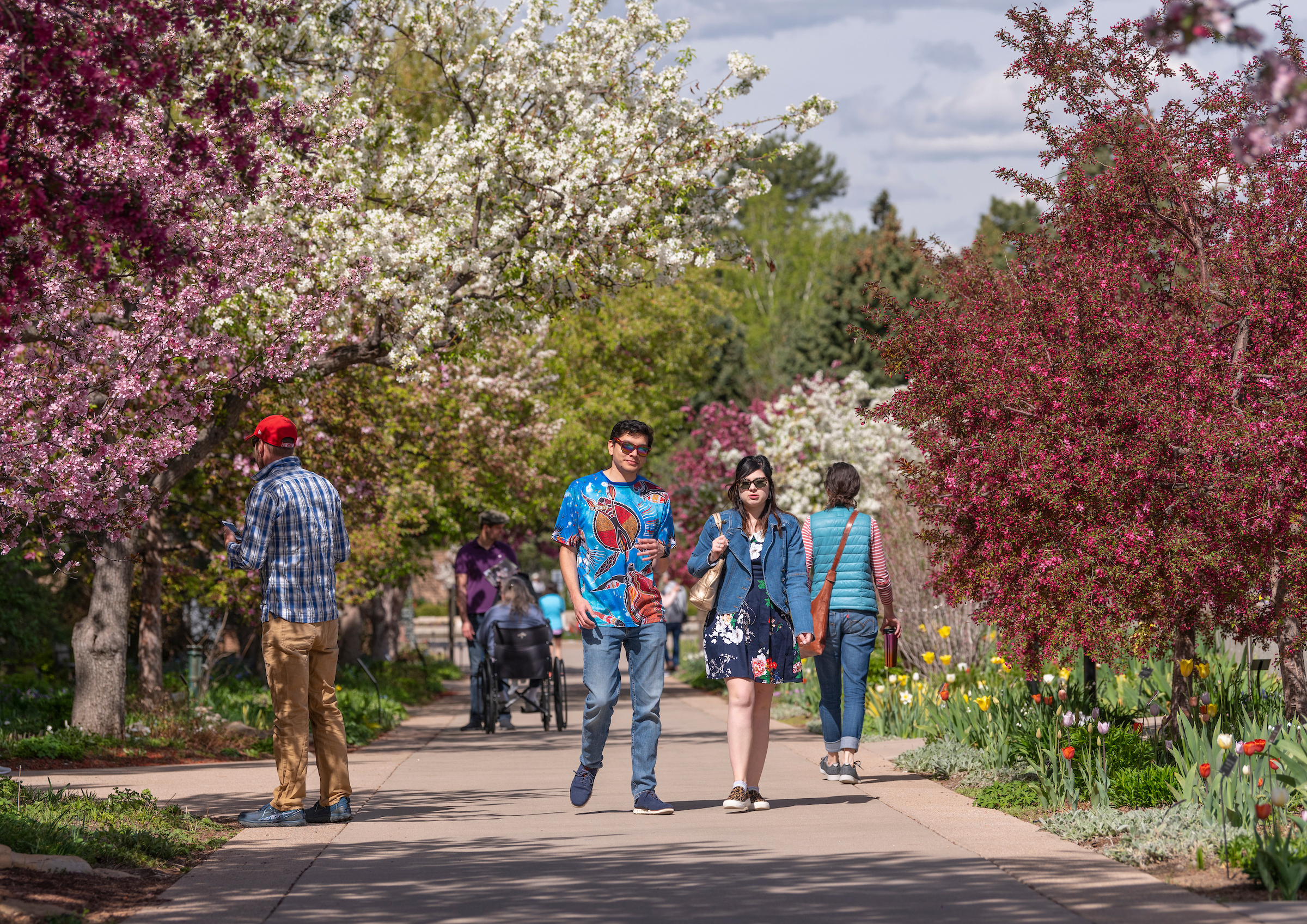
When you arrive at the gardens, pick up a map (or use this online version) and stroll around to see what’s blooming. You can marvel at Japanese cherries in the Shofu-En Japanese Garden and apricots in the Scripture Garden, for example. Head to the aptly named Romantic Garden to admire dreamy crabapples and striking, yellow Cornelian cherries. Open daily, 9 a.m.–4 p.m.; $16 for adults.
University of Colorado Boulder
The university campus is home to at least 5,000 trees representing nearly 60 species. Print out this handy map and take yourself on a self-guided tree tour next time you’re in the area. Highlights this spring might include redbuds, magnolias, and Pagoda dogwoods.
Washington Park
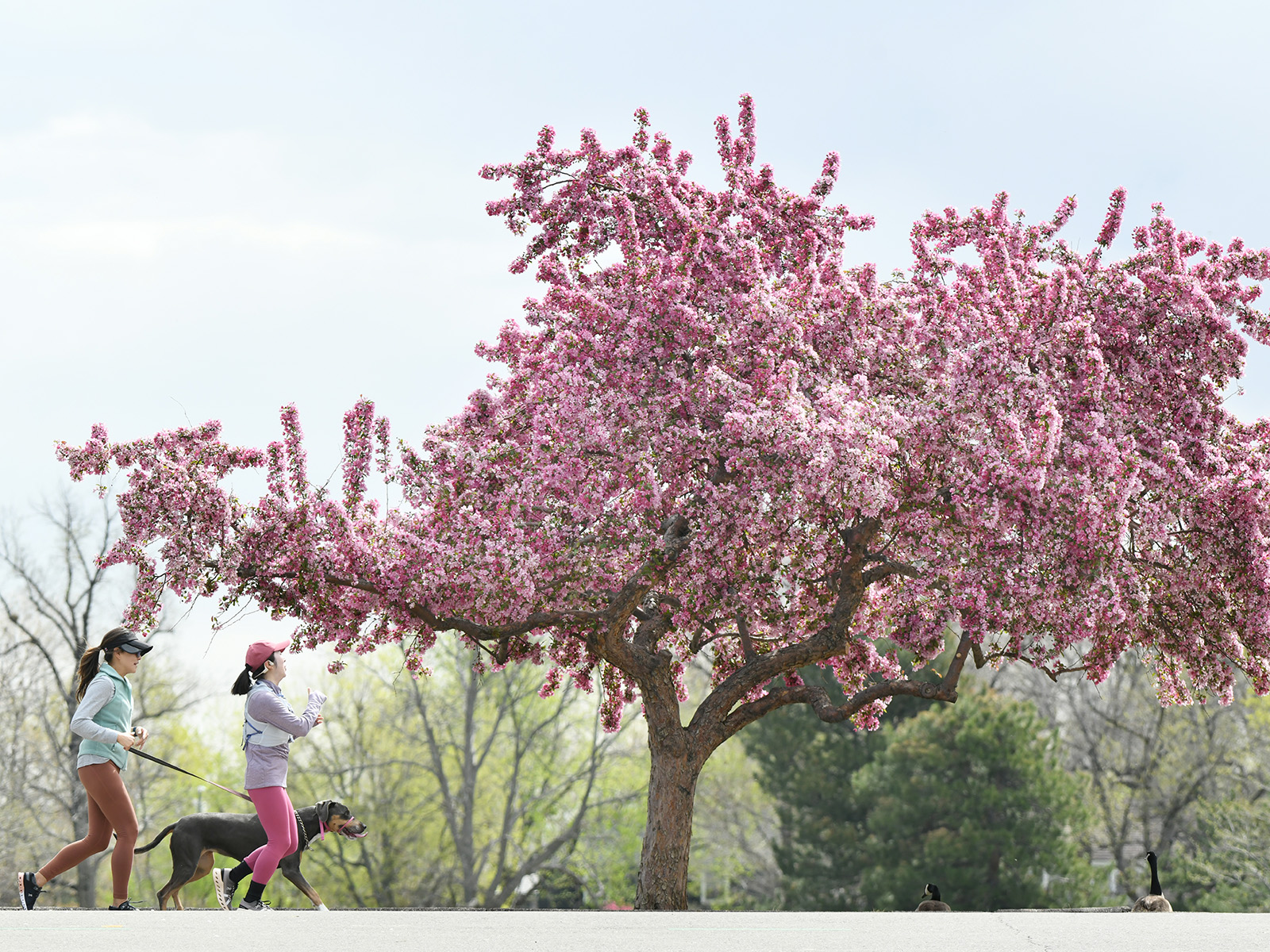
Wash Park’s perimeter trail is lined with crabapples and cherry trees (both the hardier Montmorency and the delicate, showier Japanese). “Usually cherries start to bloom around late March, early April, but with the warm weather we’ve had, I won’t be surprised if they start earlier,” says Ben Rickenbacker, a certified arborist and forestry operations manager with Denver Parks & Recreation. He and his crew have been busy nourishing the trees with copious winter watering over the last few months, and soon their work will start to pay off. Don’t miss the 155-acre park’s two flower gardens, including a re-creation of George Washington’s Mount Vernon gardens.
Cherry Creek Trail
For a relaxing Saturday-morning stroll in downtown, park next to the flagship REI on Platte Street, grab a coffee from Red Silo next door, and walk with a friend along the Cherry Creek Trail, which will soon be popping with chokecherries, crabapples, and a scattering of Japanese cherries.
The High Line Canal
This newly improved greenway traverses 71 miles from Littleton to Aurora, and it’s teeming with native trees and wildlife. “You’ll really notice the chokecherry and American plum in that area,” says Rickenbacker, as well as the buzzing bees, birds, and butterflies that come to feed on the flowers and fruit. Chokecherries and plums are both edible, with hobbyist foragers often cooking them down into jams and jellies.
Cheesman Park
One of the best picnic spots in downtown, historic Cheesman Park boasts a stately neoclassical pavilion and a reflecting pool, plus gently sloping lawns bordered by groves of flowering trees. If you catch a whiff of something funky, it’s likely a Bradford pear, whose lush white blooms belie its faintly fishy smell. “They put out tons of blooms in the spring, but some people don’t like them because of the scent,” says Karim Gharbi, a CSU extension agent in Denver. While he’s concerned that our overly warm winter could lead to trees blooming too early, then getting nipped by frost, he marvels at the ingenious adaptations Colorado plants have evolved to persist in our crazy climate. “Some trees will put out both a secondary and a tertiary bud, as a form of insurance,” Gharbi says. If a hard freeze kills the first bud, the plant’s built-in backup will help it survive.