

The Local newsletter is your free, daily guide to life in Colorado. For locals, by locals.
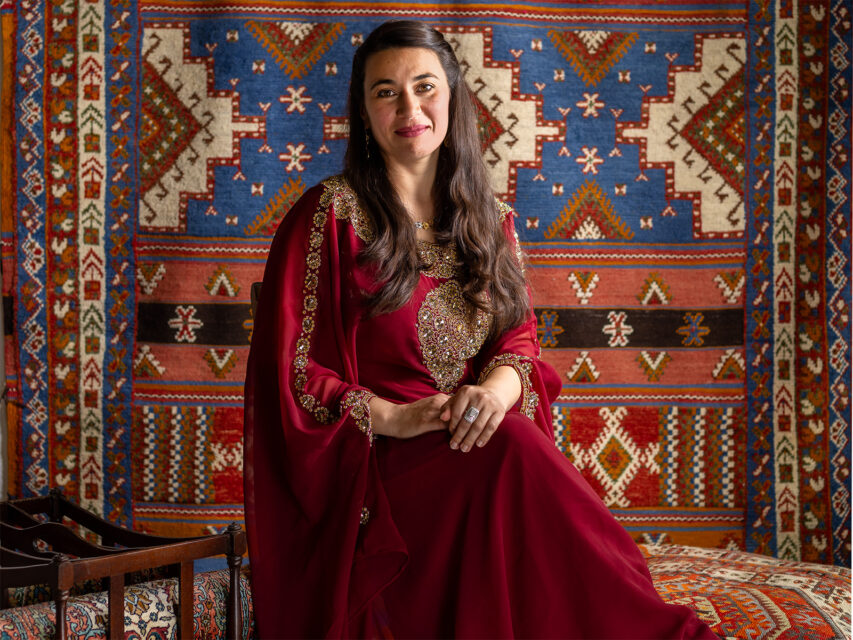
In 2014, Enas Alsharea fled her home in Baghdad as threats to her safety became imminent. She settled in Colorado as a refugee and eventually became an assistant professor at the University of Colorado Anschutz School of Nursing. But before her 40th birthday in 2023, Alsharea made a wish: to go home. “I didn’t know what I was missing,” Alsharea says. “The art felt very alive. The city was very vibrant. The colors, the spices…I wanted to bring that vibrancy to the United States.”
Two years later, Alsharea opened Innana Creations, a rug shop in Superior that specializes in custom and vintage weavings from the Middle East. Here, Alsharea shares how the business has changed her perspective on community.

Editor’s note: The following conversation has been edited for length and clarity.
5280: The Middle East produces an array of beautiful objects. Why did you choose rugs?
Enas Alsharea: I feel really connected to the weaving process—the slowness of it, the art, the colors, the story that it tells, the women who make the rugs in their homes.
[Opening this shop] has also brought up so many aspects of me. Part of it is nostalgia for my roots, but it’s also about my journey here in the United States. When I first arrived, I wanted to assimilate and become like everyone else. With time, I learned my identity—a different perspective, belief system, language, upbringing—can also be celebrated and cherished, like the patterns and contrasting colors in a rug.
You sell both custom and one-off rugs. Where do they come from?
Ninety-nine percent of the weavers in the Middle East are women who live in villages. Typically, they’re commissioned to start a rug, and once finished, those rugs are taken by men who have access to the city, to the tourists, to different languages, to spaces where they can sell the rugs at a higher price. The weavers still get paid, but not enough for the art they produce. I source directly from women weavers. My goal is to empower them and show them that their pieces are so valuable in the world. I can pay them way higher than the pennies they’re making, and they don’t have to travel to big cities to earn fair wages.
How did you meet these women?
I started going to faraway villages in Turkey, Morocco, and Iraq. In Baghdad, I hired a taxi and traveled for hours to a small village, where a weaver hosted me in her home and showed me her very primitive loom. She would look at a design, focus on it for 15 seconds, and then start weaving. No pattern, no numbers, no measurements. She’s never been to school; she’s illiterate, so we communicate over voice notes. I saw the power and talent in her, and I just wanted to support her.
Fostering connection seems like your overarching mission.
I don’t sell my items online even though I have been asked to many times. I want people to come to the shop and look and feel and connect and have a conversation with me. I want them to learn about the weavers and the dyes and the weaving techniques of the piece they take home.
[Looking at a beautiful rug] connects us to parts of the world that we only see in the news—areas that are portrayed as full of suffering, war, conflict, death, darkness. Seeing beauty coming from that side of the world just gives us a different idea. When my clients come home from work and the TV is broadcasting bad news, maybe the eye will turn to the floor and see beauty.