
The Local newsletter is your free, daily guide to life in Colorado. For locals, by locals.
It was only the first night of our backcountry rafting trip on northwestern Idaho’s Salmon River when my five-year-old encountered the rattlesnake. Just after a visit to the groover—non-river rats call this a “toilet”—Eve heard the eerie maraca shiver that can only mean one thing. Sure enough, there was a Western rattler tightly coiled on a nearby rock. “It was showing us its fangs!” her seven-year-old brother, Sam, later reported. He had sprinted over to see for himself, naturally.
The situation resolved itself as these things almost always do: The snake slithered away, the kids got a good story, and nobody had to worry about antivenom on a beach situated hours from the nearest hospital. It was a brush with the truly wild—and honestly, wasn’t that exactly what we were hoping to find here in Idaho?
My husband, Norman, and I are longtime backpackers—or at least we were before the kids came along. Nothing else resets my mind, body, and spirit in the same way, and we want our children to experience that sense of escape, too. But the unfortunate truth is that extended backpacking with young kids is nearly impossible. While I suppose we physically could, Norman and I had no desire to haul a week’s worth of food and gear for four people, to say nothing of the inevitable whining (theirs, and potentially ours).
At some point, a revelatory thought occurred to us: Say, what if a boat carried all the stuff? A river trip might be the perfect way to get our young family into the wilderness, no hiking or hefting required. It couldn’t be just any river, though. We wanted to be on the water long enough to truly shed the everyday routine. We hoped for great camping and water warm enough for swimming. The rapids couldn’t be too spicy for a kindergartner to handle. As if our list wasn’t prescriptive enough, we also needed a river we could get on that season—no permit lotteries.
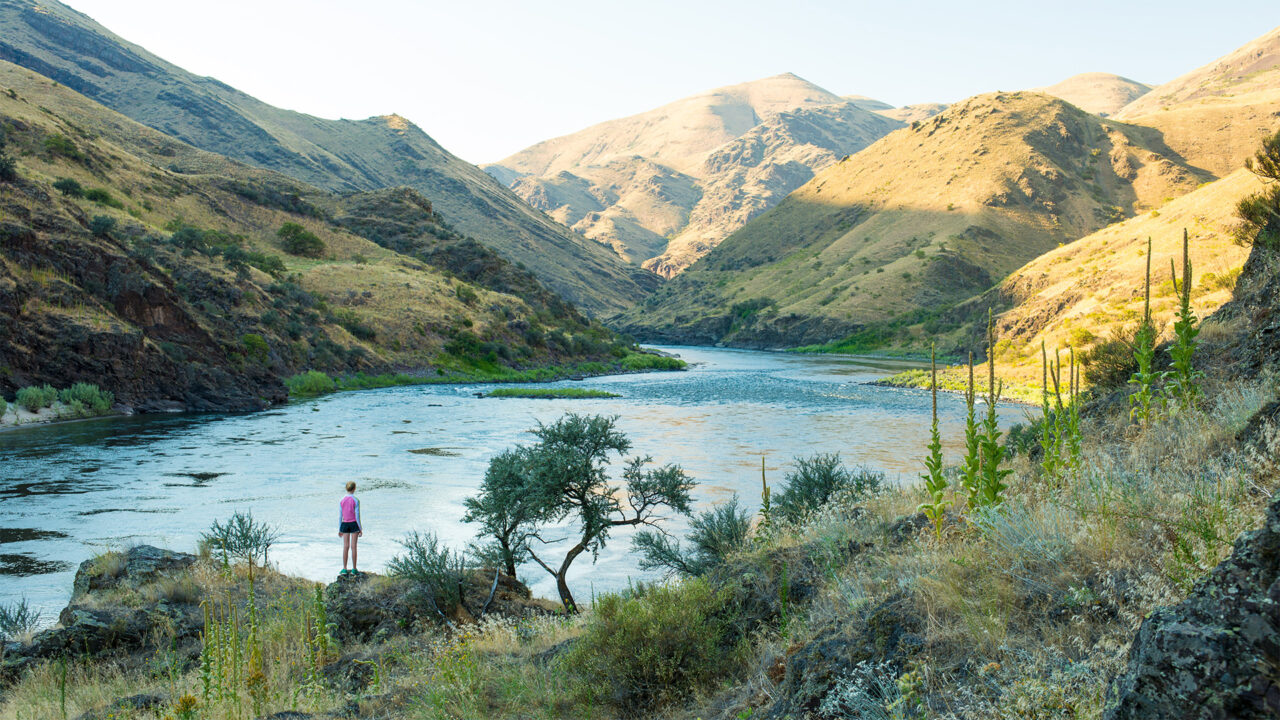
When we stumbled across the Lower Salmon River, a wild waterway coursing through the basalt canyons and willowy hills where Idaho, Oregon, and Washington meet, we knew we’d found our trip. The 61-mile section between the Pine Bar and Heller Bar launches would keep us out for five days. Sandy beaches dot the riverbank. And access is a breeze: Some floats, like the iconic Colorado River through the Grand Canyon or the Yampa-to-Green rivers through Dinosaur National Monument, require winning a permit lottery that’s about as cutthroat as getting into Harvard. Traffic on the Lower Salmon, however, is light enough that anyone who wants to go can.
Still, this section of water does sport a handful of challenging Class IV rapids, and though Norman has some experience on rough rivers, we didn’t feel confident running the Lower Salmon by ourselves. When we discovered that ROW Adventures, an outfitter based in Coeur d’Alene, Idaho, offers a families-only trip complete with kids’ meals and a “river jester” who entertains the children, we couldn’t sign up fast enough.
After the excitement of the rattlesnake that first night, we settled into our corner of camp. We knew better than to enforce any particular bedtime on vacation, but the day’s swimming and sprinting around in the sand had done it for us. When both Eve and Sam drifted off in our tents not long after the sun set, I smiled. I could already feel us shifting into river time.
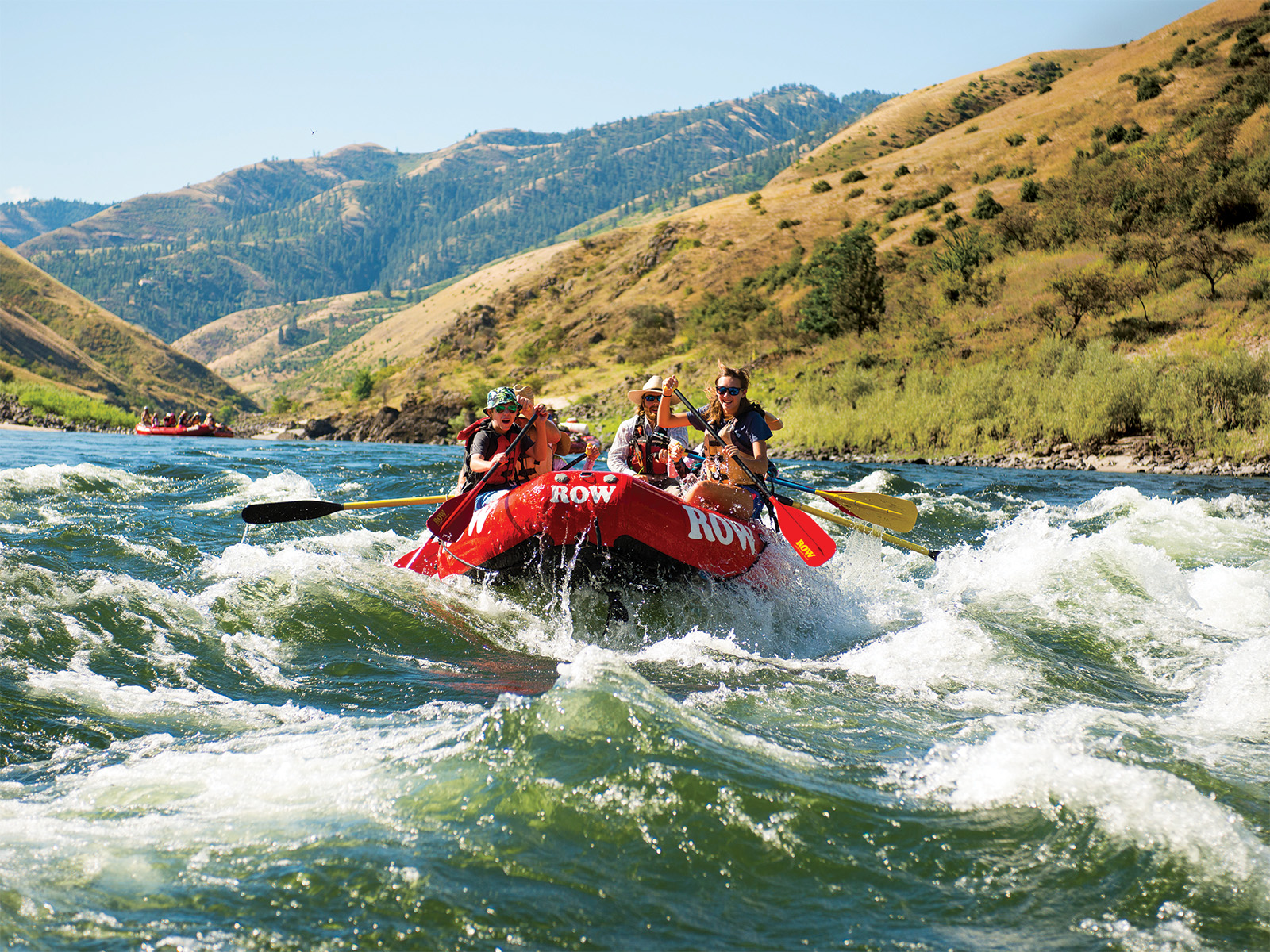
Ten or so hours earlier, we’d stepped off the bus onto the hot August sand at our put-in, a 90-minute drive south of ROW’s staging ground in Lewiston. Along with the other three families on our trip—a Denver doctor with three boys ranging from six to 12, a father-son duo from Texas, and a North Carolina couple with two tween daughters—we wrangled life jackets and spackled our kids with sunscreen. The lead guide, Connie, bustled around our five-boat flotilla of rafts and an inflatable kayak, tightening straps and counting drybags. Laid-back and rocking a long, white ponytail, Connie has been floating Idaho’s rivers professionally since the ’80s. Jenn, a guide with green and blue streaks in her hair, launched into a safety talk. The kids, who’d been excited about this trip from the get-go, started fidgeting; I hoped they’d be able to handle sitting still in the boat. Before too long, though, we were shoving off into the Salmon’s greenish-brown current.
We were floating the last miles of the main stem of the Salmon, which rises in central Idaho’s Sawtooth and Whitecloud mountains and flows west for 425 miles in dramatic fashion. To the east, the river has made millennia-long work of carving its eponymous canyon (at about 7,000 feet, it’s the second deepest in North America, behind only the Snake River’s Hells Canyon to the southwest), exposing 1.5-billion-year-old gneiss as it goes. And—unusual in the West or anywhere else—there aren’t any dams on it. That’s lucky for us, I thought as we landed on one of the many beaches lining the banks for a taco lunch. Dams trap the sediment that every river carries, piling it up on reservoir bottoms. But a free-flowing river deposits its sediment wherever it likes, building sandy expanses in the natural eddies.
A couple of hours later, when we arrived at our first camp, the sand made for an evening’s worth of entertainment for the junior set. The river jester (I’m tempted to call her a babysitter, but ROW frowns on that term since parents are expected to be cognizant of their kids at all times) led Sam and Eve to the water’s edge to build giant sand birthday cakes. Lena, an aspiring guide and college student at the University of California, Berkeley, had a never-ending supply of activities up her sleeve; all the kids took to her right away. The guides got to work prepping a fresh salad for dinner. This left Norman and me with the unfamiliar sensation of free time. I wandered down to the bank and swirled my toes in the water, gazing at the cappuccino-colored hills cradling the river.
People have been doing much the same thing on the Salmon for more than 16,000 years. Earlier that day we’d floated past Cooper’s Ferry, where archeologists have discovered some of the oldest human artifacts in North America. These spear points and charred mammal bones got there well before the glaciers of the last ice age melted, challenging the theory that the first way humans populated this continent was walking south from the Bering land bridge. Some experts now believe the earliest arrivals migrated down the West Coast from Alaska by boat—perhaps using the Columbia and Snake rivers as highways to this very place. Much more recently, the Salmon became home to the Nimiipuu (or Nez Perce), who established winter villages along the water and invented bowl-shaped “bull boats” to float the river. Many Nimiipuu still live here, on and around the tribe’s reservation 25 miles or so north of our campsite.
At 9:30 the next morning, we hopped back on the rafts for our first day of big water—at least, Class III and IV rapids sounded plenty big to me with the kids aboard. The Salmon River’s ominous nickname, “River of No Return,” didn’t soothe my anxiety. The moniker isn’t meant to be a warning of danger; it dates to the 1870s, when gold miners shipped supplies downriver in wooden boats that couldn’t make it back upstream, thanks to the Salmon’s turbulent rapids and tight canyons. But still.
The river eased us in with a few Class II splashers and wave trains before we entered relatively smooth water in Cougar Canyon. From her perch at the oars, Connie explained that the vertical rock walls around us were remnants of volcanic islands that got smashed up against the West Coast hundreds of millions of years ago, when Idaho was the West Coast. These days, enormous, angular chunks have crumbled off the canyon walls, leaving a very cubist-looking landscape behind. We pointed to bald eagles posted up on rock edges overhead and gazed at chukars—plump Asian partridges now firmly established in the West—pecking their way from boulder to boulder.
Then the current picked up. We plunged into our first major rapid, Bunghole (those under 10 think it gets funnier every time you say it), to much splashing and delighted squeals. Fiercely gripping a strap on Eve’s life jacket, I shrieked right along with the children; the rollicking cadence of the waves made me feel like a kid myself. But a few more miles and Class III rapids later, I snapped back into adulthood as we approached Snowhole, a Class IV. Connie’s guidebook described it as a “steep drop with huge boulders and holes,” matter-of-factly reporting it was “relatively straightforward if you’re in the right spot” but “very dangerous if you’re not.” This was why we signed up with the pros.
Norman and I each grabbed a paddle for extra power and made the kids crouch down in the bow. Eve covered her eyes the second we hit the waves. Halfway through, the river yanked us 180 degrees, and we sailed over the biggest drop backwards. Turns out, this is not a problem if you’re a skilled rafter like Connie (a truth I’d loved to have known beforehand).
Our second night’s camp, on an expansive beach dotted with willows, was even better than the first. Swallows darted overhead. Tiny lizards did tiny push-ups next to our tents. Sam found bliss rolling around in the soft sand while Lena took the other kids on a blackberry-picking expedition, leaving us parents free to inspect the guides’ selection of White Claws. Suddenly, the children came streaking back. Eve peeled off before the rest of them waded into the river and started frantically splashing their legs. “We were playing Sardines, and Lena said we were hiding in a patch of poison ivy,” she reported. “But I’m the only one wearing long pants, so I’m OK!”
As dusk fell, we decided to follow the guides’ lead and let the kids sleep out in the open for the first time. Unlike the Rocky Mountain campsites we were used to, here the nights were mild, biting bugs scarce, and bears a nonissue—so why not? We dragged our sleeping pads into a clearing among the willows and tucked Sam and Eve into their bags. They passed out swiftly, but not before glimpsing the evening’s first bats fluttering between us and the brightening stars.
Sam blinked awake with the sun the next morning. “That was the best night’s sleep I’ve ever had,” he said.
By day three, we’d settled into an easy rhythm: Enjoy coffee and hot breakfast, pack up gear, rub on reef-friendly sunblock, jump in a raft, ride the rapids, look for eagles and ospreys. I hadn’t realized how much I’d missed the clarifying simplicity that sets in once you leave regular life for a few days. My brainwaves felt stretched out, slower. I wondered if the kids sensed the same.
They had their moments, of course. Sam and I tried paddling the kayak one morning, an ultimately frustrating endeavor that left him whining to go home. Bouncing, splashing, and other kid shenanigans popped up regularly in the rafts. At one point, Sam and Eve got in a huge fight over her singing an annoying song of her own composition on repeat, forcing us to send him to another boat. Wilderness immersion didn’t magically turn them into angels.
But we did find magic. Sam and his best buddy on the trip scooped up tadpoles in their hands, delighting in the little creatures’ lashing tails. The discovery of a miniature diamond-patterned reptile near our tent sparked much discussion over whether it was a baby rattlesnake or the more benign gopher snake. (The jury’s still out.) Everyone oohed when a coyote trotted into view on the opposite riverbank.
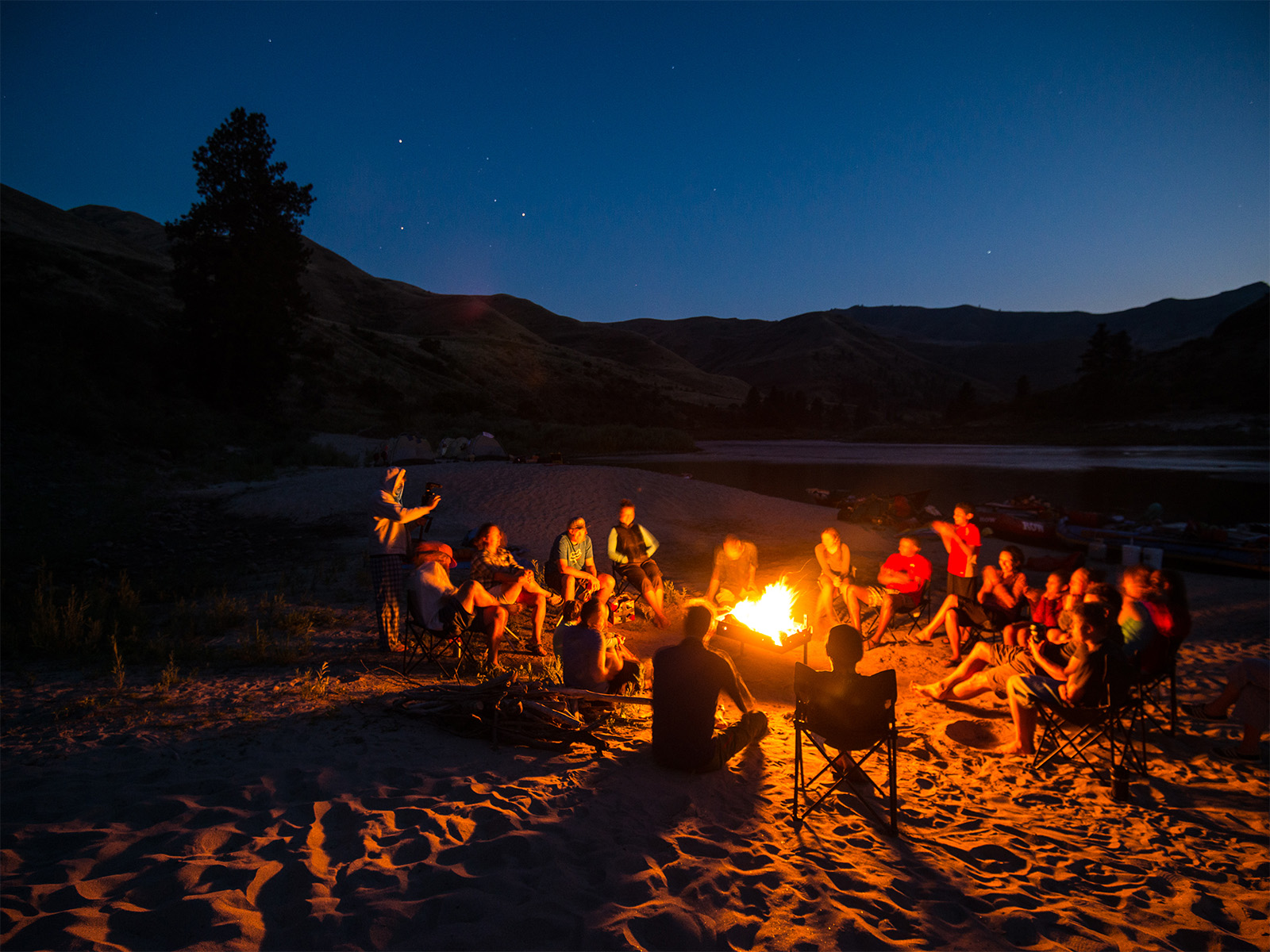
On our third night, we set up the sleeping pads under the stars again and huddled up to read bedtime stories. A few minutes in, a beam of impossibly bright light shot out from behind an outcropping downstream: the rising moon. We stopped reading to stare as it slowly crept into full view, looking far too big to make sense; the kids were as enraptured as they’d ever been with Bluey. When the moon finally ascended to its normal size, we flipped onto our backs and pointed out the handful of constellations we knew by name. A flash streaked across the sky, and we all gasped. Sam and Eve had just seen their first shooting star.
The next day happened to be Sam’s eighth birthday, an occasion the guides marked at breakfast with a special stack of chocolate-chip pancakes smothered in whipped cream. Sam insisted on riding in the “kids-only” boat with the other boys for our morning float through Blue Canyon, another Picasso-esque chasm full of rapids. The landscape began to pinch, undulating hills giving way sharply to vertical, blue-black basalt walls. After one more big drop, we flowed with the Salmon as it poured into the Snake, entering Hells Canyon National Recreation Area. Though the river swelled, from 4,000 cubic feet per second to 17,000, the water also widened and slowed. Our guides had to muscle the oars hard for the last few miles to camp. The real world suddenly felt too close.
The next morning, we lashed the rafts together and fired up a small motor to chug through what’s dubbed “the Great Snake Lake.” Here, the canyon widened so much and the current mellowed so dramatically that we needed a mechanized assist. We stopped for lunch at an orchard marking the end of Hells Canyon, toasted the trip with Champagne, and shared our favorite memories. More than one person teared up. Before we knew it, the journey was over. We piled into a bus for the 45-minute ride back to Lewiston.
I thought back to the previous night, which the guides gleefully called “La NO-ter,” for “Last Night on the River.” We’d celebrated with an impromptu talent show, decked out in Hawaiian shirts, velvet robes, and anything else we could dig out of the guides’ costume box. Lena led the kids in a cute skit about an invisible bench, dads told dad jokes, and the youngest boy softly sang a Justin Bieber tune while twirling in a circle. My abs got a workout from laughing.
On our very first evening, Jenn had risen to toast the Salmon: “To the living river.” I now knew what she meant. We’d been able to watch the water change in a million ways over the past five days, in color, current, mood. Floating on its surface, splashing in its eddies, sailing through its wave trains—we could feel it like a breathing organism. Standing with my toes in the river, I sensed a connection between my body, the water, and the landscape around me.
I don’t know if Sam and Eve felt the same thing. But they’d watched every sunrise and sunset, marveled at the snakes and eagles and lizards, and felt sun and water on their skin and sand in their hair. Best of all, they wanted to do it again. We couldn’t ask for a better beginning.
How To Float the Lower Salmon River
- Getting there: The closest major airport is Spokane International, a two-hour, 20-minute nonstop flight from DIA via United, Frontier, and Southwest airlines
- Staging ground: Lewiston, Idaho (two hours from Spokane International; 90 minutes from put-in and 45 minutes from takeout)
- Permit: Free, self-issued BLM permits are required and available at the Pine Bar put-in; outfitters like ROW typically handle permits
- Best season: July through early September; ROW only offers this trip in July and August
- Guides: Several major outfitters run trips on the Lower Salmon; ROW Adventures offers all-ages and families-only options ($2,090 per adult, $1,690 per child; all-inclusive)