
The Local newsletter is your free, daily guide to life in Colorado. For locals, by locals.
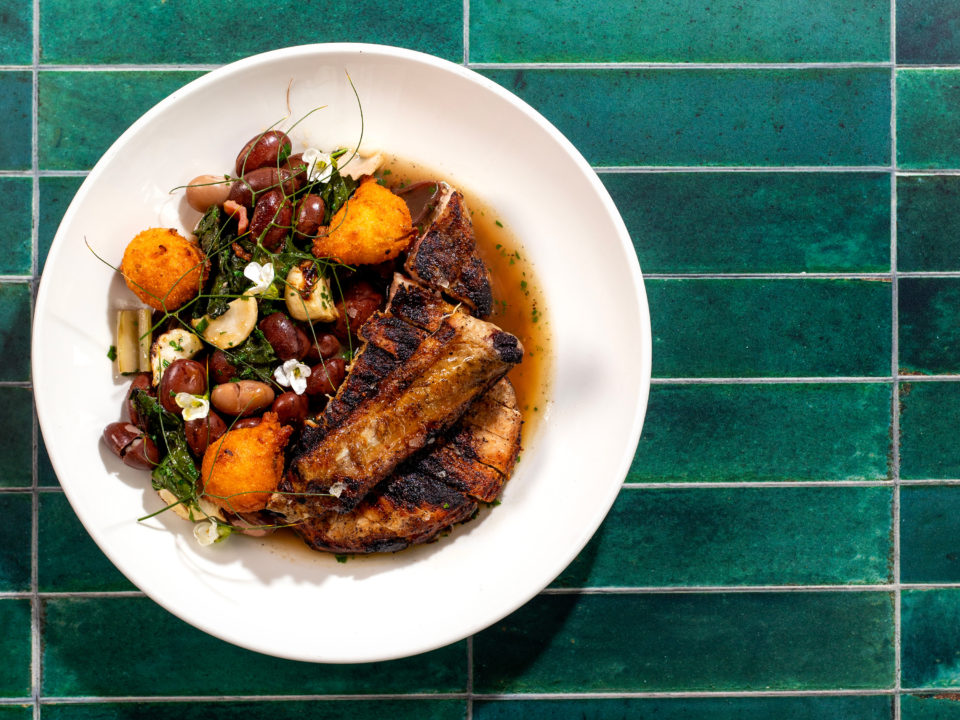
“There’s a very long story behind those beans,” the server at Whittier’s Point Easy said when I asked about the Fremont beans siding a pork chop entrée on the menu. Supposedly, she explained, a small number of the beans were discovered in a clay pot in a cave dwelling in Utah, and a handful were given to a farmer who cultivated enough to sell.
Overcome with curiosity, I ordered the dish, and when it arrived, the beans were Jack-and-the-beanstalk huge, purplish, and nearly spherical, plumped from hours of cooking. The interiors were almost meaty and the flavor was bold and earthy. These were no ordinary baked beans.

But was the tale true? Point Easy’s executive chef, Reuben Tomlins, wanted to think so. “My rep from our food supplier told me about the beans,” Tomlins said. “I was hooked on the story: an Indigenous bean from the Four Corners, local food from local purveyors.”
Tomlins’ supplier buys Fremont beans from Fassett Hay and Cattle Company in Olathe on the Western Slope, so I put in a call. In the meantime, I found some online from a Kansas company called 21st Century Bean, so I ordered a bag—for a jaw-dropping $25 per pound (that’s nine cents per bean). The back label recounted the story I’d heard at Point Easy and credited Worden Farms in the eastern Colorado town of Burlington as the grower.
This led me to Darin Worden, the farmer who started it all. “My wife and I were at a cafe in Elsinore, Utah, about 12 years ago, and the owner of the cafe was cooking a Crock-Pot of these huge beans,” Worden recalls. “He said he’d found them while exploring around highway construction near St. George, Utah, in the 1960s and started growing them to serve at the cafe. He handed me a Ziploc bag with about 40 beans.”
Darin grew enough for seed stock, which he gave to his brother, Doug, to sow on his Burlington farm. From 2015 to 2021, the crop was harvested there and sold in Utah through Darin’s Heirlooms and More Farm and Produce as Fremont beans, the name Darin chose to honor the pre-Columbian Fremont people who once inhabited what is now Utah. Then, Doug enlisted 21st Century Bean to handle manual cleaning and sorting (the beans are too big for automated machines) and sales. Darin, who’s since left farming, says 21st Century now owns the name “Fremont beans.”
Despite the clay-pot legend, it’s unlikely that the original beans were desiccated remnants of a lost culture, but it’s possible that the variety has been continuously cultivated for centuries in central Utah. Rachel Quist, an archaeologist in Salt Lake City, wrote about Fremont beans on her SLC History blog after purchasing some at a market in her city. She had also talked to Darin, who told her he had sent samples to the U.S. Department of Agriculture. The agency determined that Fremont beans are most likely a larger, more colorful variety of scarlet runner bean, but with unique traits, such as producing occasional black or white color variations. She adds that dry beans are unlikely to sprout after sitting for 500 years, as some stories claim. Quist found no archaeological research records to corroborate the story and surmises that the beans could have been stored or left as an offering by more recent Native peoples before being stumbled upon.
Doug still grows some nine acres of Fremont beans (down from a high of 60 several years ago) in Burlington, harvesting about 800 pounds per acre—a very low yield in the bean-farming world. Kali Fassett of Fassett Hay and Cattle says her family also still grows them in Olathe from seed originally provided by the Wordens; this year’s crop was planted in mid-June.
So, whatever their true origin, the incomparable Fremont beans are safe for now, thanks to two Colorado farms and one Denver restaurant—and maybe your home kitchen, if you’re willing to pay the price for a taste of local history.