


The Local newsletter is your free, daily guide to life in Colorado. For locals, by locals.
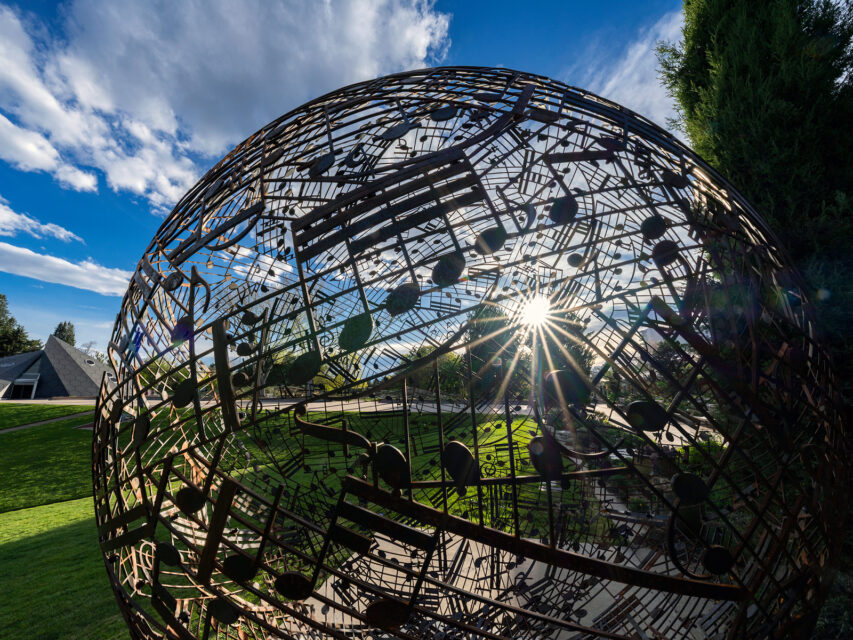
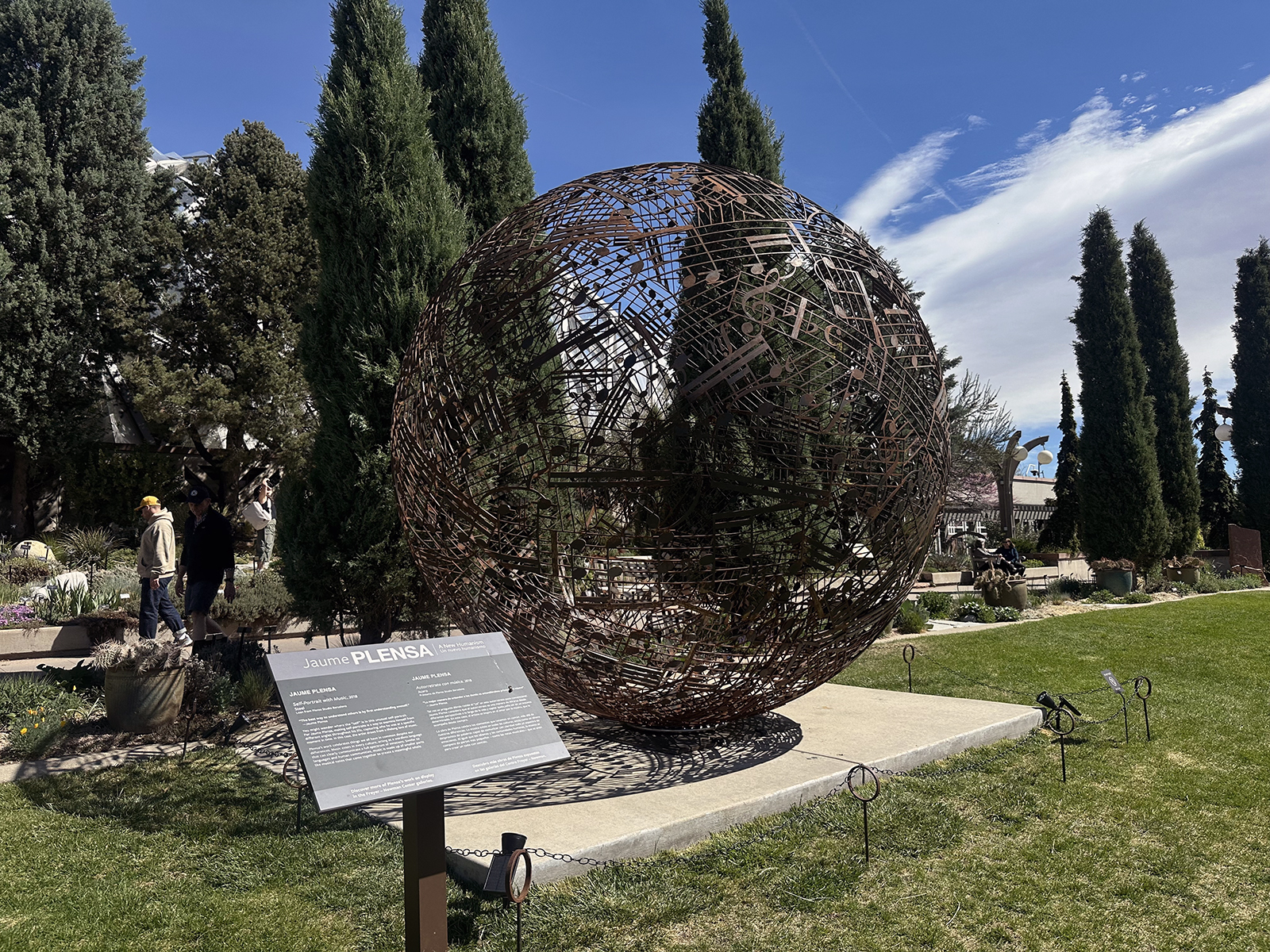
On a warm spring morning at the Denver Botanic Gardens, children are doing what children usually do around large, interesting objects: running around them, ignoring them, occasionally pausing to study their details. Looming over the UMB Amphitheater, where the gardens hosts a summer concert series, is “Self-Portrait with Music,” an 11-foot-tall steel sphere of interlocking musical notes by Spanish artist Jaume Plensa. To those in the know, Plensa is the internationally celebrated visual artist behind iconic pieces like Chicago’s “Crown Fountain,” but to the children, it’s just a cool thing to look at before they play in the grass.
“I think it’s fantastic,” Plensa says. “This is probably my first time having an exhibition in a hybrid space, where some of my art is in a gallery and some is in the gardens. Kids don’t know if it’s art or not. For them, it’s a place to play, it’s a park.”
It’s a different story inside the Freyer-Newman Center galleries, where the noise of the children in the amphitheater gives way to something quieter. The closed-eyed portrait heads that greet visitors to Jaume Plensa: A New Humanism seem to demand a different kind of attention.
Plensa’s first U.S. retrospective spans decades of his work (the oldest piece is from 2002). He’s spent those years creating sculptures, drawings, and etchings that resist easy explanation. Plensa has often said that sculpture is the best way to pose questions (seen most literally through “Firenze II,” an imposing aluminum and iron question mark), but it’s not always the place for answers. “I’m 70 years old now, and I’ve spent my whole life chasing answers to questions that I still haven’t found,” he says.
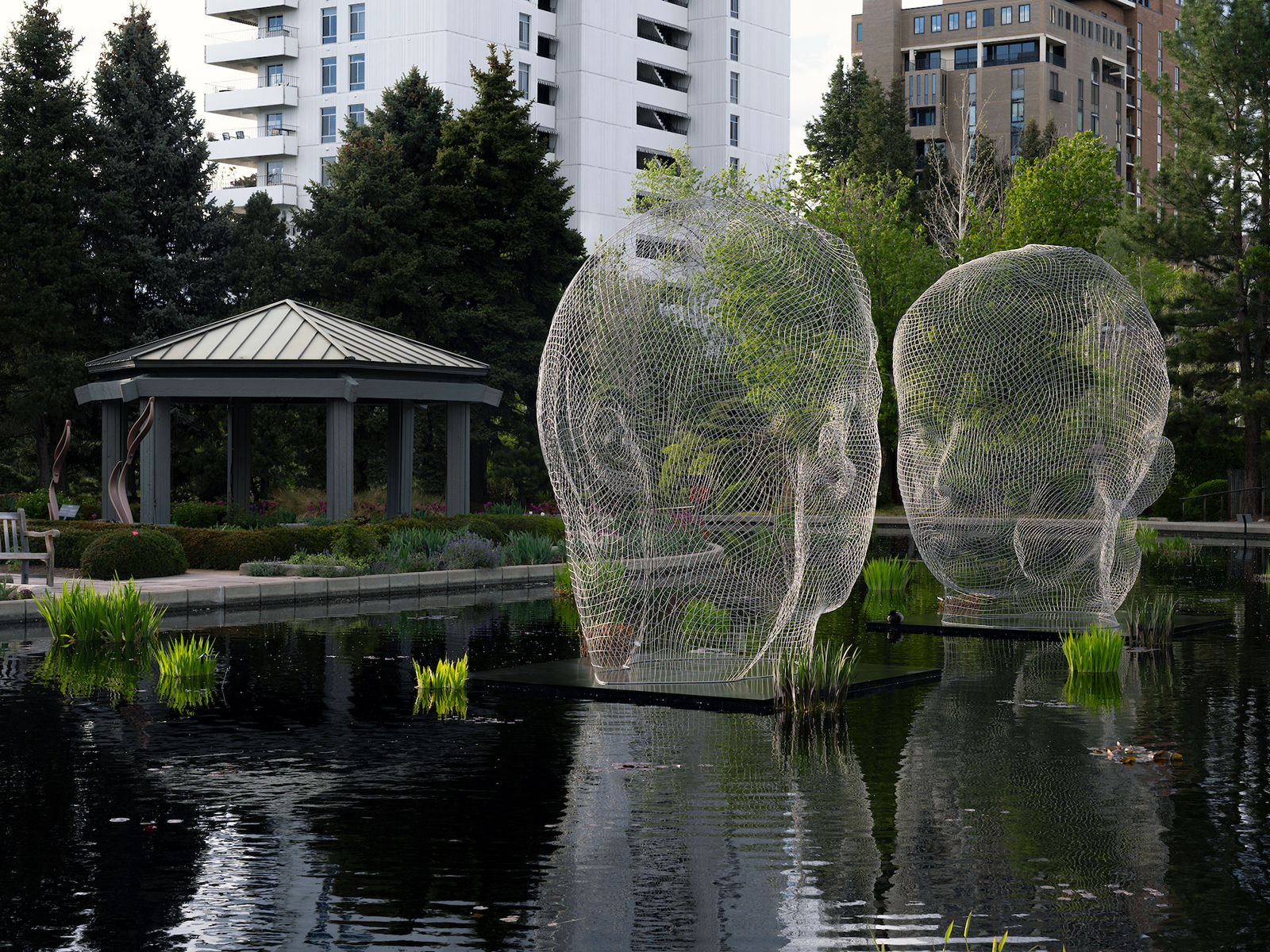
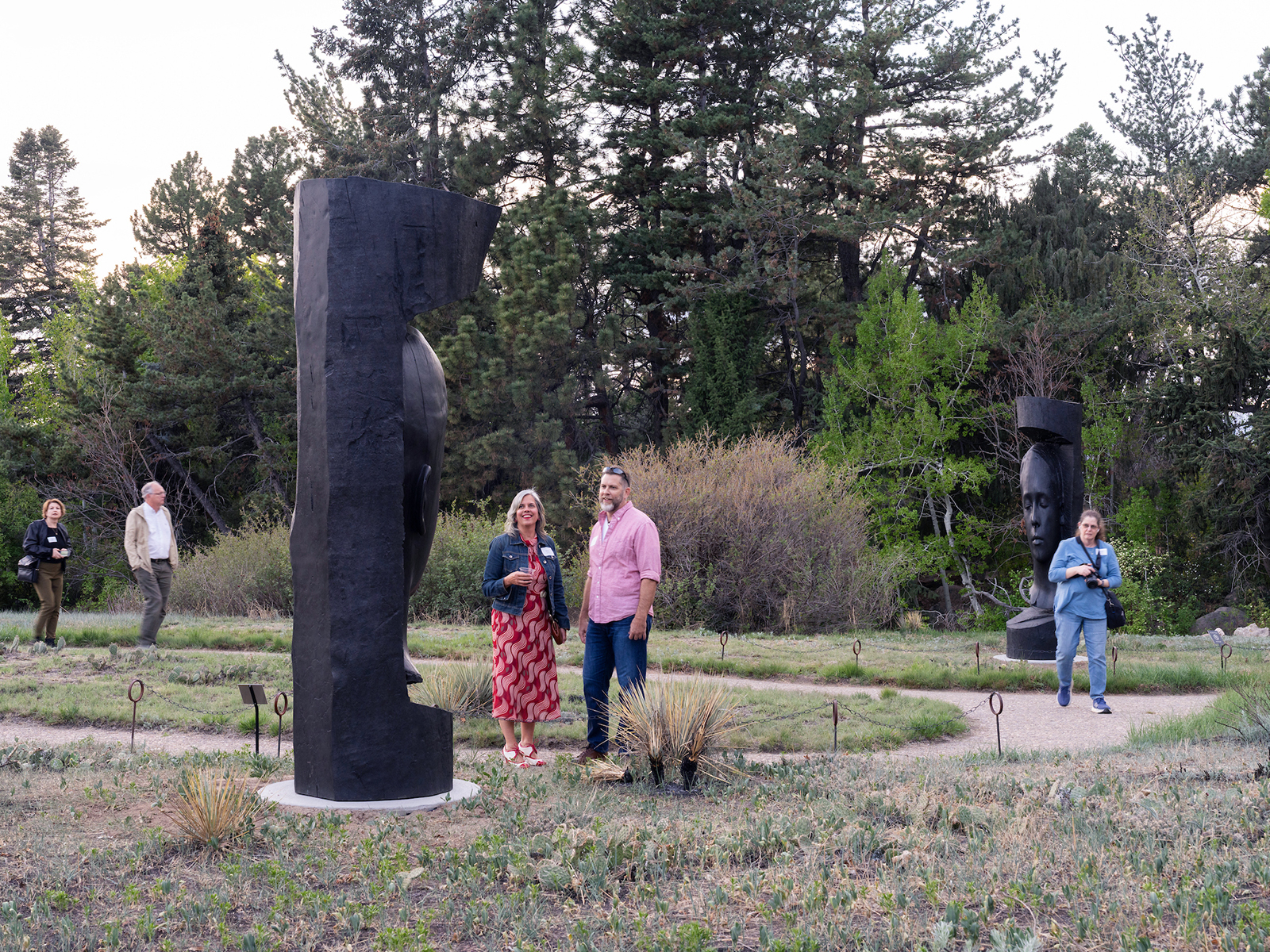
What those questions often return to is our inner lives: the private world each person carries that we rarely speak about yet connect us to one another. His portrait sculptures, installed throughout the gardens and in the Freyer-Newman Center galleries, wear that idea faithfully with closed eyes and unreadable expressions, as if absorbed in their own thoughts.
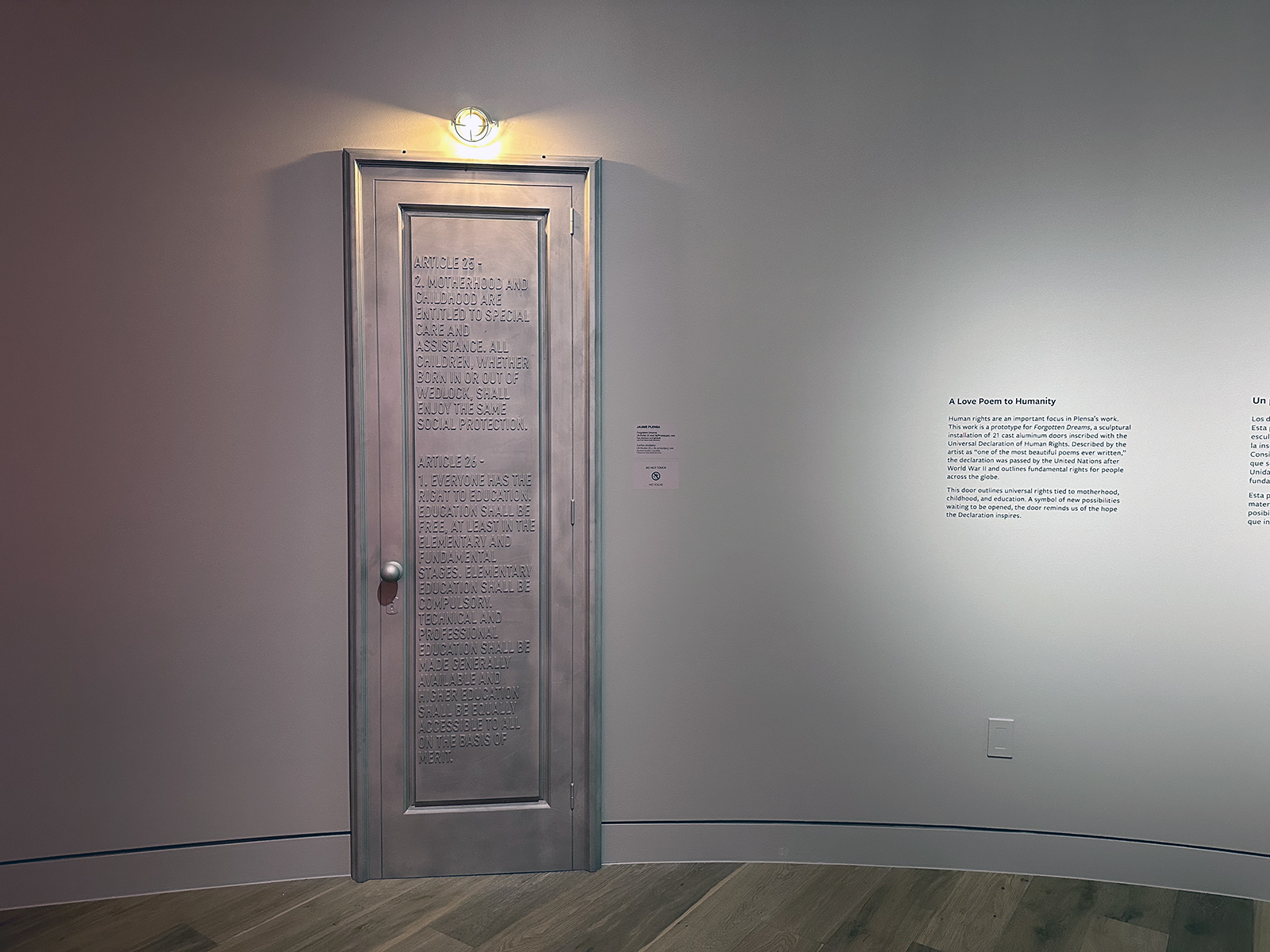
The exhibition gives that philosophy room to breathe across a range of forms—from the monumental heads rising from garden paths outside to miniature suspended clusters of letters inside. Among the quieter works in the show is a single cast-aluminum door, titled “Forgotten Dreams.” The piece comes from a larger collection of 21 doors, each inscribed with an article from the Universal Declaration of Human Rights, a foundational document for freedom that was adopted by the United Nations in 1948. “We are living in such a strange time with violence and war all over the world,” Plensa says, “that this piece feels more important than ever.”
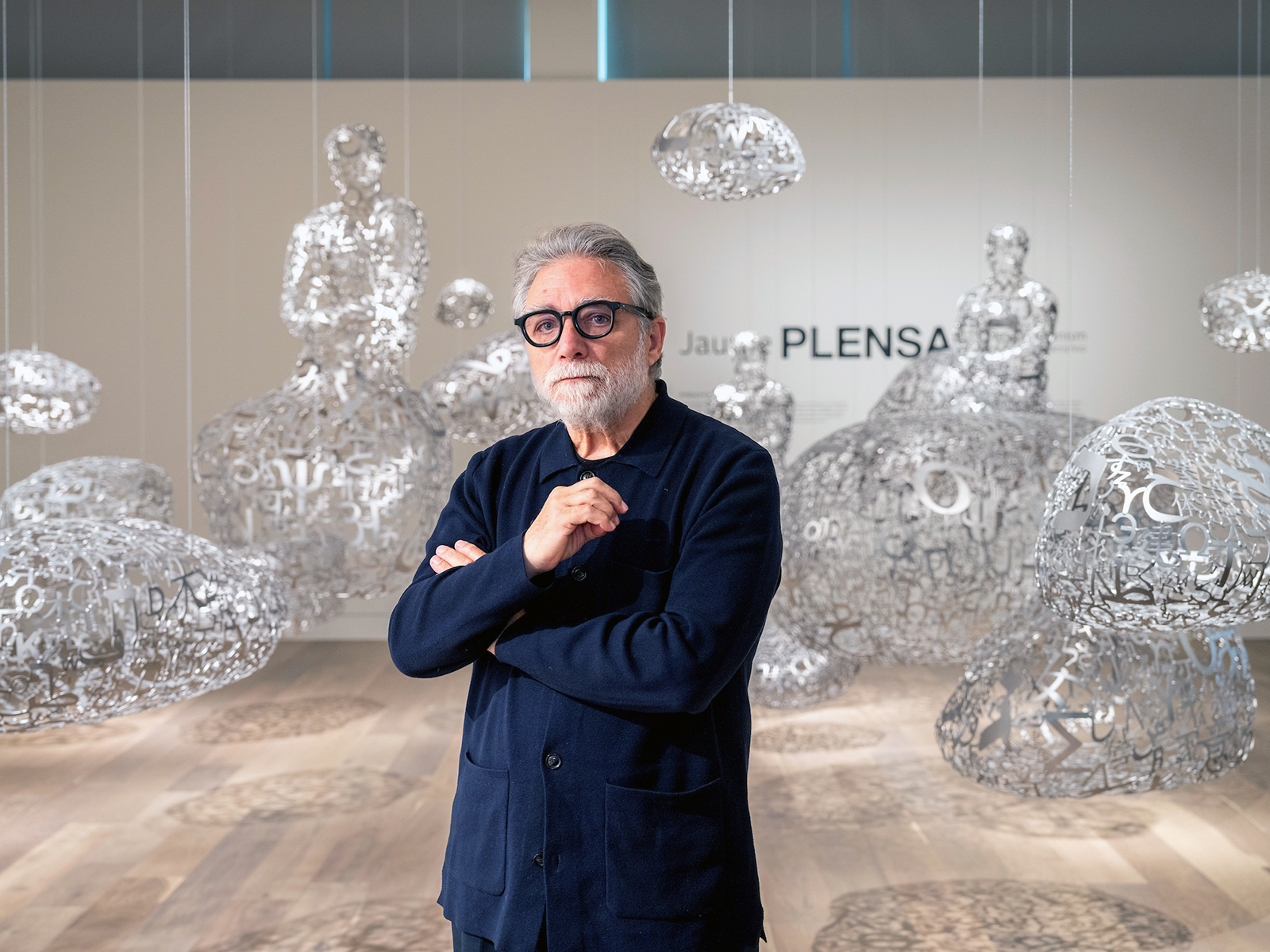
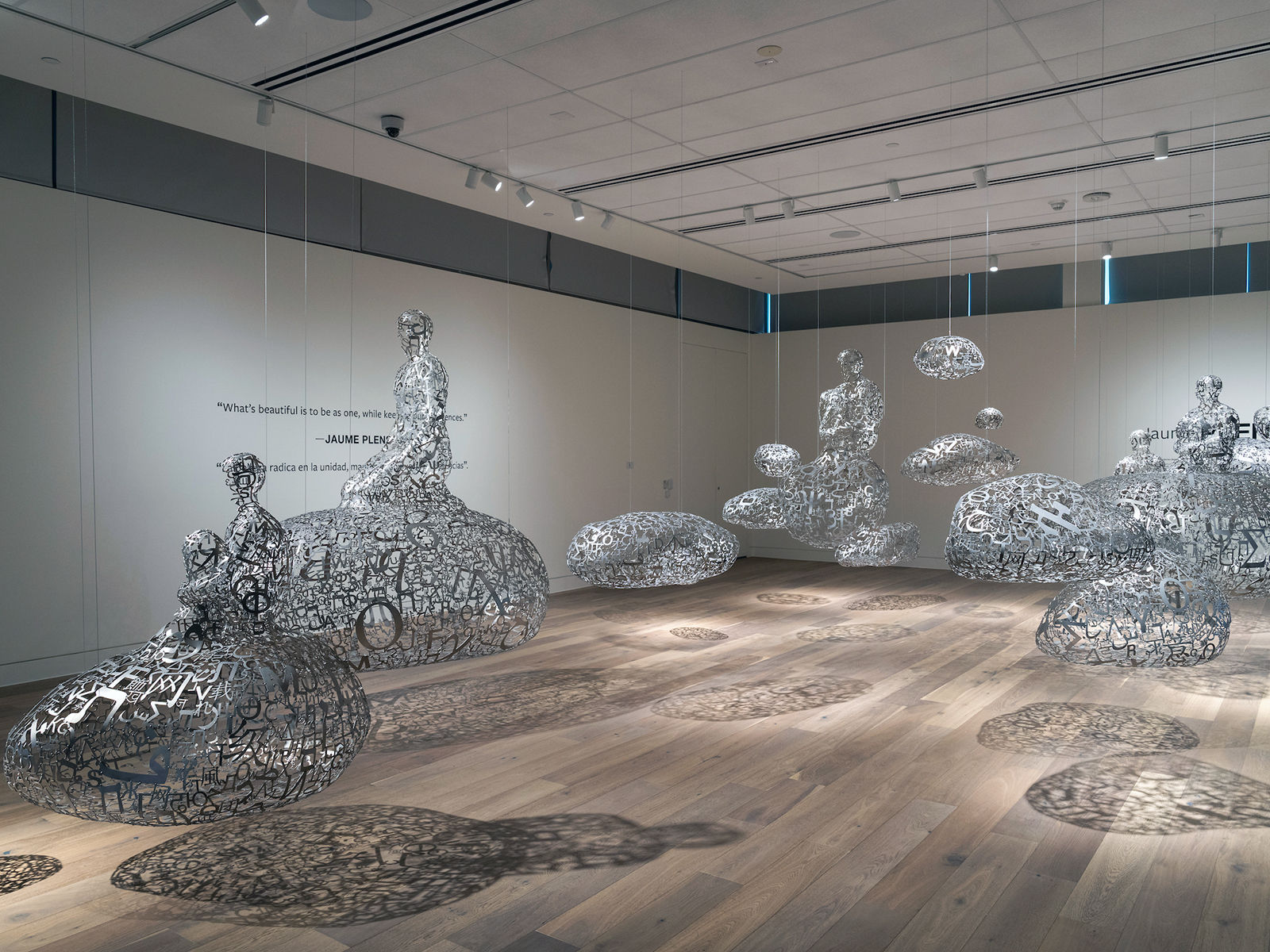
In the next room, “Talking Continents” feels more hopeful. Clusters of stainless-steel letters float overhead, their forms composed from several different languages including Arabic, Japanese, and Greek. Five of the spheres support faceless human figures. “It’s a celebration of diversity,” Plensa says. “We have so much to exchange and learn from each other, but I think even just being together as humans is the key point.”
For Plensa, a retrospective of his work also means revisiting work he hasn’t seen in years, like “Anònim II,” “Anònim VI,” and “Anònim VII,” three mixed-media works made from paint and collage. Created in 2003, they layer text, portraiture, and even scans of Plensa’s feet and his wife’s hands. Running through it all are lines from Macbeth, a play Plensa cites as deeply affecting his life and career (Plensa once directed a Spanish production of the opera by Giuseppe Verdi).
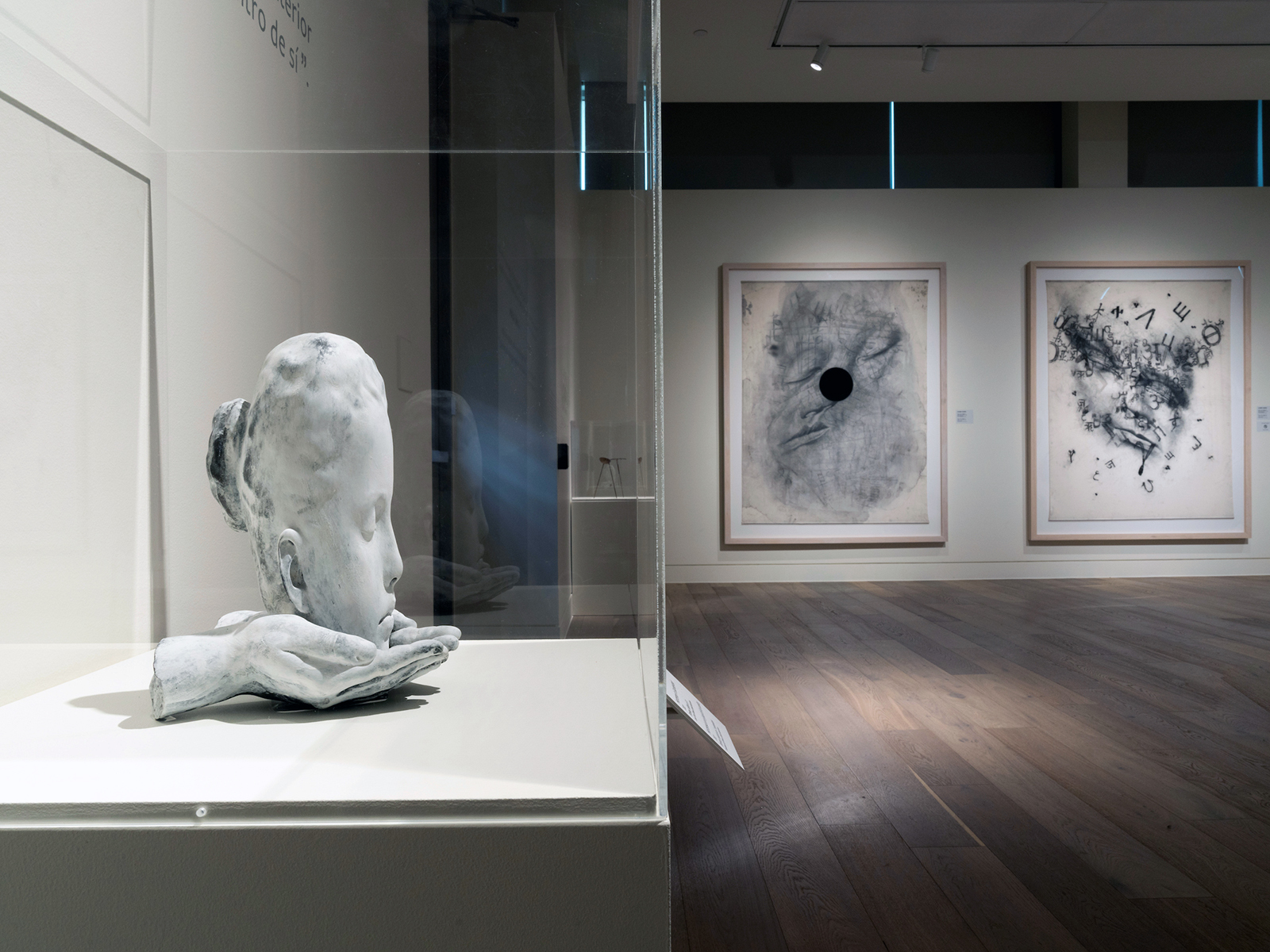
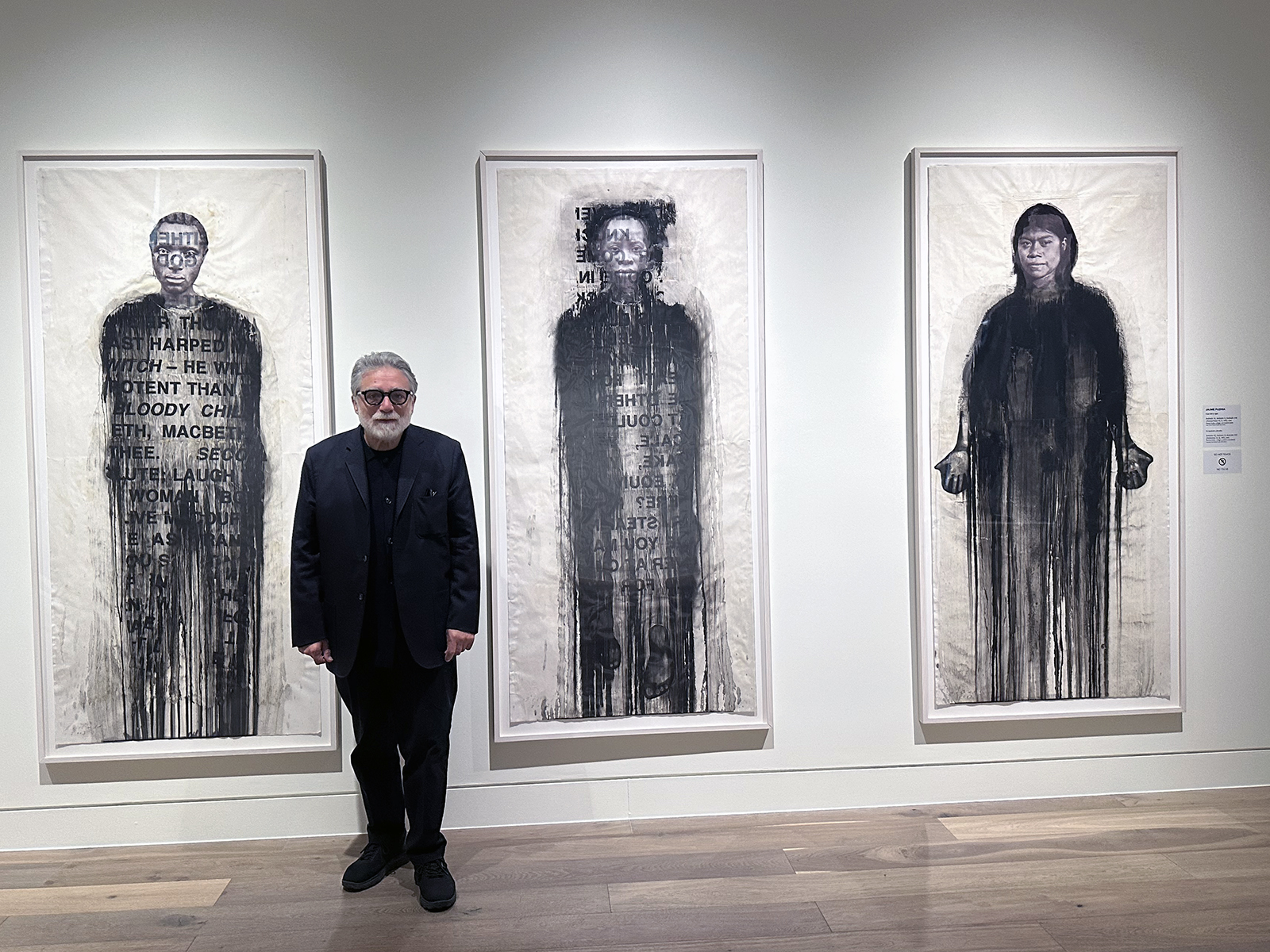
“I haven’t seen these drawings in years until I came to look over the final details of the show,” Plensa says. “I remember perfectly creating the piece, but I don’t remember what my personal situation was like at the time and what I was feeling. I become like a viewer in a sense, and it’s very exciting.”
Nearby, “Juana Silence,” a 2023 marble bust of a woman, holds a finger to her lips in a shush. Around her, much of Plensa’s life’s work fills the galleries and spills out into the gardens, where children are still running through the grass, orbiting a giant sphere of musical notes.
“[Shushing] is one of the main postures in my pieces. I feel like it creates quietness and silence,” he says. “It’s a very noisy period of life that we are living right now.”
His works have always asked something similar of those who view them. They demand a different kind of attention.
“My portraits have their eyes closed because I’m trying to emphasize how important the interior world is, how much beauty we’re hiding inside ourselves,” he says. “If, thanks to my work, people in Denver could try to look within themselves, I would be the happiest man in the world.”
5 More Cool Exhibits To Check Out:
- What To Expect at the Denver Museum of Nature and Science’s New Brick Planet Exhibition
- Meet the Seriously Silly Monsters Invading the Denver Art Museum
- It’s a Yeti’s World at Shiki Dreams
- Black Cube Celebrates a Decade of Unconventional Art Exhibits
- Inside Denver’s Cookie Factory Turned Art Gallery
Jaume Plensa: A New Humanism is on view at Denver Botanic Gardens through September 7 and is included with general admission.