


The Local newsletter is your free, daily guide to life in Colorado. For locals, by locals.
I was late to the Lego game. More interested in how Nancy Drew would solve yet another case the adults couldn’t crack, I didn’t really care about stackable bricks until my son turned one and Lego Duplo (larger cousins to the famous choking hazard) became a colorful, er, enhancement to my living room decor.
In the years since he’s stopped experiencing the world by gnawing on it, my son has bought (and been gifted) ever more complicated Lego builds. The bricks have galvanized creativity (like the Steamboat-inspired gondola that stretched across his bedroom), babysat ($30 for three hours of independent play is way cheaper than a high schooler’s going rate), and taught compassion (my son and I were incredibly sympathetic toward my husband when he stepped on a Lego traffic cone—after we’d stopped howling with laughter).

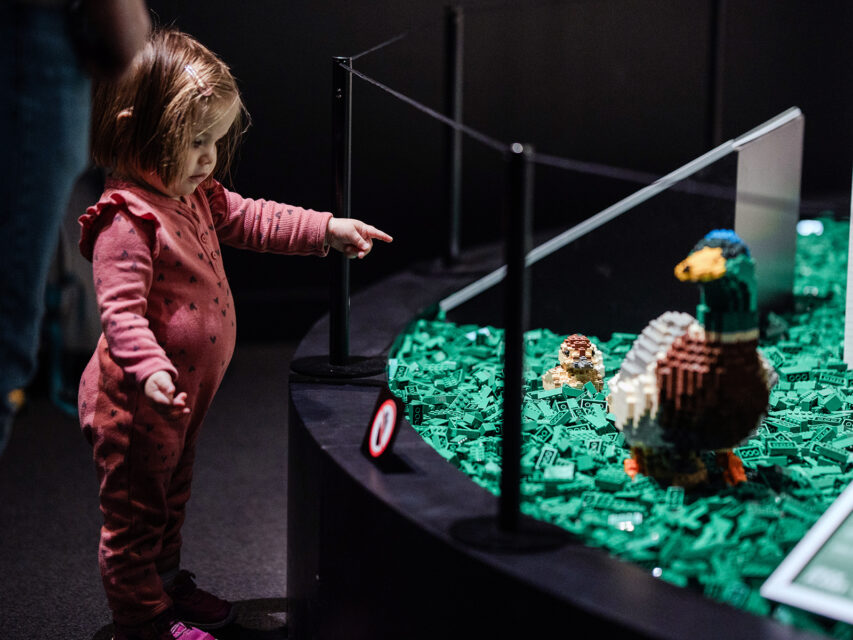
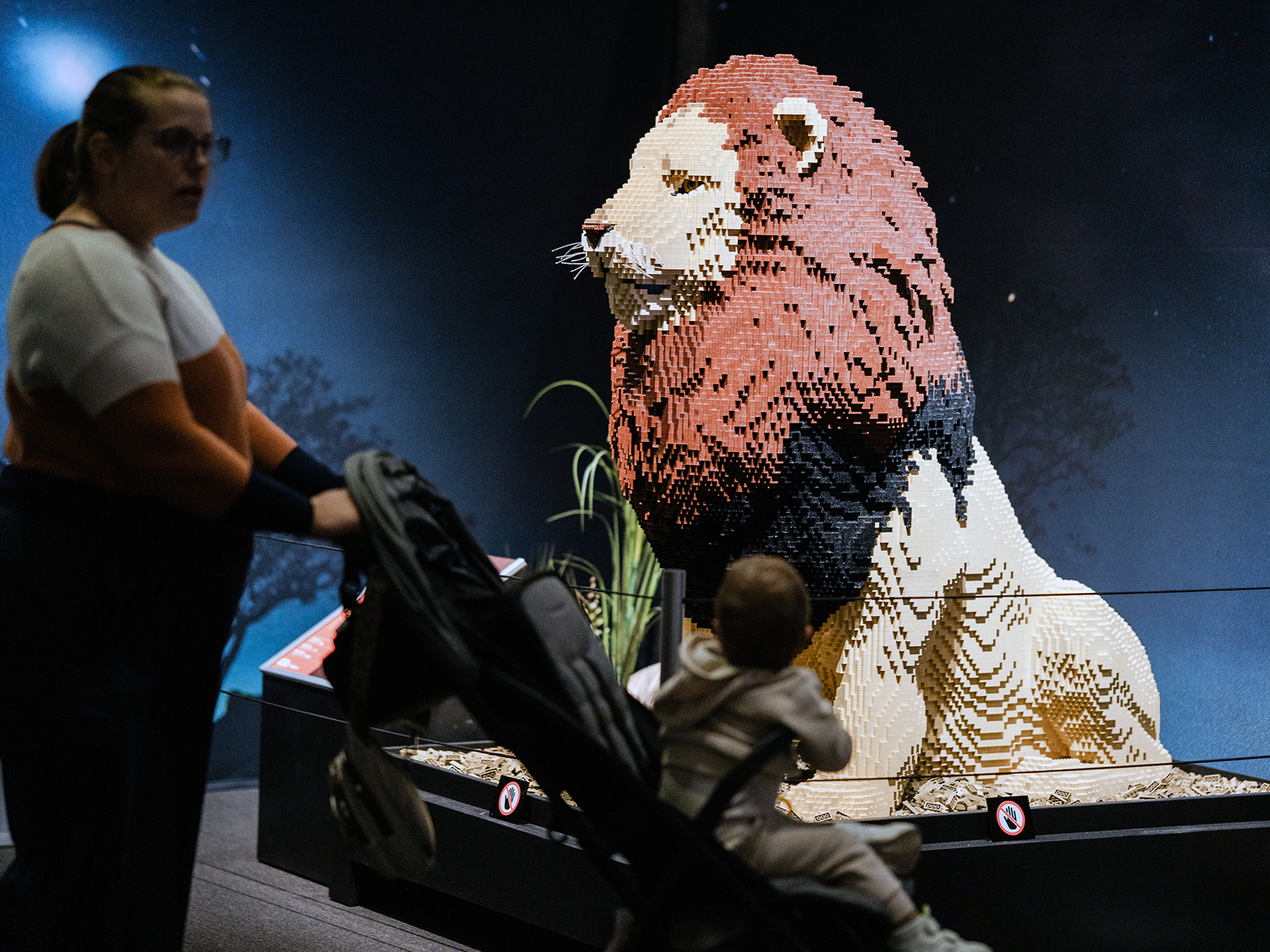
Though I’ve come to recognize the beautiful simplicity of a single brick and the endless possibilities for what it can be, my appreciation pales in comparison to that of Lego artist Sean Kenney. His exhibition, Brick Planet: A Magical Journey Made With LEGO® Bricks, has temporarily taken up residence at the Denver Museum of Nature and Science, offering Lego fans a chance to see 1.5 million bricks shaped into a life-size polar bear, a definitively not life-size praying mantis, and numerous other sculptures inspired by the natural world. We wouldn’t miss it.
Upon entering the museum last month, my nine-year-old and I, along with two of his buddies, beelined it toward the third-floor exhibition. Our progress, however, was halted halfway there. “Wow” was our collective, if not particularly verbose, response to the fourth grader-size ruby-throated hummingbird hovering above an Esperanza flower.
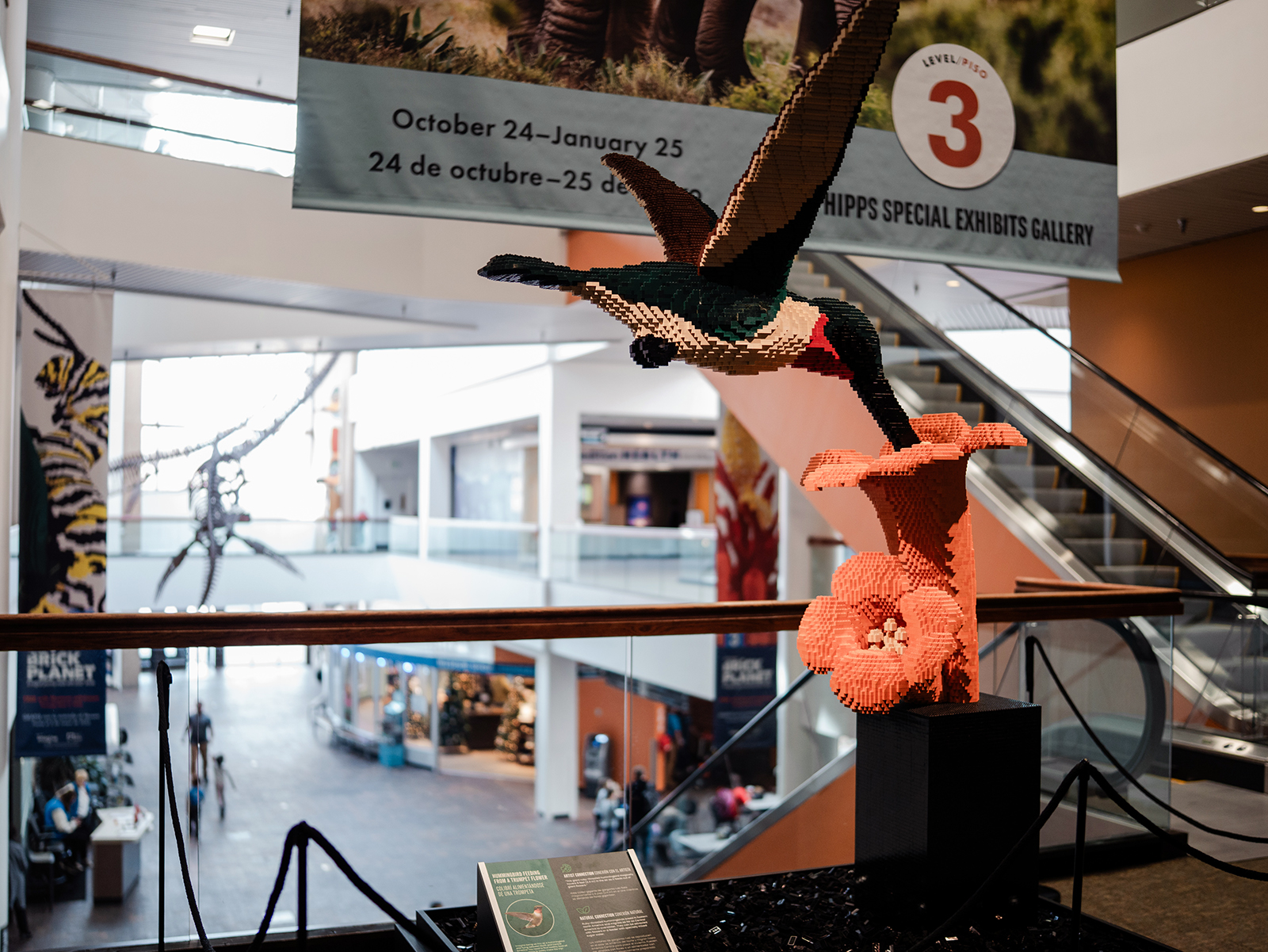
Impossible to miss in the second-floor hallway—an effort to whet appetites for the main Lego Planet exhibition—the sculpture boasted a sign at its base describing how these typically tiny flyers migrate more than 1,000 miles annually. The boys indulged my interest but were far more blown away by the report that 36,300 bricks comprised the structure. “I wonder how one artist did all this,” a kiddo mused upon reading that it had taken 515 hours to build.
We learned more after another escalator ride. The award-winning artist and former Lego Masters guest judge himself was there to welcome us into his exhibition—or at least a cartoon self-portrait crafted in Lego pieces did so. Kenney’s Lego exhibitions have toured the globe since 2012. Much of his art is inspired by nature, family, and—if the true-to-size bicycle surrounded by a highway’s worth of much smaller motor vehicles is any indication—a desire to encourage environmental responsibility. “The bike is green, but the cars are black,” my son noticed. “That means the bike isn’t polluting,” added his friend astutely as we made our way deeper into the exhibition, “but the vehicles are.”

Rounding the corner, we plunged into Kenney’s Lego rendition of a Planet Earth documentary. A lumbering Galapagos tortoise lets a Darwin’s finch catch a ride on his intricately blocked back, while a monarch perches atop a bouquet of flamingo-pink dillweed. Both (as the signs point out) provide examples of symbiotic relationships, which prompted a quick science lesson about mutualism and commensalism.
Farther on, we see an emperor penguin hunched over his nestling, a family of deer, and a milk snake whose ebony eyes, one of the kids pointed out, is in fact a thumbnail-size construction helmet. A gaggle of kindergarteners staked their claim on the interactive “Mystery Mosaic,” where visitors are encouraged to match colored bricks to their correct location on a large Lego-building plate, so our crew continued onward past the hollowed-out “Disappearing Rhino” sculpture and a few toddlers defying the “don’t touch” signs near the hatching sea turtle.
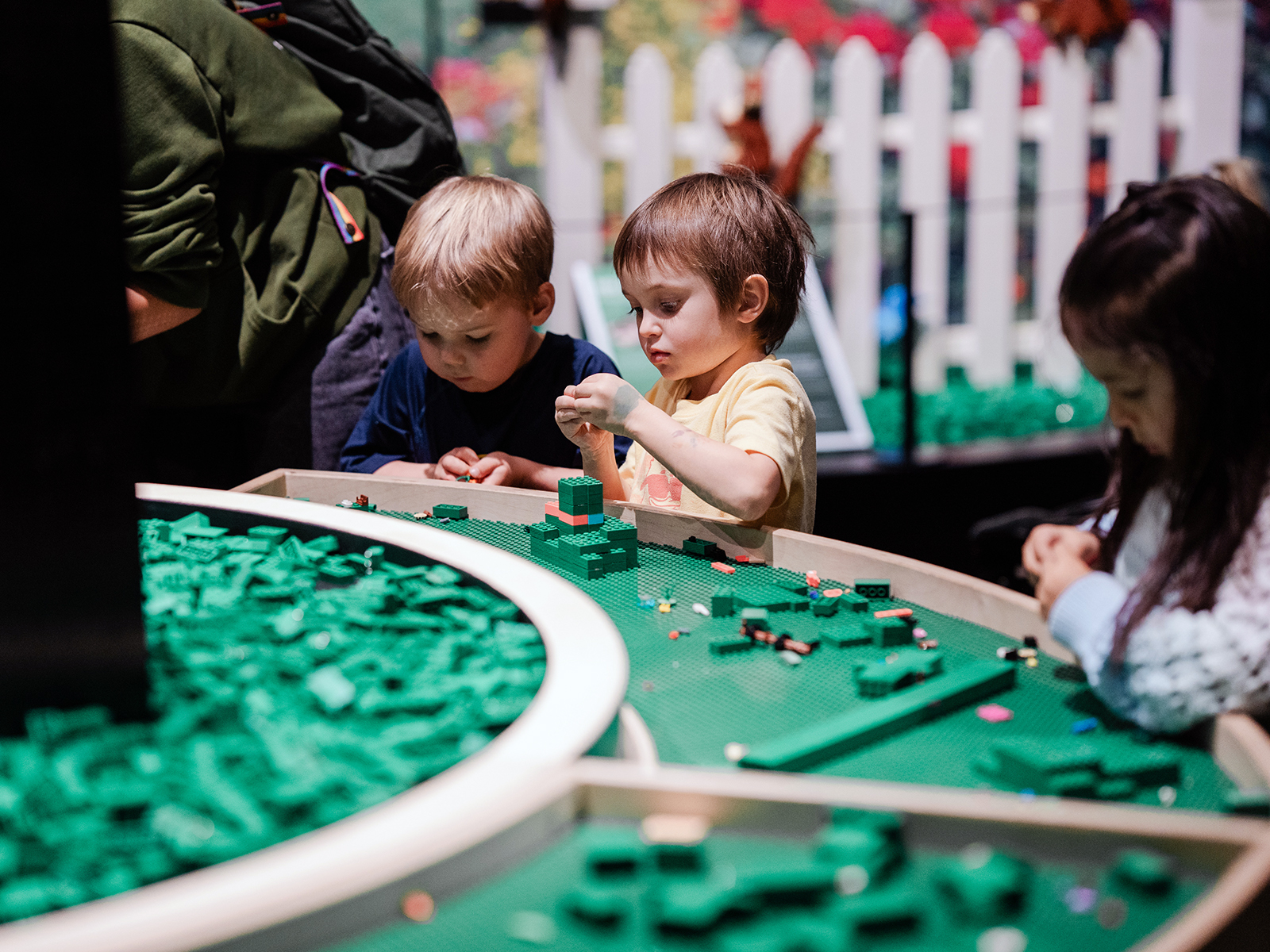


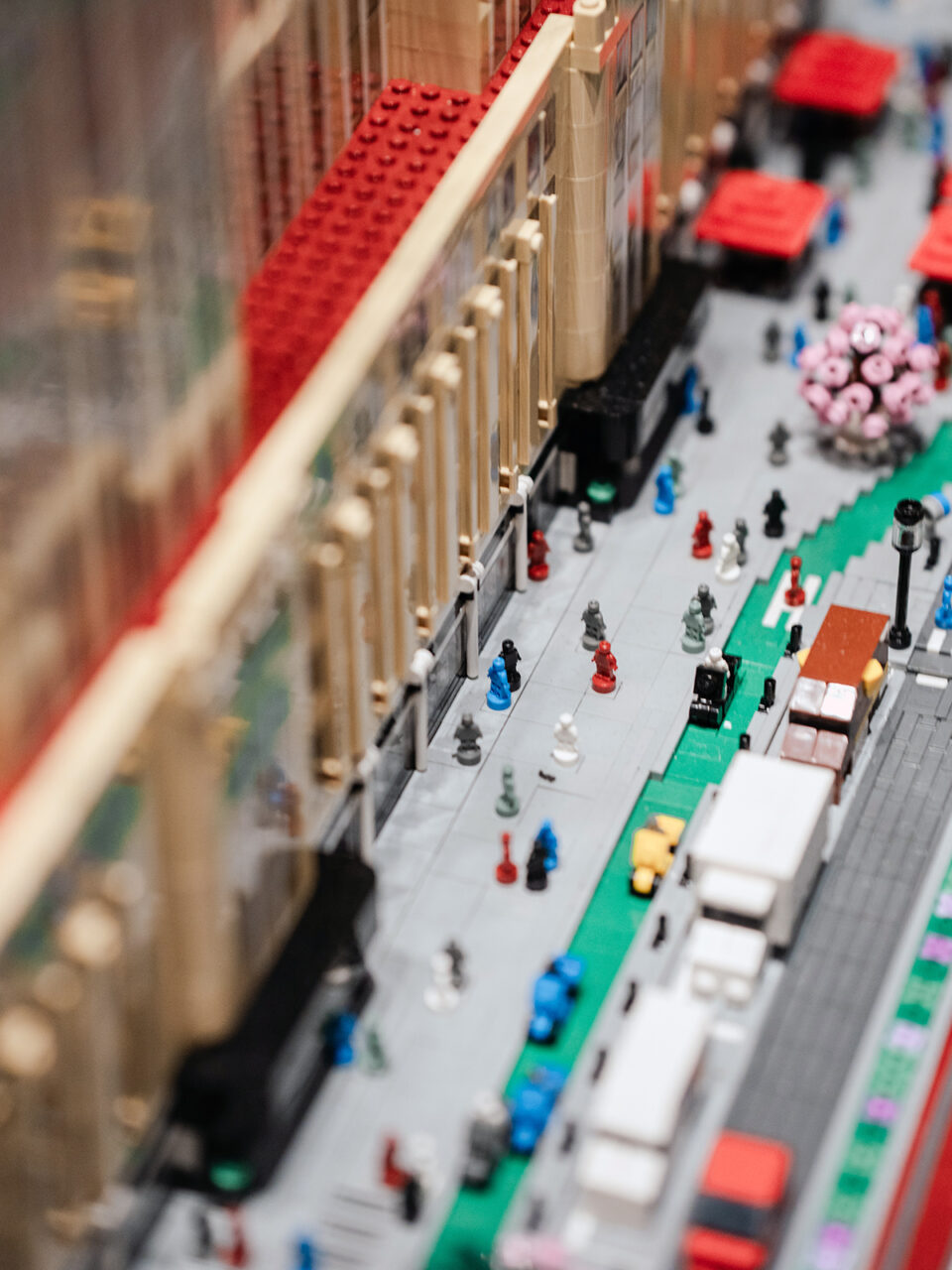
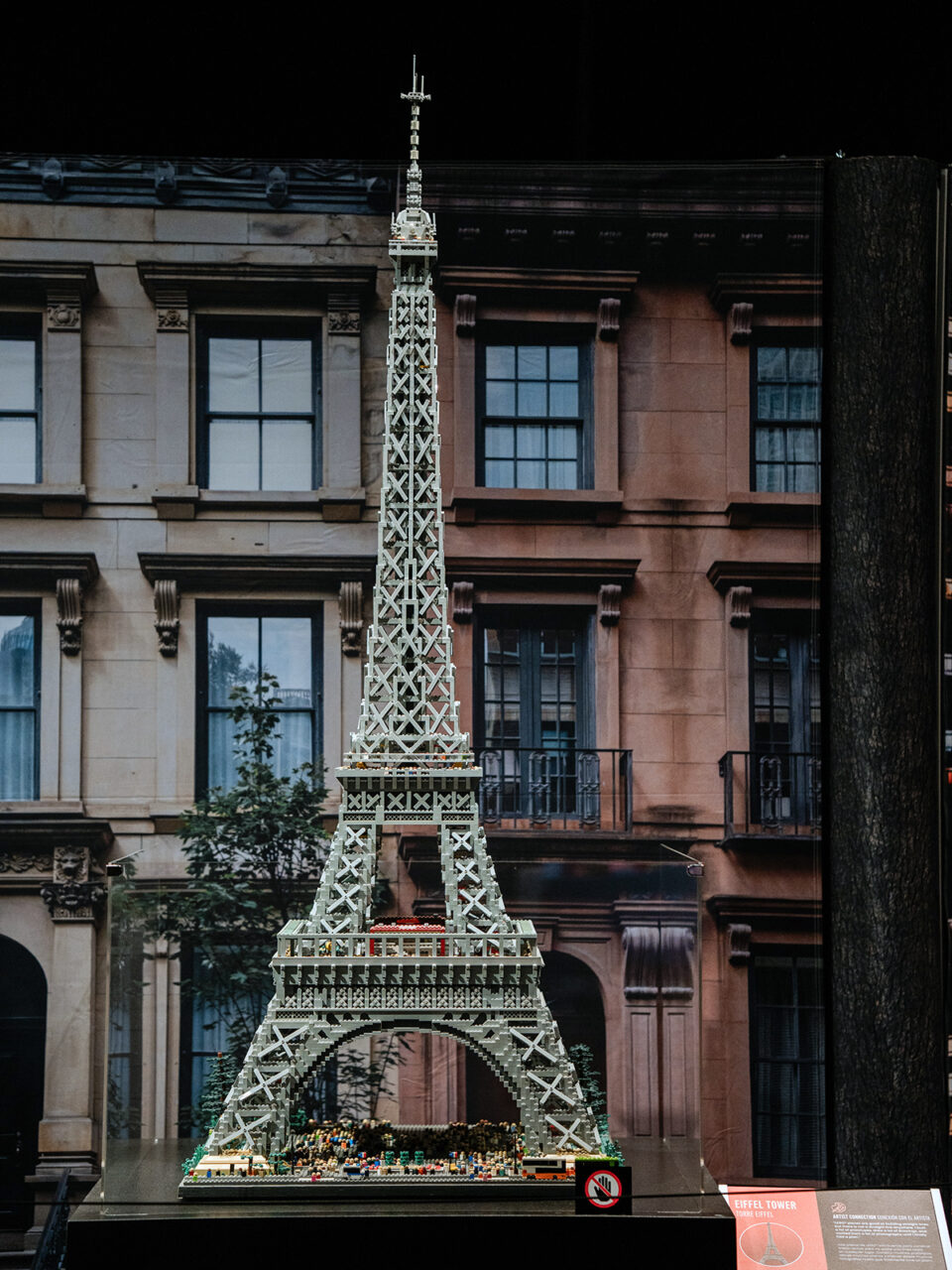
After a brief stroll through “Paris” and “Times Square” (Kenney’s take on the Les Misérables marquee leaves me awestruck) and past the world debut of a 53,368-brick Empire State Building, we made it to “Our Own Backyard,” where the boys immediately congregated around the community garden exhibit. They noticed the giant honeybee collecting nectar from a pixelated pansy the size of a monster truck tire, but it was quickly forgotten as the trio became enthralled with building flowers themselves out of the smattering of Lego bricks on hand for just this purpose.
Ten minutes later, we made our way back toward the car. “What did you guys think?” I asked. The boys’ volume-level had increased by roughly 20 decibels, and they were far more intent on scrambling for their preferred seat and ensuring I queued up the right spoof on Camila Cabello’s “Havana” for the drive home than reflecting on the past hour. Yet the stark contrast between this bustling energy (what I’m learning might be a nine-year-old’s natural state) and the quiet focus they demonstrated for more than an hour as they made their way through the exhibit just might be answer enough.
4 More Cool Exhibits To Check Out:
- Meet the Seriously Silly Monsters Invading the Denver Art Museum
- Who Killed Thomas Riha? A New Exhibit Explores One of Colorado’s Coldest Cases
- It’s a Yeti’s World at Shiki Dreams
- A Four-Year-Old’s Review of the Children’s Museum’s New Catawampus Exhibit
Brick Planet: A Magical Journey Made With LEGO® Bricks is on display through May 3, 2026, and is included with memberships (family memberships starting at $135 per year) and general admission (under age two, free; age three to 18, $20.95; ages 19 to 64, $25.95; ages 65-plus, $22.95) at the the Denver Museum of Nature and Science. 2001 Colorado Blvd., Denver (City Park)