

The Local newsletter is your free, daily guide to life in Colorado. For locals, by locals.
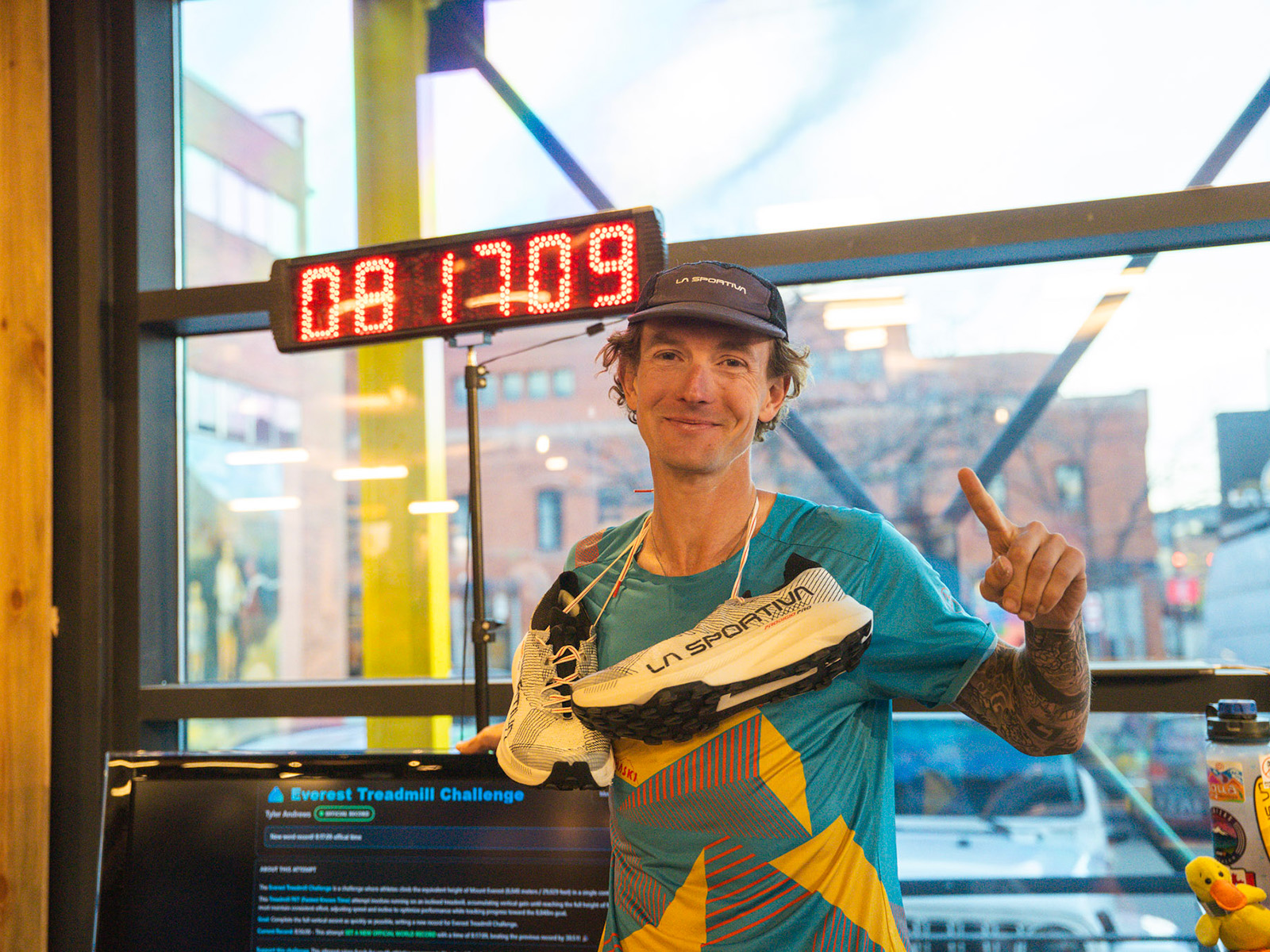
For most people, spending more than an hour on a treadmill is akin to torture—and that’s if you have at least one new episode of Bridgerton to watch while you plod. Professional runner and mountaineer Tyler Andrews could have binged the entirety of season three in one go when he spent eight hours, 17 minutes, and nine seconds on a dreadmill at La Sportiva’s Boulder flagship store to climb the equivalent elevation of Mount Everest. Andrews crushed the previous record for “Everesting” on a treadmill by nearly 40 minutes.
What was similar about Andrews’ stationary, 29,032-foot ascent last month and actually attempting to climb the world’s highest peak? “Basically, it’s similar in name only,” Andrews laughs. “On a treadmill, you just lift your legs up and take a step forward. Climbing up a big, technical mountain is the opposite of that.”

Andrews would know. He’s claimed a “fastest known time,” or FKT, on the highest peaks in South America, Africa, and Nepal’s 26,781-foot Manaslu. He also holds the speed record for the round-trip Everest Base Camp trail—a feat he completed in just under 24 hours compared to the 12-to-18 days most take.
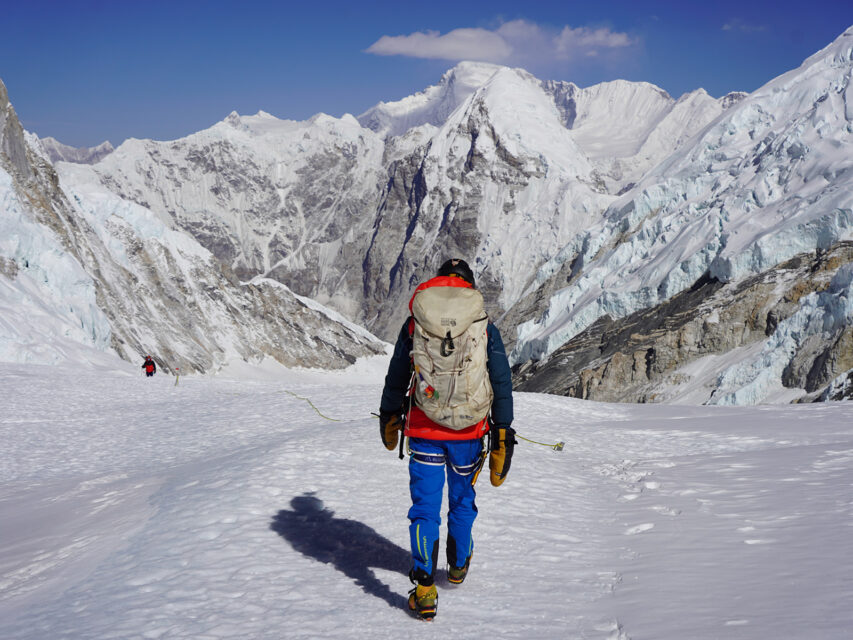
Everest itself was Andrews’ obvious next conquest—except, it hasn’t been. Andrews has attempted to summit the world’s tallest peak five times, including once last May when his pace was well ahead of the previous record until a gear malfunction just 1,312 feet below the summit necessitated a return to camp.
This May, he will once again set out to stand on top of the world in record time. Here, he talks about Everesting on a treadmill, Everesting on Everest, and why he loves moving fast in the mountains.
Editor’s note: The following conversation has been edited for length and clarity.
5280: Let’s start with Everesting on a treadmill. You began at a three-mile-per-hour pace and eventually cranked it up to about four miles per hour. That doesn’t sound so bad.
Tyler Andrews: It starts out looking pretty easy, like a slow walk, but at a 20 percent grade it gets pretty hard. It was the length, duration, repetition, and the mechanical fatigue from landing on my foot in exactly the same place 50,000 or 60,000 times in a row that really hurt.
I’ve actually done a couple of these treadmill records before, including in 2014 when I did the fastest flat half marathon. Everesting was a long way from that, but I always found those to be really fun events. When you run a race, whether it’s a half marathon or 100 miles, you only see your friends and family for a few seconds here and there. These treadmill events, you’re obviously in one place. People could wander into the store and talk to me while I was running and cheer me on. I actually met the guy who said he invented this concept of climbing the height of Everest.
Two days before your treadmill Everesting effort, Boulder was lashed by 100-plus-mile-per-hour winds that knocked out power around the county. What was the backup plan if the electricity didn’t turn back on?
That was wild. We were going to do a dress rehearsal the afternoon before: plug in the machine, test it, get the tracker system going, have the cameras going, but there was still no electricity. My friend has an electric vehicle, and he said, “Worst case scenario, we can run the treadmill off of the truck in the store.” Luckily, it all worked out.
Hopefully all will work out in a few months when you return to Everest again. What, besides treadmill treks, will you be doing to get ready?
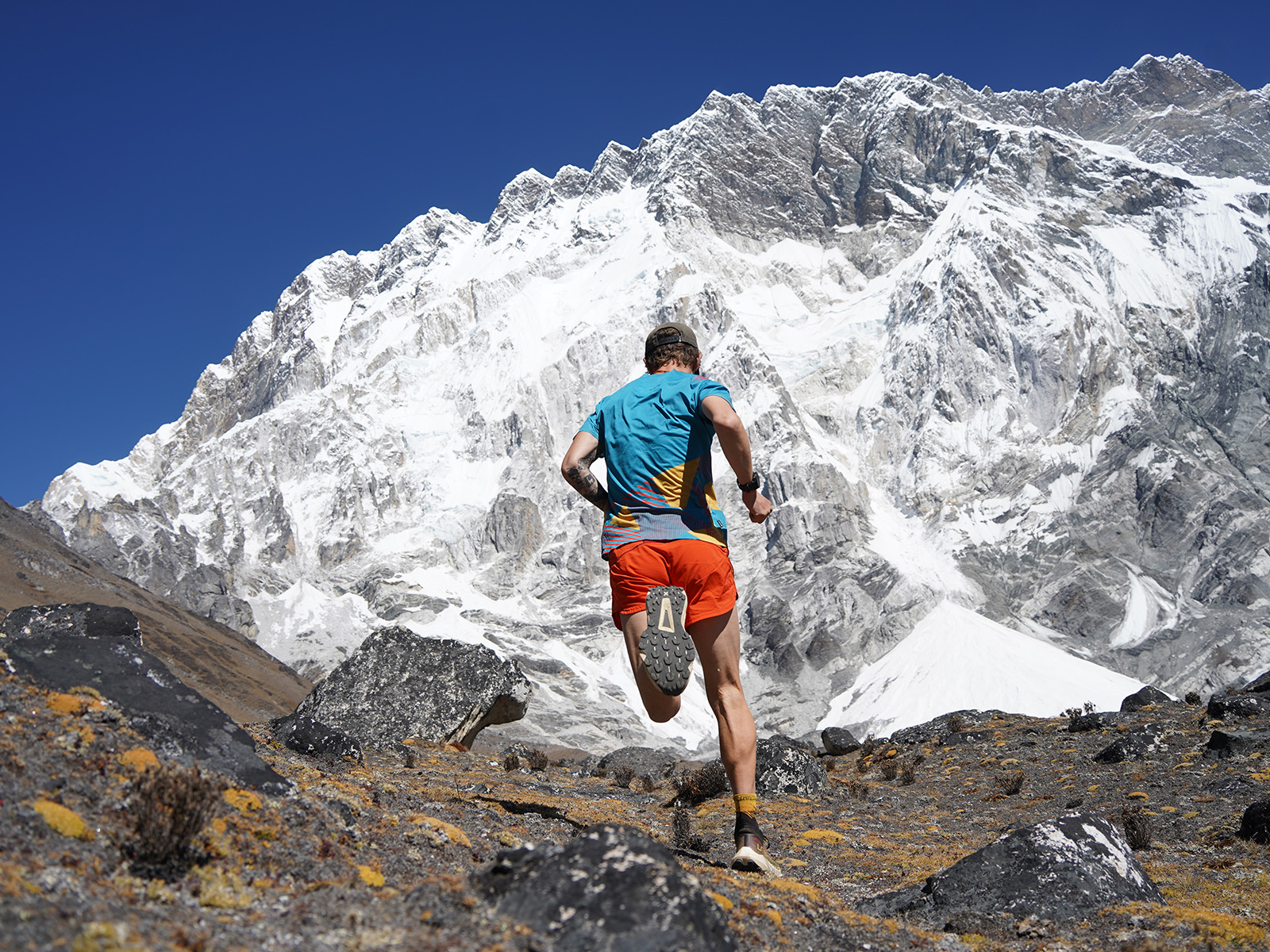
I have a podcast with my dad, and we talk about training, but we’re basically training to be moving uphill quickly. I’m really lucky to live in Quito, Ecuador, which is at altitude, has a lot of access to mountains, and has pretty good weather most of the year. I have a 7,000-foot climb right out my back door that I do almost every single day and supplement with some work on the treadmill and strength training, both to keep the body healthy and to fortify the legs and glutes.
What makes you better prepared to get the FKT on Everest this year, even though you’ll be taking the north route from Tibet rather than the south route through Nepal that you’ve used previously?
I don’t think I realized just how complicated it was going to be on Everest in terms of dealing with the crowds, the amount of pinch points [technical, narrow sections that force climbers into a single-file line] on the mountain, and the weather. There are a lot of objective hazards on that route that are scary. Also, because I’m climbing without supplemental oxygen, we need to be much more cautious than a commercial climber since lack of oxygen makes you much more susceptible to hypothermia. It’s a very fine window that we have to work in. There are fewer of those uncontrollable factors on the north side. If I were going back to the south side, I would feel a little bit more dread.
What about the risk involved in scaling these massive peaks at a high speed?
For me, the risk that I take is extremely calculated. There are people way more experienced than me, but I think I’ve probably done the most preparation to be on the mountain. That’s the thing I think people get wrong about risk sometimes. High-consequence risk is the only thing they think about. But you take risks getting in the car. You have to think about what risks you’re comfortable with for what payoff. I try to prepare as much as I can, focus on what I can control, and then make good decisions when I’m on the mountain.
You ran cross country in high school and at a Division II college. How did that lead you to Everest?
I found that as races kept getting longer, I was more competitive. Even in college, I was running the 10-kilometer race, which is the longest event in college. Then, I moved up to the marathon, and I was way better at that than I was at the 10K. Then I ran 50 miles and won the U.S. National title there. It wasn’t until COVID-19 that I found out about the whole FKT world. All of our races were canceled for a year, and one of my sponsors essentially said they would pay out race bonuses for doing some of these competitive FKTs. There were some of those here in Ecuador, so I started running up mountains and was like, “Oh, this is something that’s really exciting and fun to me.” I also found that I was pretty good at it. As I started to take it more seriously, I learned more about the sport, what projects people did, and what mountains were the most competitive. Everything leads to the Himalayas.
What does running mean to you?
I had a disease called aplastic anemia, which is kind of like leukemia, when I was six. I started thinking about the brevity of life very early. It’s one of the things that has led me down a path that feels less traditional. For me, running has been this unbelievable vehicle for meeting people and seeing the world. That’s not just because I’ve been very lucky and have been able to make a career out of it. I’ve seen it in the people that I coach with the Chaski Foundation. Sports are objectively silly at the end of the day—and selfish—but they can also bring this unbelievable sense of connection. I hope to be that guy who’s still running when he’s 80 or 90 or 100 years old. Being able to do that with other people, that’s what it’s all about.