


The Local newsletter is your free, daily guide to life in Colorado. For locals, by locals.
Abigail Colón and her husband, Eythan McKinnon, had just returned from their honeymoon in South Carolina when they walked into a red brick courthouse in Waynesboro, Georgia, ready to make it official. At the clerk’s desk, they asked for a marriage license. No problem, the clerk said. All they needed to do was fill out a short form and show proof of identification. Abigail nodded. Eythan smiled politely.
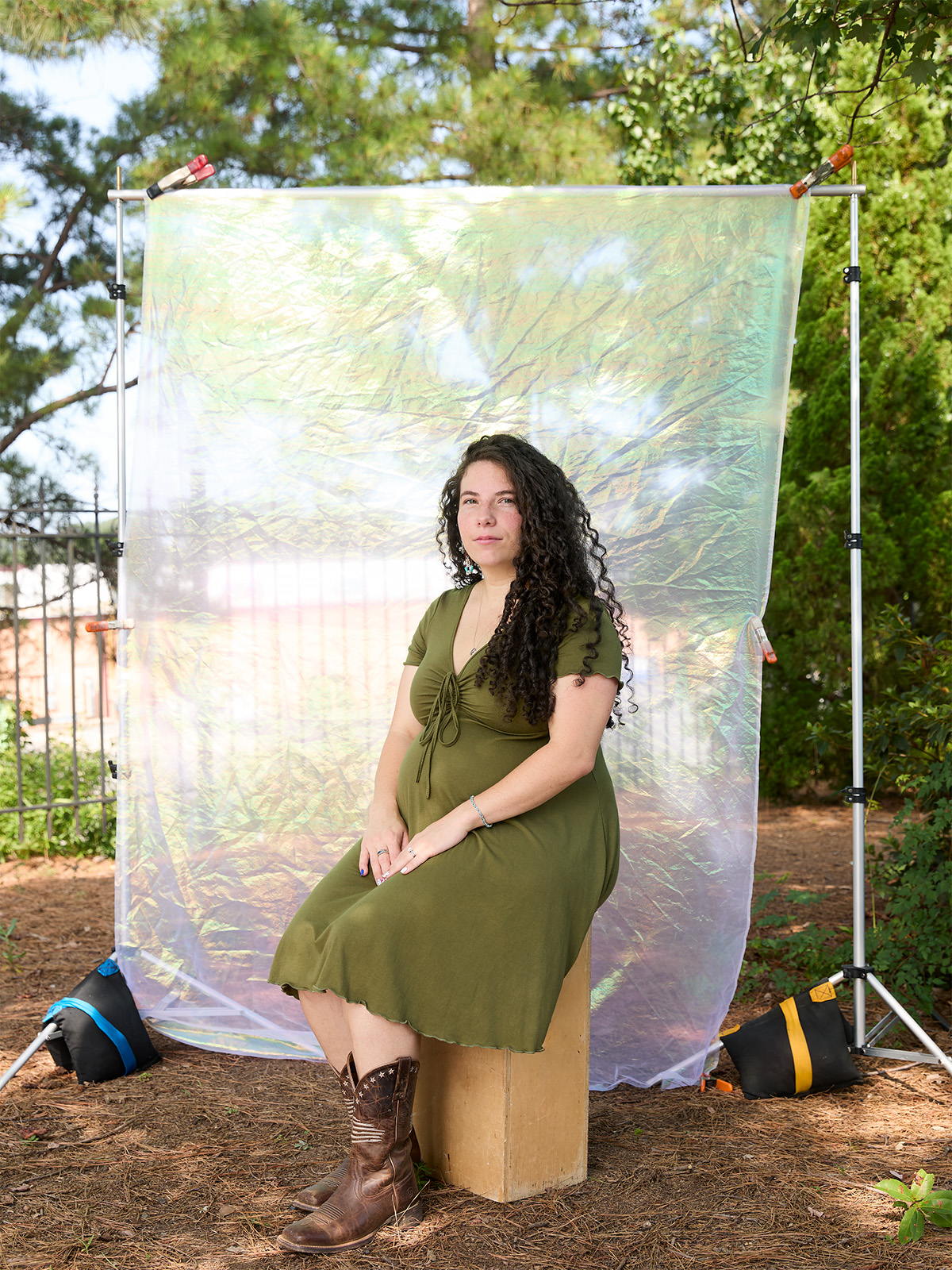
Four and a half years later, in early 2025, Abigail and Eythan are sitting across from me at a diner outside of Augusta, where they now live. We order waffles and breakfast sandwiches over the noise of the bustling kitchen and Saturday morning crowd. “Obviously, we’re not legally married,” Eythan says. His name is not on their daughter’s birth certificate either, Abigail adds, nodding to the toddler squirming in her high chair, reaching for a water cup.
The state rejected the paternity form for the same reason it wouldn’t grant her a marriage license: Abigail doesn’t have a government-issued ID.
Born just outside of Colorado Springs, Abigail was delivered not at a hospital, but in a midwife’s home to parents who chose not to register her birth with the government. Without the right paperwork from her childhood, the state refuses to give her a birth certificate, leaving the now 30-year-old without a legal identity. And Colorado is fighting in court to keep it that way.
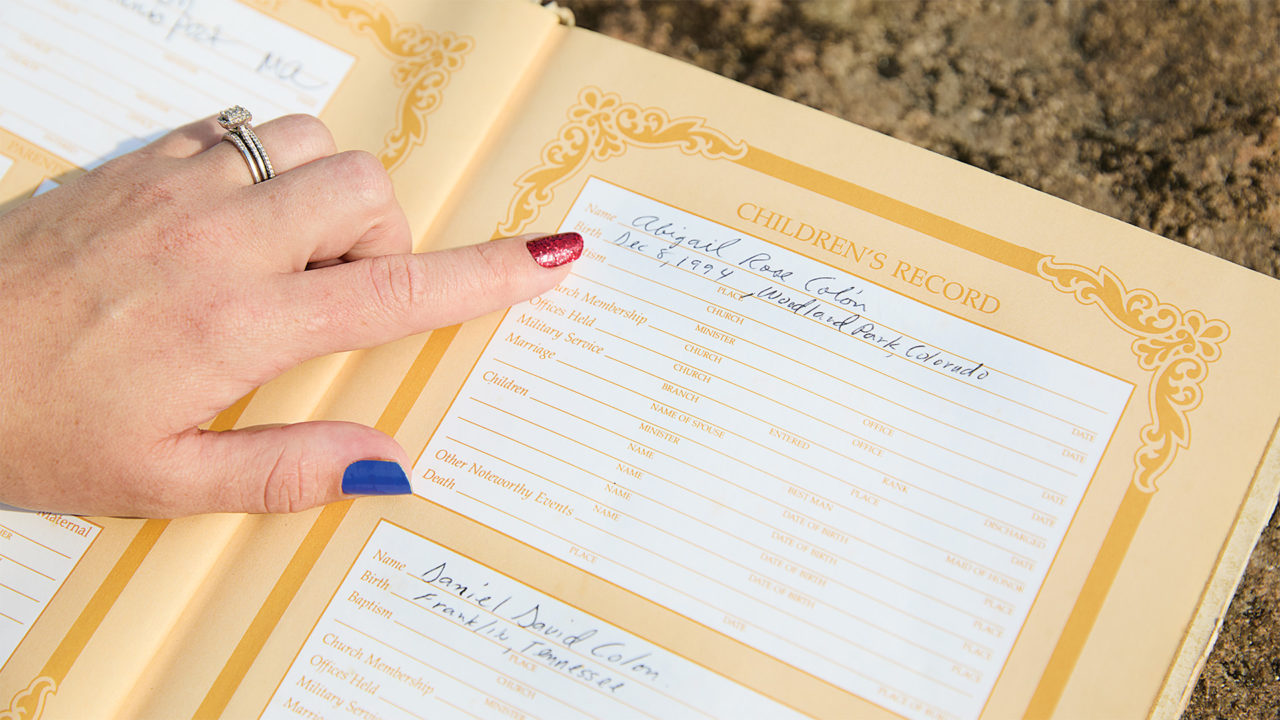
After breakfast we move to a nearby coffeeshop, where Abigail hands Eythan a thick King James Bible. He eases it out of its box. The binding is split, and the edges are worn. “Our Family Bible” is spelled out in gold lettering on its tattered cover. “Be very careful with it,” Abigail tells me. I turn to the third page, where, written in cursive black ink, is the earliest proof of existence for the woman across the table: “Abigail Rose Colón, Dec. 8, 1994, Woodland Park, Colorado.”
Abigail’s father, Alfred Colón Jr., moved his family to Colorado Springs in the early 1990s. The son of Cuban American immigrants, Alfred was born in New York City but returned to his parents’ home country in 1960 after Fidel Castro came to power; Alfred’s father believed the Communist leader was “the great liberator.” As soon as the Colóns got off the plane, however, the Cuban government confiscated their life savings and sent then-seven-year-old Alfred to a military school. The family escaped back to the United States with the help of the Swiss Embassy, but the experience stayed with Alfred.
He became a devout Christian in his 20s, when an evangelical movement swept through Massachusetts, where he lived at the time. Eventually he came to believe Social Security numbers were the mark of the beast mentioned in the Book of Revelation. He stopped using his own in 1983. By the time Alfred and his wife, Dawn, moved to Colorado, he no longer trusted doctors or hospitals. “Jesus was [our] family physician,” Alfred says today. Birth certificates, meanwhile, represented enslavement to the government.
After moving to Colorado, the Colóns started attending church in Woodland Park, a mountain town about 20 miles northwest of Colorado Springs. Dawn was pregnant, and a friend from the congregation introduced them to a midwife named Dorothy Nott who helped deliver the baby. They named her Abigail. Dorothy’s daughter, Molly, remembers Woodland Park as a town split between “mainstream families” and a small community of Christian fundamentalists who wanted to “answer to God and not the government.” If the Colóns intended to have Abigail “under the radar,” Molly says, “I’m sure my mom was the type of person that would have been obliged to [do] that.”
The Colóns didn’t remain in Colorado for long. Abigail lived in more than a dozen places during her childhood. “I guess [my father] was scared that his children were gonna get taken away because of his beliefs,” Abigail says. She was soon joined by three younger siblings, none of whom were born in a hospital or got birth certificates. “I was born in the back seat of a converted Greyhound bus we were living in at the time,” Abigail’s brother Daniel says. His father helped deliver him while being coached by a midwife over the phone.
Alfred was also suspicious of schools and never enrolled any of his children. Daniel describes his childhood as living “outside of society, just a bunch of ghosts meandering through life, just barely getting by.”
When Abigail was about 14 or 15 years old and living with her family near Fort Pierce, Florida, she and her father got into an argument. He told his daughter she was no longer welcome in his house. Abigail stuffed clothes and food into a backpack and walked 13 miles to the nearest Army recruitment center. “She’s like four-foot-11 or five-foot-tall,” Daniel says, “but she’s got the attitude of a six-foot-two boxer.” When Abigail walked in, the enlistment officer sighed—obviously, she was too young to join—and asked for a birth certificate, Social Security number, and a parental consent form. Abigail had no idea what any of those things were.
Back at her house, her mother revealed that, as far as the government was concerned, Abigail was a ghost. “There’s no record of Abby anywhere in a hospital, anywhere on medical records, or anywhere in school,” Alfred told me, “because we believe in the sovereignty of the family.” Abigail’s grandfather threatened legal action if her father did not allow her to move back in. Alfred relented. “My father hated my grandparents,” Abigail says.
Abigail left her parents’ home for good when she was 20. She found a job cleaning hotel rooms and was paid under the table, but she couldn’t rent a house because she didn’t have a photo ID. “I was homeless for a while,” Abigail told me. She eventually moved into a friend’s camper outside of Linden, Tennessee. She lived there and rode her bike 14 miles one way to work for four months.
Abigail decided she needed a driver’s license, but first she needed a birth certificate. When she was 16 or 17, she had begun sending applications to Colorado’s office of vital records, a division of the Colorado Department of Public Health and Environment, which required her to provide at least two documents that prove her date of birth, place of birth, father’s name, and mother’s name. One of the two documents must have been created during the first decade of Abigail’s life. She submitted papers with all the right information, but none of them were from before she turned 10. Colorado denied her applications.
Abigail met Eythan through Instagram in 2017. After they started dating, he began calling the state every month to ask if there was any progress on his girlfriend’s latest application. There rarely was. Eythan soon realized that, like many people caught in an endless loop of government bureaucracy, Abigail needed a lawyer.
“Stateless” is the legal term for a person whom no government recognizes as its citizen and is usually an immigration problem: Neither the United States nor the country the immigrant comes from claims them, leaving them in limbo. But there is also a group of people scattered throughout the country who were born here and have “no evidence to prove that they legally exist as people,” says Samantha Sitterley, an attorney with United Stateless, an advocacy organization. They cannot get a birth certificate, photo ID, Social Security number, or passport. Unregistered Americans, like Abigail, are citizens in name only. There are no official estimates on how many unregistered Americans there are, but over the past six years, 84 of the 347 Coloradans who filed for a delayed birth certificate were rejected by the state.
After several denied applications, Abigail enlisted the help of Colorado Legal Services, a nonprofit that provides free legal aid. In October 2022, Abigail’s attorneys filed another application for a delayed birth certificate. It, too, was denied. Abigail and her attorney, Casey Sherman, say they’ve searched everywhere for a document created within the first 10 years of Abigail’s life. “The earliest record of her existence is from age 11,” Sherman says. That document is a report from child protective services in Florida, which looked into the Colóns after receiving an anonymous report of child neglect. Investigators closed the case after finding no evidence to support the allegations.
“CDPHE has essentially asked Abigail to build a time machine and go back and undo her parents’ decisions that they made on her behalf as a child,” Sherman says. A CDPHE spokesperson says privacy laws won’t allow officials to discuss Abigail’s case, adding they are “committed to working with individuals to find a viable solution that also protects the integrity of the records and follows regulations.” The agency couldn’t find a solution for Abigail, though, so she sued the CDPHE in district court in July 2023.
Abigail would seem to have an important supporter in her quest for a birth certificate: Phil Weiser, Colorado’s attorney general. Within hours of Donald Trump’s inauguration this year, the president signed an executive order to end birthright citizenship for children of undocumented parents. Weiser joined a lawsuit challenging the order in federal court. “I will fight to ensure that all who are born in the United States keep their right to fully and fairly be a part of American society as a citizen with all its benefits and privileges,” Weiser said in a press release this past January.
But the attorney general is also required to defend state agencies like the CDPHE when they are sued. This has put Weiser’s office on the opposite side of Abigail’s fight to reap the benefits of citizenship. (The Attorney General’s Office said it cannot comment on active litigation. Weiser’s campaign for governor similarly said Weiser cannot discuss Abigail’s case or his views on birthright citizenship or birth certificates in general because it may impact the litigation against the CDPHE.)
Abigail’s attorneys argued that the agency’s 10-year rule is unconstitutional because it prevents her from exercising her constitutional rights as a citizen—the right to marry, travel, vote, and own property. The Attorney General’s Office didn’t dispute that Abigail was born in Colorado. Rather, it made a hairsplitting technical argument by contending she has no fundamental right to a birth certificate itself, only to the fundamental rights and privileges of citizenship the birth certificate gives access to. The state also claimed her inability to get a birth certificate has only “an attenuated effect” on her “ability to vote, travel, marry, parent, acquire property or own firearms.”
That sentiment rings hollow to Abigail—a view echoed by Susan Pearson, a history professor at Northwestern University and author of The Birth Certificate: An American History. “Citizenship is fairly meaningless without the documentation to establish it,” Pearson says. The flimsy piece of paper is the “key that unlocks the door” to the privileges of citizenship. Without it, Abigail can’t fly on a plane, open a bank account, qualify for a credit card, rent an apartment, check in to most hotels, set up a cell phone plan, pass a background check, and pay taxes. “If I want to return something at GameStop now,” Abigail says, “I need a photo ID.”
Abigail and Eythan are fairly reserved about their feelings and will say only that Abigail’s yearslong struggle is aggravating. At times, they simply shrug about their daily challenges. They laugh at the absurdities. But Abigail’s frustration breaks through when she talks about having to rely on other people—when she feels like a burden on others. Eythan’s job as an electrical utility technician requires him to travel a lot, so Abigail, a stay-at-home mom, has to rely on her in-laws, who live nearby, for help. She can’t drive her daughter to the playground or pediatrician’s office. When Eythan got sick, her mother-in-law had to buy the age-restricted medicine.
Until Abigail started collecting evidence to get a birth certificate, she felt invisible. If something happened to her, would anyone outside her family know? Would anyone care? The stack of papers she and her lawyers have accumulated proving her birth has at least given her a small sense of identity, if not legal status. “I still don’t exist because I don’t have proper paperwork,” Abigail says.
Abigail’s brother Daniel was born in Tennessee. A judge ordered that he be given a birth certificate after two court hearings. Another brother, Jesse, was born in Missouri. Their parents testified over Zoom, and the judge quickly granted him a certificate. Despite nearly a decade of trying, their older sister still hasn’t gotten hers from Colorado: Abigail’s case against the state sat in court for nearly a year before the judge ruled against her, writing that the agency’s 10-year rule had only an “indirect” effect on Abigail’s constitutional rights. Abigail filed an appeal, which is ongoing.
“Colorado, without question, has the most restrictive delayed birth certificate policy in the country,” Sherman says. One difference between Colorado and states like Tennessee and Missouri is that those governments allow a judge to weigh the evidence and rule independently. Colorado leaves the decision entirely up to the CDPHE.
The agency says it has to follow its regulations as written, which exist mainly to prevent fraud. Abigail’s attorney told me that the CDPHE has never suggested Abigail isn’t who she says she is or that she wasn’t born in Colorado. “As far as we can tell,” Sherman says, “the sole reason for the denial was because that one record was created when Abigail was 11 instead of nine.”
Abigail plans to keep appealing if she has to. She wants the law to change, not just for herself but for others who are living as ghosts. Colorado Legal Services says it has five other clients waiting on the outcome of Abigail’s appeal because the 10-year rule is also stopping them from getting their documents. “If me fighting for a certain cause that I think is right benefits people in my shoes—then yeah. I’m going to do what it takes,” Abigail says.
Sitterley, the attorney from United Stateless, says it’s a human rights violation to deny someone their inherent rights of citizenship or a legal identity. She points to international treaties and the 1958 U.S. Supreme Court case of Albert Trop, a World War II soldier found guilty of desertion. As punishment, he was stripped of his U.S. citizenship and rendered stateless. The court found this punishment to be unconstitutional. Chief Justice Earl Warren wrote that stripping away a person’s citizenship is “the total destruction of the individual’s status in organized society” and rendering someone stateless “is a form of punishment more primitive than torture.”
Abigail just wants to live a normal life. She wants to go on a plane and look at the clouds. She wants to get a college degree or certificate. She wants to get a fishing license and go line dancing without having to tell her life story to the guy at the door asking for IDs. She needs health insurance.
Abigail gave birth to her first child at home, assisted by a midwife. When complications arose—a nearly fourth-degree tear—she was moved to a nearby hospital for emergency surgery. Six weeks later, she and Eythan returned to the same hospital to schedule a follow-up appointment. At the front desk, the receptionist asked for her ID and insurance card. Abigail said she didn’t have either. The receptionist paused, then told her she must be at the wrong hospital. Abigail pulled out the discharge papers from her emergency visit to show that she wasn’t. Eventually, the receptionist offered her an appointment for a nonemergency visit—in eight months. If she had had health insurance, there were appointments available that day.
Abigail and Eythan are now expecting their second child. If Abigail’s appeal against Colorado is successful, she may receive a birth certificate of her own not long after her newborn does. Until then, she’ll navigate the challenges of parenthood without a legal identity, a woman and mother who exists in every way but one: on paper.