The Power of Trust in Middle School Education
Everyone has a middle school story.
For some, it’s a blur of lockers slamming, shifting identities, and just trying to fit in.
For many, it’s a chapter they’d rather forget. Middle school often gets written off – a chaotic in-between, something to survive rather than celebrate. And yet, what if that’s the very reason it matters so much?
What if these overlooked years are actually one of the powerful, possibility-filled windows in an adolescent’s life?
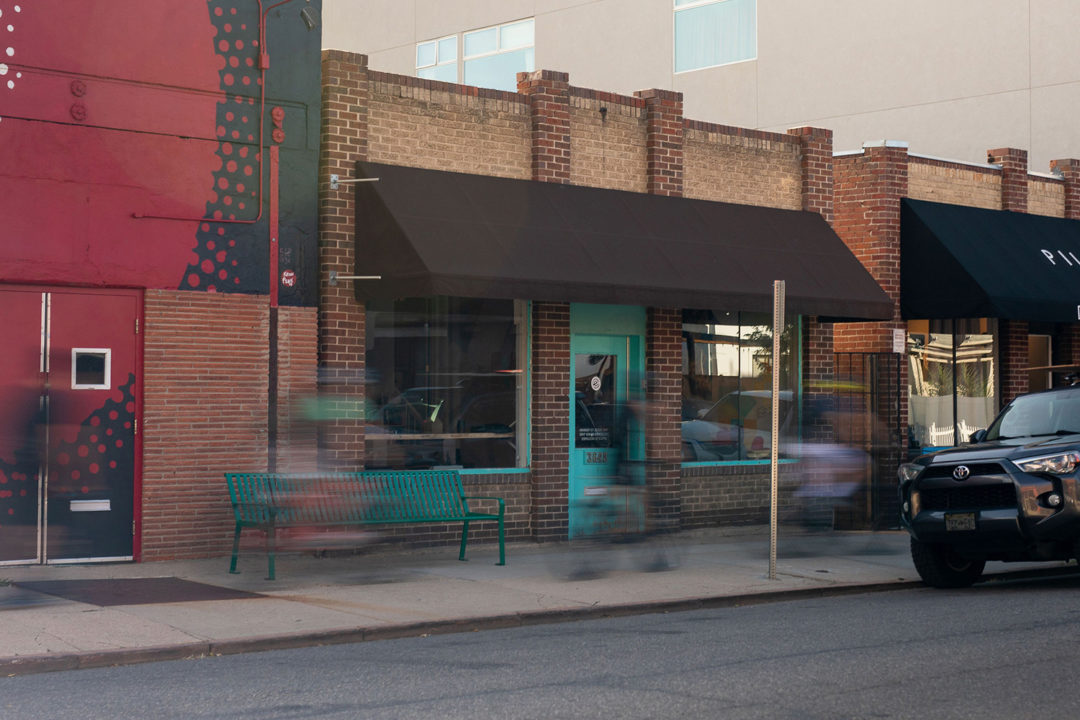
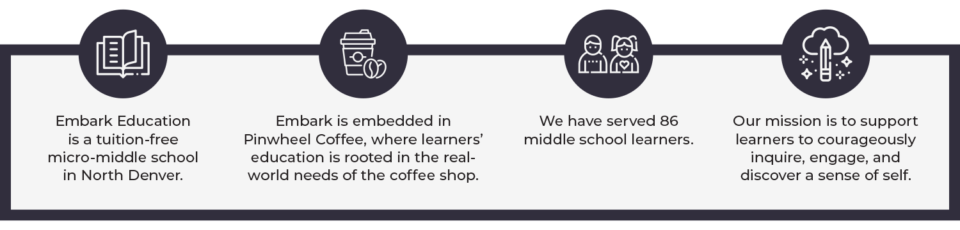
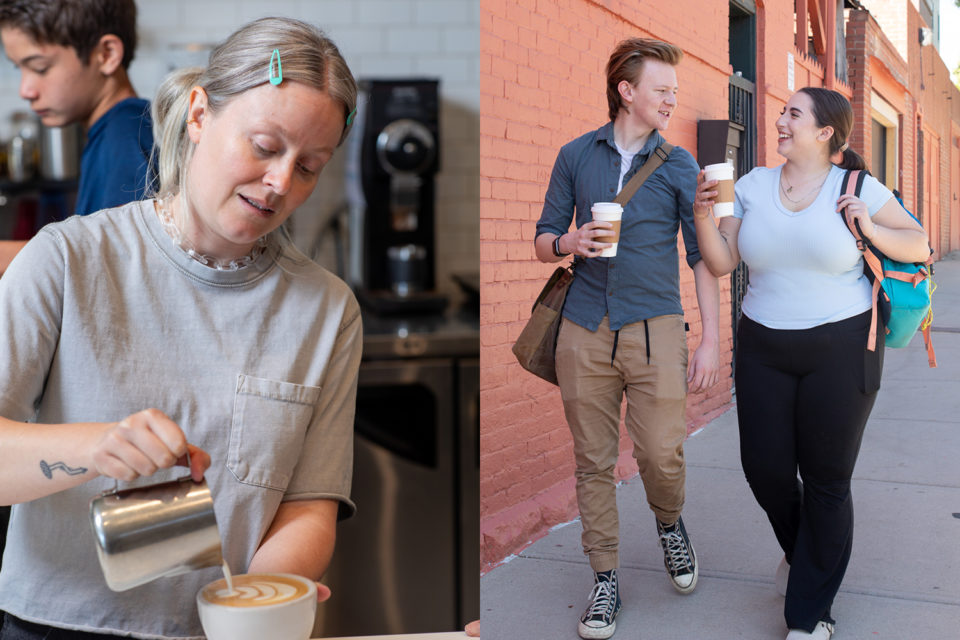
This is where we started when we founded Embark Education, a micro-middle school embedded in a coffee shop in North Denver.
We didn’t stop at imagining a better version of what already existed. We set out to build something entirely different.
What if middle school could be transformative—even joyful?
What if these years weren’t defined by rules and tests but by purpose, power, and deep connection? What if we stopped asking kids to earn our trust – and started giving it freely from day one?
Could they rise to meet that responsibility?
Could they lead?
Could they thrive?
We knew the answer was yes. And we built a school rooted in trust—one where curiosity was welcomed, identity was affirmed, and learning wasn’t confined to a classroom, but grounded in real-world experiences.
We centered our learners.
We designed for agency, iteration, and reflection.
We built a middle school for middle schoolers.
“There is a widely accepted philosophy that responsibility and trust must be earned, but what if we have it backward? What if, when given responsibility and trust, adolescents learn more, work harder, and earn more opportunities?” —Brian Hyosaka, Head of School
This philosophy didn’t just shape our approach – it shaped lives.
You’ll see that in the stories ahead: Tahliiya, who challenges every adult to believe in middle schoolers. Walden, who reminds us what’s possible when we do. And Embark alumni, who – without prompting – named the very skills linked to thriving in high school and beyond.
We share data that demonstrates how our learners experienced Embark – overwhelmingly positive compared to national averages – proving that this wasn’t just a powerful story; it was a transformational model.
Now, as we prepare to close our doors after six unforgettable years, we do so with full hearts—proud of the learners we walked alongside, the questions we explored, and the seeds we planted that will take root in ways we can only begin to imagine.
This is the story of what’s possible when we trust young people, honor their brilliance, and reimagine middle school not as something to survive, but an opportunity to thrive.
Voices of Embark: Experience Middle School Through the Lens of Our Learners.
Don’t Underestimate Us: What Middle Schoolers Are Capable Of
Written by Tahliiya H. (seventh grader)
Being underestimated is something that middle schoolers get a lot. Many of us experience it, but at Embark, I’ve learned how to make people think twice and expect the unexpected. As a middle schooler, many assume I can only do the bare minimum of basic math, reading, and language arts. Yes, I can do all of that, but at Embark, I’ve learned I can take those basic skills and make them something more.
At Embark, we focus on authentic learning inspired by real-world experiences, allowing us to go beyond the basics. Take, for example, our science projects. We don’t just learn about the properties of liquids. We turn an ordinary science project into a fun, collaborative project where learners create unique drinks for the Pinwheel Coffee menu. You might expect our creations to be gross or unappetizing, but in fact, it’s just the opposite. Over the years, some of our drinks have made it onto the Pinwheel menu! For example, the Apple of My Chai (made by Max O., an eighth grader) and the Ube-be-be Matcha (made by Walden S., an eighth grader).
The fact that middle schoolers are trusted to create and propose drinks for the Pinwheel menu has shocked learners, parents, and even customers, but in the best way possible. It’s experiences like this that show how Embark encourages us to break boundaries, think outside the box, and always aim to surprise others. In a world where we’re often underestimated, we’ve learned to turn that into an opportunity to showcase our skills, creativity, and potential.
At Embark, we turn basic skills into something extraordinary. Our experiences prove that middle schoolers have the ability to think critically, show empathy, and take responsibility.
Don’t underestimate us; we’re ready to surprise, create, and make a difference.
Revealing What’s Possible Through Real World Learning
Written by Walden S. (eighth grader)
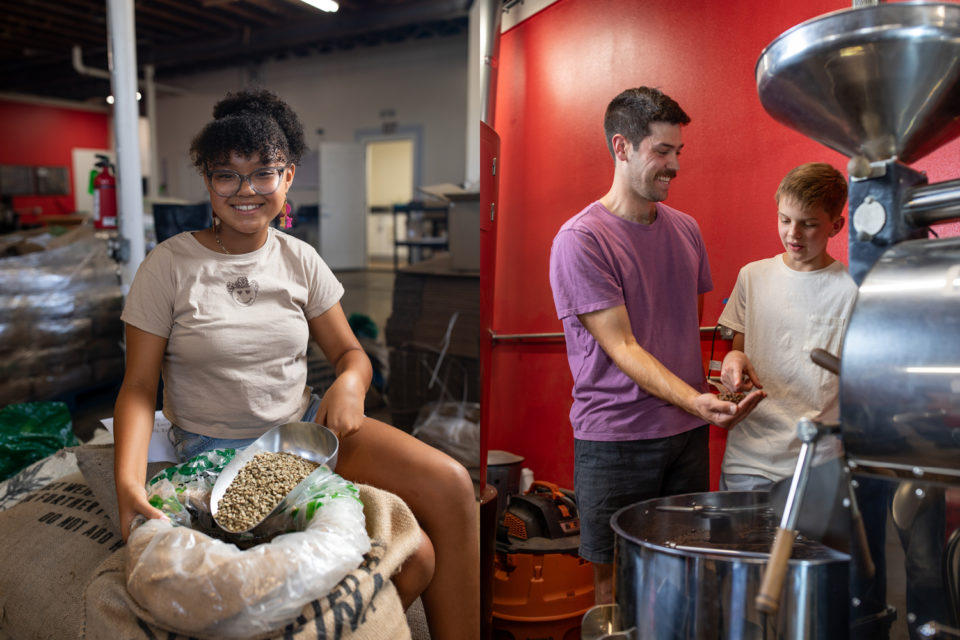
The air was thick and hot from the 1,000-degree roaster, and all the garage-style doors were closed. I walked up to the green, unroasted coffee beans. I scooped the coffee into the bin, walked it over to the roaster, and put it in the hopper. I could see my paper, which was scattered with roasting recipes, measurements, and guidelines shaking in my hand, and I was super nervous. I focused and successfully roasted my coffee. That moment? That’s what learning at Embark feels like. It’s hands-on, exciting, sometimes nerve-wracking—but always rewarding. Embark has shown me that education isn’t just about textbooks and tests; it’s about real-world experiences, like the eighth grade Roasting Apprenticeship that I led, that make learning fun, engaging, and, most importantly, relevant.
“Embark develops key skills in learners, like agency, reflection, and collaboration, and sometimes, it’s so embedded that we don’t even realize it until we look back.” –Walden
Micro-school, Mighty Impact: We caught up with our alumni to hear about life after Embark. Here’s what they had to say.
At Embark, communication isn’t a discrete, standalone skill; it is a constant practice woven into the daily rhythm of school.
Julian S. remembers “walk and talks” with educators as transformative moments. “It was the first time I felt like teachers actually wanted to hear what I had to say.” Through these casual, trust-building conversations, he learned to express himself openly and ask for help when needed, something that he found “nearly impossible” before. Now, Julian is in high school and reports regularly advocating for himself with educators, confident in his ability to dialogue and clarify his needs.
For Kai W., the impact of communication is equally as powerful and showed up in everyday moments – like developing friendships in high school where it feels easier, more natural. At the same time, academic life became more manageable. “I learned how to organize my homework, keep track of what I needed to do, and not panic when things piled up,” Kai said. These were small shifts with a big payoff, rooted in Embark’s emphasis on key, core competencies.
Both of these alumni experiences speak to more than just academics; they describe a shift in how they navigate the world. They listen more closely, speak more clearly, and take responsibility for themselves with confidence. Communication and agency are intertwined and have been cultivated through trust and real-life skills at Embark over time.
Owning the Clock
At most middle schools, time is tightly managed by bells, schedules, and adult directions. At Embark, students confidently manage their own time.
For Julian, this shift wasn’t just logistical, it was transformational. “I figured out how to organize my homework, balance sports, and keep up with everything going on,” Julian reflects.
At Embark, where students are trusted to make real decisions, time management isn’t just taught: it’s practiced. Learners don’t just meet expectations; they design their own systems and routines to meet them.
This level of autonomy isn’t the exception, it’s the norm. Learners build their daily schedules, adjust when plans change, and learn from the natural consequences of their choices. At Embark, it is learning by living, and it sticks.
Vida W. shares that the time management strategies she developed at Embark now help her stay on top of responsibilities at home managing chores without feeling overwhelmed. That’s what it looks like when a skill leaves the classroom and reshapes everyday life.
Josh F. has harnessed executive functioning skills he learned at Embark, like time management, to flourish both in and outside of school. He shares, “Embark has helped me be able to turn my work in on time and know what I need to do, like if I need to talk to a teacher about something related to an assignment.” Josh’s experience was validated by his freshman high school teacher who during a conference said, “your executive functioning is well above average for a kid your age.”
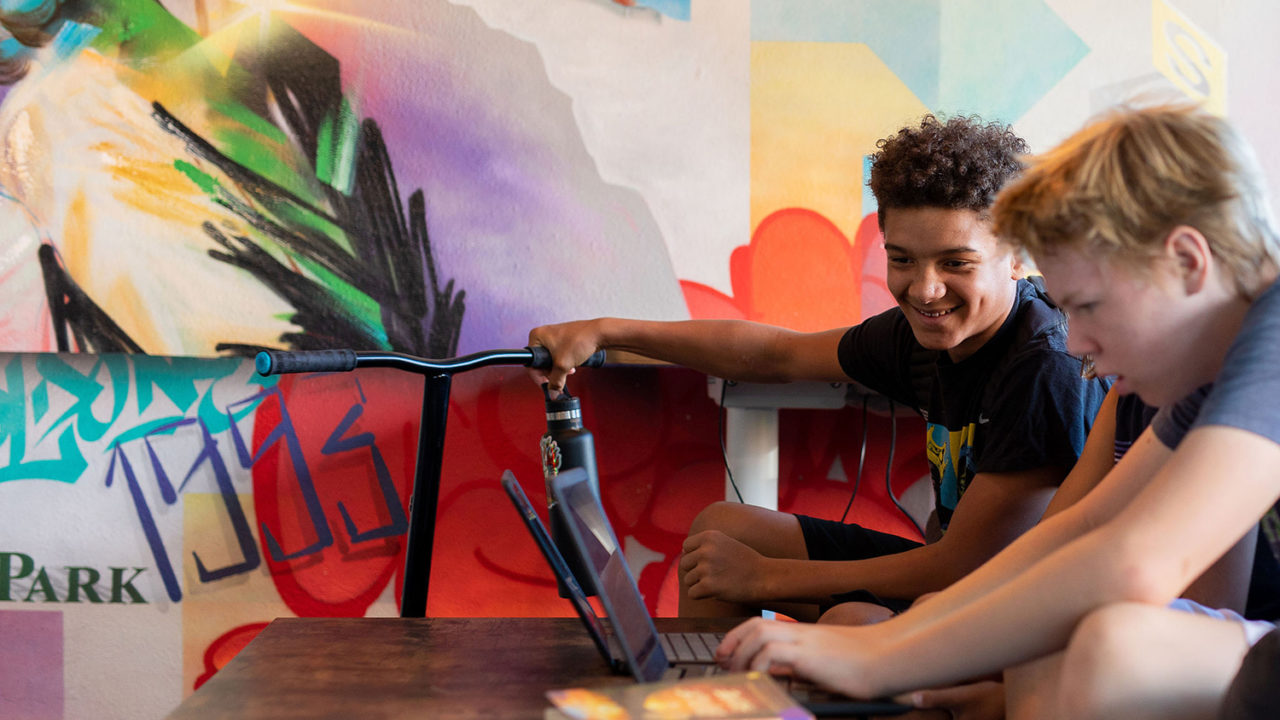
Learners also gained vital habits through real responsibilities at Embark: shop shifts at Pinwheel Coffee, completing projects, meeting deadlines, and collaborating with peers. These weren’t simulations. They were real-world experiences that taught learners how to show up for themselves and others.
“I know how to manage my time, and I can use my time well,” Vida said, without hesitation.
With that agency, learners weren’t waiting to be told what mattered. They were choosing. We now know that alumni continue to embody this beyond their years at Embark – 100% of alumni interviewed reported that Embark prepared them for high school and beyond.
Students who develop agency and self-management early are more likely to thrive in high school and beyond.
Over three years, 84% of Embark learners reported that “adults respect my ideas and suggestions,” compared to 48% of 86,483 learners surveyed nationally. Transcend Leaps Student Voice Survey*
Leading the Way
Leadership at Embark isn’t about titles. It’s about learning how to listen, collaborate, and adapt, even (and especially) when things don’t go as planned.
Lachlan F. reflected on a six-week group project where he was paired with a younger learner who wasn’t contributing much to the group’s work. Frustrated and unsure how to move forward, he found support in his educator, who didn’t step in to “fix” the problem, but instead helped Lachlan reflect and grow.
“It was the first time I really had to work through something like that. I didn’t just learn how to handle it, I learned how to understand someone different from me.”
Rather than just solving for the assignment, Lachlan began learning how to collaborate with patience, perspective, and empathy, a skill that extends far beyond the classroom.
Braiden S. shared a similar turning point during a seventh-grade environmental project. He entered the group with a clear vision and a strong desire to lead. But what began as control shifted into something more powerful: servant leadership.
“I started the project wanting everything to be perfect. I ended it wanting everyone else to grow.”
That shift—from individual ownership to collective growth—was a defining moment in Braiden’s personal development.
Lachlan and Braiden aren’t the only ones at Embark that experienced collaboration and leadership in the community: In fact, when surveyed in the 24-25 school year, 86% of Embark learners agreed that at school they learn how people can work together even when they disagree, compared to 55% of 24,187 learners nationally. (Transcend Leaps Survey)
Discovering a Sense of Self
What if middle school could be transformative – even joyful?
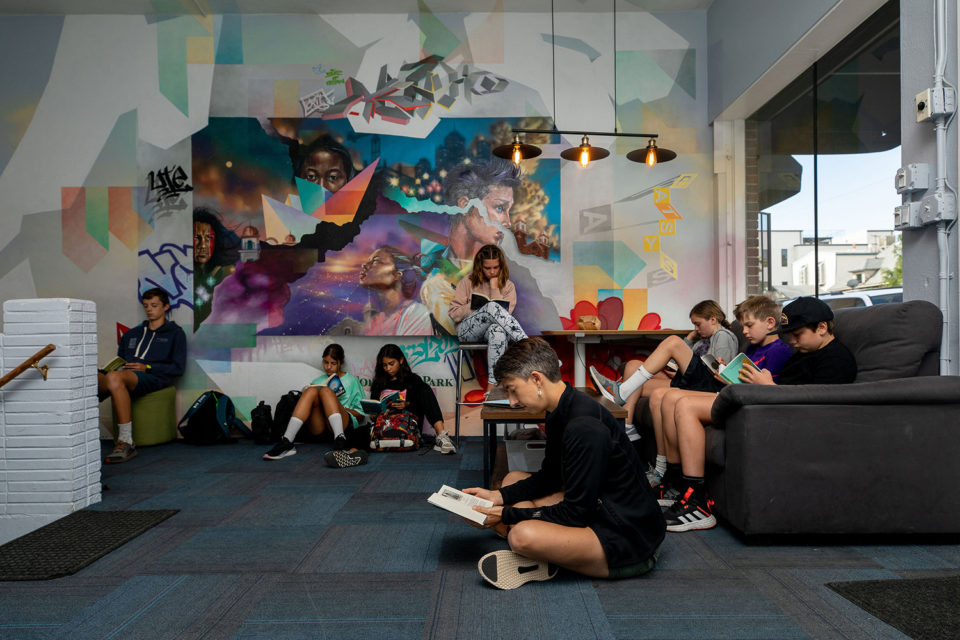
This is one of the key questions that we set out to explore when we founded Embark. After six years exploring the answer, what we have found is not only can middle school be both of those things, but when it is, the impact on adolescents is undeniable. When middle school is done differently – with learners at the heart of their education – it propels their personal development, transforming their perceptions of themselves and the world around them.
We see this come alive in alumni like Samara I., who, despite only being a learner at Embark in her eighth-grade year before continuing on to high school, shared “Honestly, it’s really amazing that even one year at Embark has shaped how I am as a learner and a person.”
Samara went on to share that her experience at Embark has shaped who she is as a person, as well as how she navigates through life with a heightened sense of awareness and empathy for those around her. She shares, “I think that’s such an important thing that Embark taught me: be open to other people’s stories and their identities and appreciate the diversity that’s in the world.”
Ruby B. shared a similar sentiment, saying that her time at Embark helped her figure out who she is as a person, as well as who she wants to be for herself and others around her.
This heightened sense of self and the journey of self-discovery in Embark learners is palpable not just for learners themselves, but for their parents, too. One Embark parent shared, “We continue to be grateful for our choice to send our learner to Embark, as it truly has given her the playground to evolve into the learner and human she is.”
These aren’t just school stories. They’re life lessons in collaboration, flexibility, and emotional maturity. They demonstrate exactly what’s possible when middle school is redesigned to reflect the complexity and the potential of real human development—when middle school is for middle schoolers. Because if the locker-slamming, anywhere-but-here years can become this—a place of joy, purpose, belonging —then what else might we be brave enough to reimagine?
Curious to dive deeper into the strategies, mindsets, and practices we implement to radically reimagine what’s possible? Our founding educator, Carissa Solomon, is writing a book about Learner-Centered Strategies! Learn more.
*Transcend’s Leaps Student Voice Survey provides educators with near-term data to better understand how their students experience learning. By deeply understanding students’ experiences, schools are able to redesign their offerings to be more positive and engaging learning experiences which are associated with stronger outcomes and increased opportunities for all students.