

The Local newsletter is your free, daily guide to life in Colorado. For locals, by locals.
After Aidan Lyons finishes restocking a small pile of recently used boots, poles, and skis at Breeze Ski Rentals in Frisco, he plans to return to his book, The Silent Patient, a thriller by Alex Michaelides. “My days are a lot slower. I see less people,” he says. “It’s really sad.”
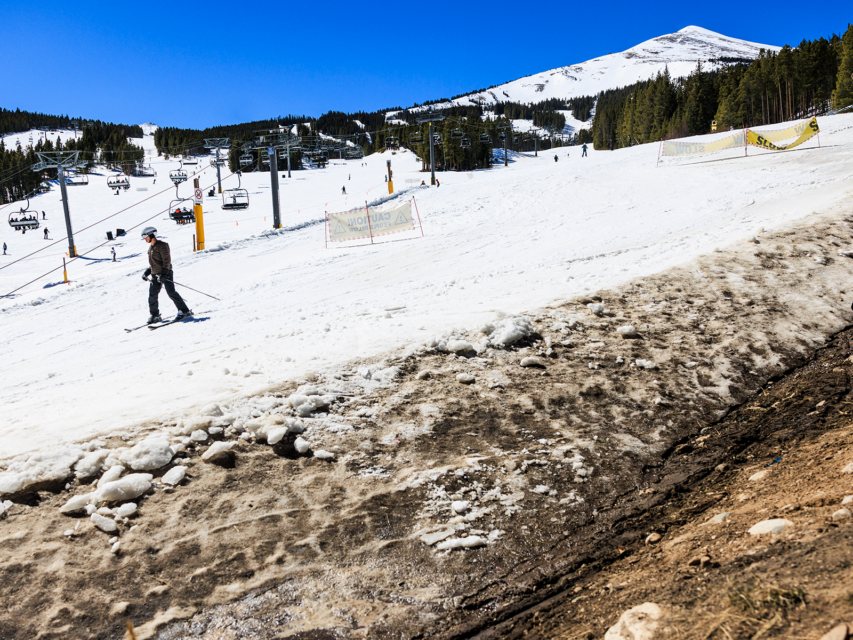
Lyons, 22, the store’s assistant manager, tells me that only a handful of customers stopped in at this strip-mall ski-equipment shop 10 miles from Breckenridge on a snowy Tuesday morning last month. Business has been slow this year, due in large part to Colorado’s disturbingly low snowpack over the past few months: just 34 percent of the median as of March 26. One Colorado State University climatologist recently said this past winter represented “the lowest snowpack in more than 40 years—and possibly ever—in Colorado’s mountains.”

The snow totals at resorts from Breck to Telluride to Steamboat Springs have rattled workers at nearby businesses, from the bartenders who’ve had to take second or third jobs to the store managers who’ve opted not to hire seasonal help.
“The traffic is just a lot lower,” says Lyons, who commutes about three hours round-trip from Boulder to the Frisco job and sleeps in his car at a nearby parking lot two nights per week. “The people who book their trips in advance, usually from Texas and Florida—there’s just a lot less of them. Everybody’s going to the East Coast. The snow’s great there. Vermont’s getting it.”
Employers have had to recalibrate financially for the smaller crowds: Vail, Steamboat Springs, and Breckenridge are among many resorts that cut hours for some workers this ski season. In Telluride, snow totals were lower than usual throughout 2025, which had an impact on two straight ski seasons, and in January the town’s iconic resort settled a late-season strike by ski-patrol workers—prompting local hotel owners to economize. “Last winter and this winter, it has been tight with the purse strings,” says Derek Blankschein, who works at the front desk of Bivvi Hostel Telluride, in Placerville, a small town 15 miles northwest of the resort. “Generally, [hostel owners] are not trying to spend more money than we need to.”
The usually packed High Side Brewing, on Main Street in Breckenridge, has not supplemented its weekday bartending shifts with a “float shift” to complement the primary bartender. That helps workers in one way—fewer employees share the community tip pool—but because there are fewer customers, the overall revenue is lower, too. “I’m taking home less money,” says Wesley Black, a bartender who commutes two hours round-trip from Idaho Springs, as “It’s Bad You Know,” by bluesman R.L. Burnside, blares from the speakers. “Luckily, I’m married to a wife who does exceptionally well. So this is just supplemental to our income. I can imagine, if it was just me, I would have probably a second or third job to keep myself afloat. I’m very grateful.”
Across the street from High Side, Olivia Lowrie mans the register at the Local Market and Liquor Shed, which she has owned for 15 years. She’s hiring fewer workers this season and not doing as many “case deals” for liquor, she says, because “it’s going to take longer to sell.” On the Tuesday morning after President’s Day weekend, she’s working alone. One customer shows up for cigarettes, but declines Lowrie’s offer of free, post-Valentine’s Day chocolates.
“It’s hurting everyone,” Lowrie says. “A lot of people that work locally come in, and restaurant people [say], ‘My shift was cut today. I got sent home early.’ I hear that all the time.”
Adds Miriam Roskam, owner of Mountain Shire Books & Gifts in Winter Park: “There’s a lot less foot traffic in the area, especially during the week. Sometimes on the weekends, it’s really slow.”
In Steamboat Springs, according to a resort spokesperson, 75 percent of the skiable acreage was open as of February 22, and the resort had to reduce hours for seasonal and part-time staff in a variety of departments. Two local hotels, the Western Lodge and the Hotel Bristol, have lowered rates to draw more customers—and the formula has worked so far, according to Tammie Thompson-Booker, the area manager, who says occupancy is up 18 percent compared to last year. “It could be way worse. It really could,” she says. Out-of-state skiers who booked their Steamboat vacations have largely kept their reservations, she observes, including one Texas guest who stayed one week, then rebooked for a second.
Due to the uncertainty, Thompson-Booker has been “cautious” and “nervous” about spending too much money, opting against buying more supplies or hiring additional employees at either property. “I’m frugal, I guess. It takes a good, solid two weeks to get them trained,” she says. “I was afraid to get someone in here who had an expectation of 20 to 30 hours a week, and I get a phone call from the investors, saying, ‘Mmm, we need to watch this.’ ”
Nobody’s panicking. In Breckenridge, 109 of the resort’s 193 trails were open as of March 26, and most of the inaccessible runs were more difficult black-diamond trails in the back bowls and elsewhere. Locals say the availability of easier runs has still been drawing families, who indulge in ski lessons, hotel stays, restaurant meals, weekend happy hours, and gift-shopping.
And Steamboat’s malaise has created new opportunities for other businesses. At Off the Beaten Path Bookstore and Café in Steamboat, vacationing customers spend their time shopping and eating rather than on the slopes. “People are doing the downtown thing instead of the mountainside thing,” says Megan Mertens, the store’s general manager. “The customers have continued to come. We had a record-breaking President’s Day.”
That’s not to put a happy stamp on Steamboat’s ski season. “When we did have layoffs at the resorts, that threw seasonal employees into a tailspin,” Mertens says. “We’ve had people ask us if we’re hiring. More sports-based businesses in town, especially the ski shops, are hurting. Some of the restaurants are hurting. We’re also a business that caters to locals. It sucks to see them every day looking a little defeated: ‘We don’t have any snow.’ ”
Scottie Kees, a 44-year-old bartender at High Side Brewing in Breckenridge, has had to curtail his snowboarding because, he says, “Whole patches of run, you can see the brown coming through. I’ve broken enough bones. I don’t need another surgery.”
Instead, he runs his dogs and does homework for pre-nursing classes at Colorado Mountain College. “My friends and I are like, ‘This sucks.’ We’re doing more potlucks at the houses and playing cards,” he says. “We’re not in our 70s! We’re not retired. We want to snowboard.”
At Breeze Ski Rentals in Frisco, by late February, Lyons had skied only twice this season—especially concerning because he and his friends are working to publish a ski magazine and need photography content. But he doesn’t worry about his job security at the shop. At any moment, a blizzard could sweep in and the customers could return for last-minute ski trips. “I don’t think they could get rid of me,” he says. “What would they do? I am the only person here right now.”