

The Local newsletter is your free, daily guide to life in Colorado. For locals, by locals.
Nour Ben Hmieida has been perfecting her Libyan-style baklava since 2019, when she began baking the flaky pastry in her college dormitory in Hillsdale, Michigan. The layered phyllo treats, based on her family’s recipe, proved so popular among her classmates that she started selling them later that year for her international club’s fundraisers and to the Hillsdale community to help fund her other entrepreneurial ventures (which ranged from beauty products to indoor plants). After college, she moved back to Denver, where her family had settled after leaving Libya, and launched an online baklava business, Oea Bakery, with her mom, Nahla Sharif, in 2021.
Though Oea Bakery, named after the ancient city that is now called Tripoli (where Ben Hmieida and her family are from), started largely from word-of-mouth requests, Ben Hmieida says it’s been a great way to share her culture. Before coming to the U.S. at the age of 11, Ben Hmieida grew up making big circular trays of baklava with her aunt for holidays like Eid al Fitr (a celebration that marks the end of Ramadan’s month of fasting).
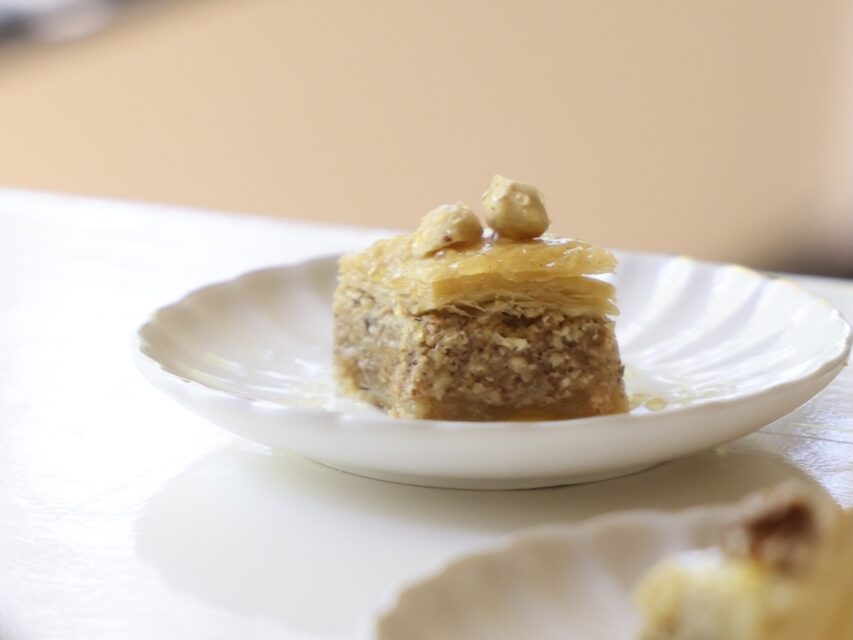
She and her mom now make Libyan baklava in much the same way: rolling out and layering thin sheets of phyllo dough (as many as 40 per batch, each brushed with melted butter), adding a nut filling, and smothering the whole tray in honey after it comes out of the oven.
While baklava is often associated with Turkey, Greece, and Armenia, it spread to Libya during the Ottoman Empire’s reign, but was adapted with local ingredients. What makes Libyan baklava unique is the use of almonds as well as a pure honey drizzle, instead of sugar syrup often used in other versions. “Some regions add nuts every five layers or so,” Ben Hmieida says. “In Libya, we only actually add it in the middle as its own filling.”

Ben Hmieida explains that, unlike other beloved Libyan dishes like couscous and bazeen (a barley-based dough served with stew), baklava isn’t an everyday food. Instead, it’s a dessert mostly reserved for celebrations, which she notes were plentiful in her big family. “During weddings, it’s a family tradition to pack the baklava into little favors,” she says.“It’s a special time to bond—from the baking to the packing to the enjoyment.”
For those who’ve never tried baklava, Ben Hmieida recommends enjoying a piece with bitter Arabic coffee or, her favorite, mint green tea.
Oea Bakery operates out of a commercial kitchen in Commerce City and ships gift boxes (packaged to emphasize the celebratory nature of the pastry) across the U.S. and Canada. In addition to fine-tuning family recipes, Ben Hmieida and her mom love to experiment; they’ve recently developed a gluten-free baklava, which they tinkered with for years to create a wheat-free phyllo dough that’s stretchy and bakes without cracking. “You definitely have to experiment a lot and be okay with failing sometimes,” Ben Hmieida says, noting that offering a gluten-free version was important because of frequent customer requests.
Ben Hmieida and her mom will soon hire additional staff to support growth plans, including selling baklava in specialty markets, offering a local pick-up option, and developing new desserts to meet demand. “Food brings people together and also shares the culture,” she says. “When you share your food and talk about its origins, it really bridges the gap of any misunderstandings.”
Order Oea Bakery’s baklava online and follow it on Instagram to learn about new events, baking updates, and baklava offerings.