


The Local newsletter is your free, daily guide to life in Colorado. For locals, by locals.
If you read the Wall Street Journal last week, you likely came away thinking downtown Denver is a Mad Max-esque wasteland of blight and crime. In a story headlined “Can This Guy Get People to Live in America’s Emptiest Downtown?,” reporter Peter Grant, profiling Asher Luzzatto and his ambitious plan to convert vacant office buildings into apartments, describes the developer, on an April afternoon, gazing out upon “vacant store fronts, empty office buildings with darkened floors, and deserted streets.”
The portrait only gets bleaker from there, with hyperbolic language describing the Mile High City as “fighting to escape a death spiral,” full of “abandoned buildings and blighted conditions,” and among other U.S. cities with “desolate urban cores.” The story—whose clickbaity framing successfully catapulted it across the Internet—closes by quoting an office worker at the suburban Denver Tech Center, who dismisses central Denver by saying, “I have eyes and I can observe. It’s just not an attractive place to be anymore.”

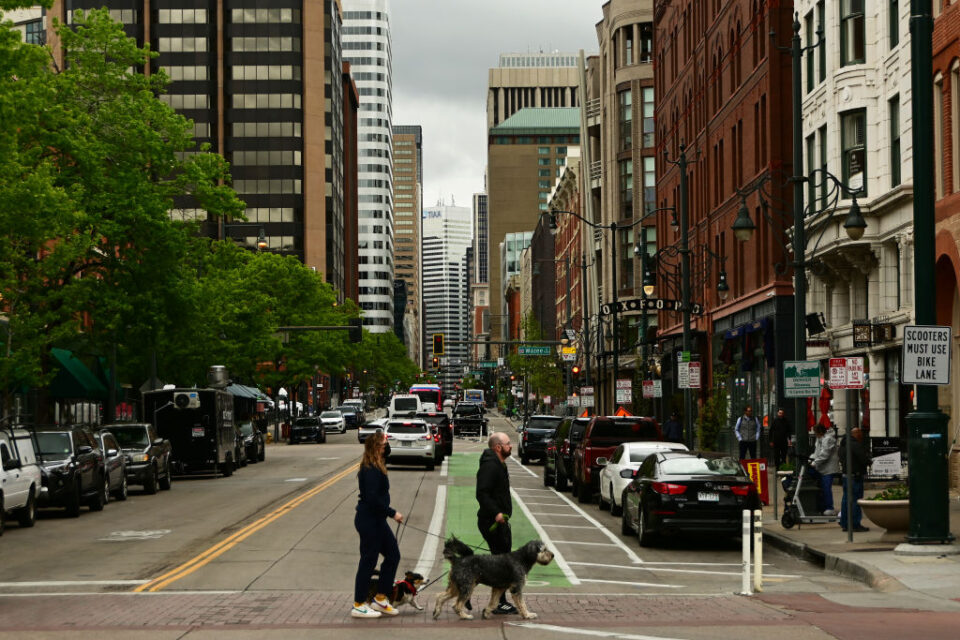
I also have eyes, and these are some of the things I observed on a stroll through downtown last week: Baseball fans walking to Coors Field, with folks in purple Rockies gear ribbing Dodgers fans in blue; a kid climbing on the Howdy Trouty fish sculptures on the 16th Street Mall; the Oxford Hotel doorman chatting with passersby; and a gaggle of office workers lined up in the morning coffee queue at Amante. I set up my laptop on a comfy chair in the Union Station lobby, grabbed a snack ($8 kimbap from a recently opened Korean spot), and enjoyed a little people-watching. The guy next to me was on mute in his Zoom meeting, and I caught a whiff of something floral as the Beet & Yarrow ladies put out fresh bouquets.
In short: I saw life happening, and lots of it.
Yes, I also saw homeless people panhandling, as is the case in any big-city downtown. As Denverite reported last week, fewer people are sleeping on the streets than at any point in the last decade: 518, down from a peak of 1,423 in 2023. Homelessness is still a significant crisis here, as it is nationwide, but let’s give credit where credit is due. The number of people sleeping on our streets has fallen by 45 percent in the last three years, after the city invested substantially in shelters, thanks in part to voters who in 2020 said yes to a proposition that funds supportive services to the tune of $55 million per year. (Because that money comes from sales tax revenue, it’s not going away.) And Denver managed to do this even as the Trump administration gutted federal funding for Temporary Assistance for Needy Families and other safety-net programs that support the poorest Coloradans.
Crime rates are down too, contrary to what the fearmongerers at DoBetterDNVR, a sensationalistic, anonymous social media account that posts grim scenes of drug use and homelessness, would have you believe. As Westword reported in April, last year Denver had the biggest year-over-year drop in homicides of any major U.S. city, and our second lowest overall homicide rate since 1990. Property crime has also fallen every year since 2022.
As for that “emptiest downtown” claim: It refers to a single data point, the share of office buildings that are empty, as measured by the real estate company CBRE. Denver’s commercial vacancy rate in the last quarter of 2025 was 38 percent, the highest among the 50 biggest American cities. This is definitely a problem, though it’s one that worries CEOs more than it does the 22 percent of Denverites who work remotely, and who enjoy not having to sit in rush-hour traffic. Maybe our city’s embrace of remote work (we’re way ahead of the national average of 13 percent) is something to celebrate, not bemoan.
Regardless, commercial occupancy is a narrow measure of what makes a city vibrant. Another data point worth a look is the number of people actually walking around. Last month, downtown foot traffic was back to 95 percent of what it was during the boom of 2019, according to the Downtown Denver Partnership.
None of this is a critique of Luzzatto. It’s laudable that he’s attempting to convert vacant office buildings into homes, despite the high costs and risks. His plan is a little pie-in-the-sky, but cities need big dreamers. He also deserves kudos for designating as affordable 75 of the 750 apartments he’s planning (going above and beyond the 70 that city ordinance requires him to set aside). However, even if he can figure out how to turn office towers into apartments (a big if, given the steep architectural and economic challenges involved), those 75 units are unlikely to make a meaningful dent in the broader affordable housing crisis. It’s naive to pin a city’s hopes on one powerful guy, but at least he’s trying to do the right thing.
It’s irresponsible, though, for the WSJ or anyone in a position of power to peddle the reductionist narrative that Denver is a “blighted urban core” trapped in “a death spiral.” Dystopian rhetoric like that persists because fear sells. That’s why DoBetterDNVR has so many followers, and why the WSJ story popped up in all our feeds. But the last time Denver went all-in on that kind of negativity, the results were disastrous.
In the 1970s, city planners and business leaders called for a project that could make Denver “an attractive place to live and work.” The “severity of blight” demanded action, as a 1973 report put it. This led to the Skyline Urban Renewal Project, whose innocuous name belied its segregationist effects: The city bulldozed 30 blocks of downtown, displacing 1,600 mostly nonwhite Denverites, all “for the promise of gleaming new towers” and the wealth they would bring. To make room for those towers, Japantown was all but erased, as were other diverse, working-class neighborhoods like Auraria, previously a Mexican-American community.
The Skyline project was straight-up racist—and it played a key role in creating the very problem Luzzatto is now trying to fix (too many offices and not enough homes downtown). That dark history doesn’t fit neatly into a headline, but we’d all do well to remember it.