


The Local newsletter is your free, daily guide to life in Colorado. For locals, by locals.
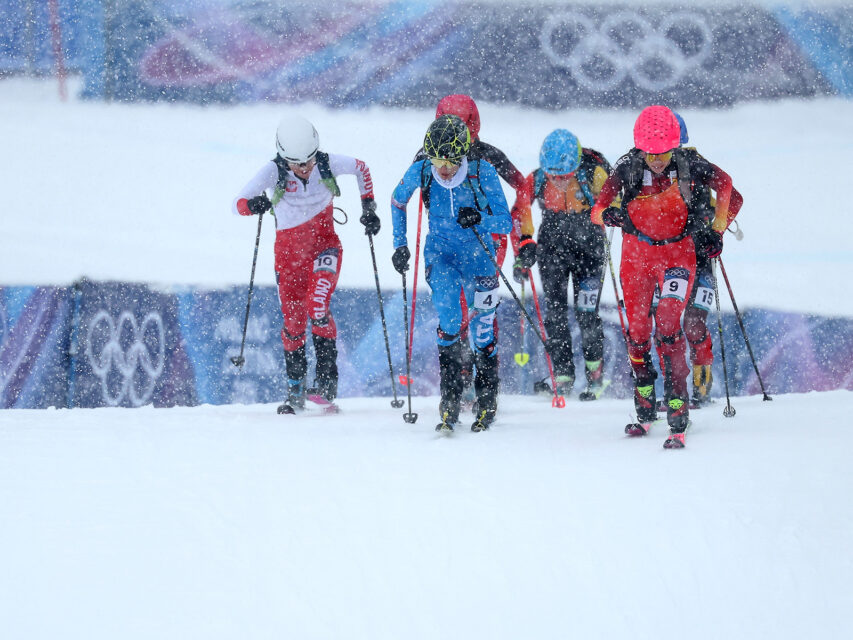
If you ski in Colorado, you’ve seen skimo without realizing it. Headlamps bobbing uphill before the lifts spin. Skinny skis impossibly speeding past you on the descent. Spandex-clad athletes ripping skins from the bottom of their planks without removing a single piece of gear.
In 2026, that once-fringe discipline is now in the limelight. Ski mountaineering (better known as skimo) is officially joining the Winter Olympics at the Milan Cortina Games, bringing a deeply European mountain sport to the global stage—and plopping Colorado athletes right in the spotlight.

But what exactly is it? Read on to learn more about this hard-charging sport and its Olympic debut.
What Is Skimo?
At its core, skimo is exactly what it sounds like: ski mountaineering. Athletes race uphill on skis with climbing skins attached. When they reach the top, they “transition” into downhill mode by removing the skins and locking their heels and boots into downhill mode. Then, they descend. The kicker: They do it as fast as humanly possible.
“The original concept was going from hut to hut,” says Eric Henderson, a longtime ski mountaineer and former agency of record for the United States Ski Mountaineering Association. “You would ski tour up to them, have lunch and a glass of wine, and then ski down.”
The sport’s roots are deeply European, where mountain huts and ski-touring culture are practically woven into society. Skimo also has ties to the 10th Mountain Division, an army infantry unit that trained for mountain warfare in Colorado by learning to navigate craggy peaks and snowy hillsides on skis.
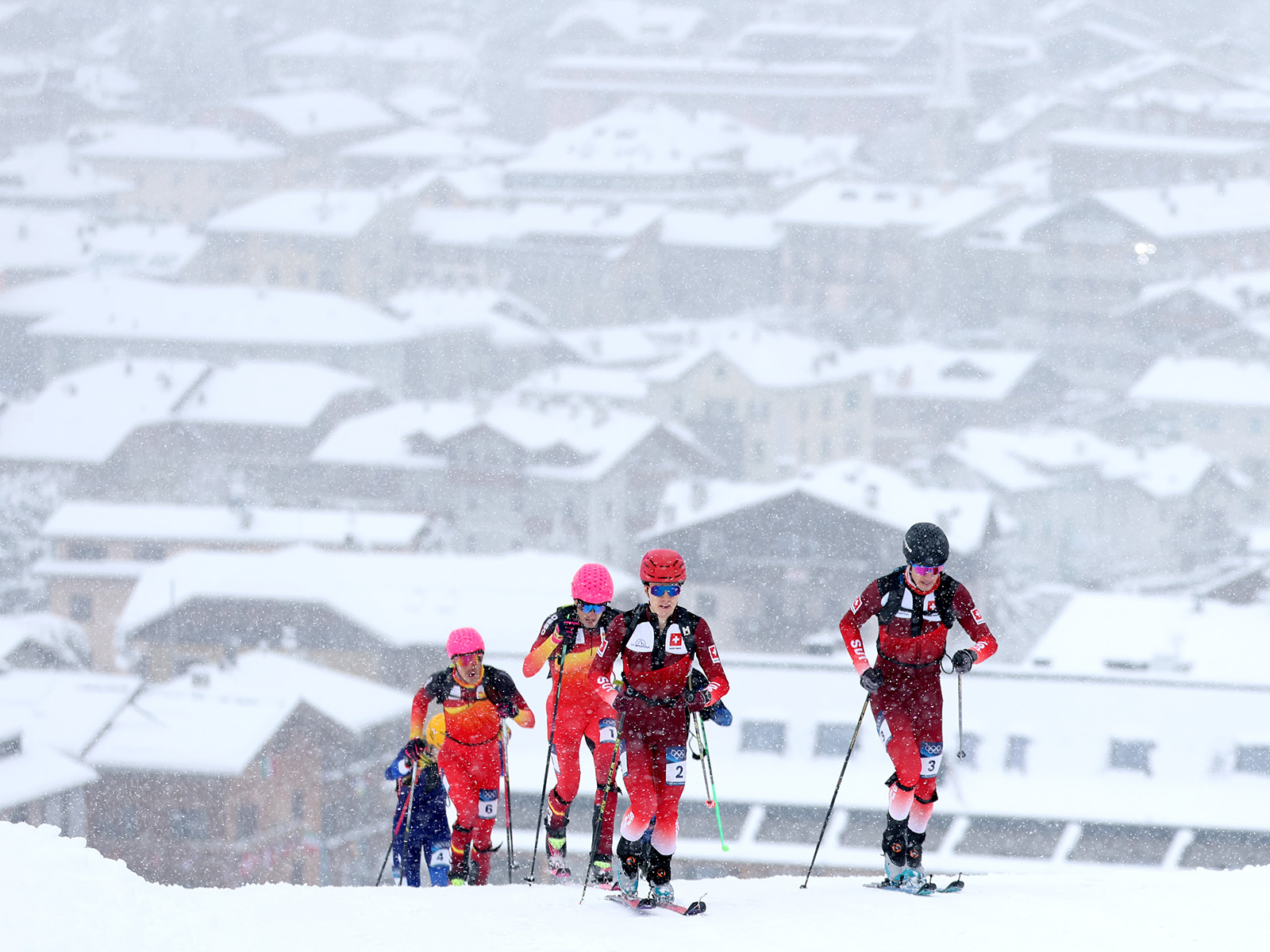
Over time, ski gear evolved to keep pace with the burgeoning sport. In the early 1980s, ski mountaineer brand Dynafit invented the first-ever “pin binding,” a lightweight system that revolutionized ski touring by making the uphill climbs more ergonomic. Once this happened, the sport began to shift from purely functional travel to competition and recreational fun. Endurance athletes realized they could move faster and farther through the mountains, and races soon followed. In fact, Colorado’s own Grand Traverse (a point-to-point race between Crested Butte and Aspen) is arguably one of the first marquee skimo events in the country.
“It’s taken us about 20 to 25 years to get to where we are today,” Henderson says. “To have a sport that’s actually now in the Olympics—it’s huge.”
What Gear Do You Need to Skimo?
To the untrained eye, skimo gear might look the same as alpine skiing gear. But if you tried to tour in your downhill setup, you likely wouldn’t get very far. That’s because touring skis are much lighter and have special bindings so your heels can lift. Plus, you pair them with skins, or fabric strips that adhere to ski bases, to provide traction.
Olympic skimo athletes use a single setup for both climbing and descending. There are no separate uphill and downhill skis. Every piece of equipment is engineered for speed and efficiency.
The boots are notably different from their alpine brethren. “The key differentiation between an alpine ski boot and a skimo boot is the pivot: the ability to have a range of motion in the cuff walk mode [a setting that lets skiers unlock the top cuff of the boot for more range of motion in the ankle],” Henderson says. Most skimo race boots weigh under three pounds and offer up to 70 degrees of cuff rotation. For comparison, a standard pair of downhill ski boots weigh twice that. But, the flexion and weight reduction are necessary; this allows athletes to basically run uphill.
The bindings are even lighter. Skimo athletes use something called pin bindings, or tech bindings. Unlike alpine bindings, they use small metal pins that insert into the toe while allowing the heel to lift freely during climbs. On the descent, you can adjust the binding to lock down the heel with an additional set of pins. “I’m looking at a race binding right now,” Henderson says. “It’s 128 grams. It weighs less than your iPhone.”
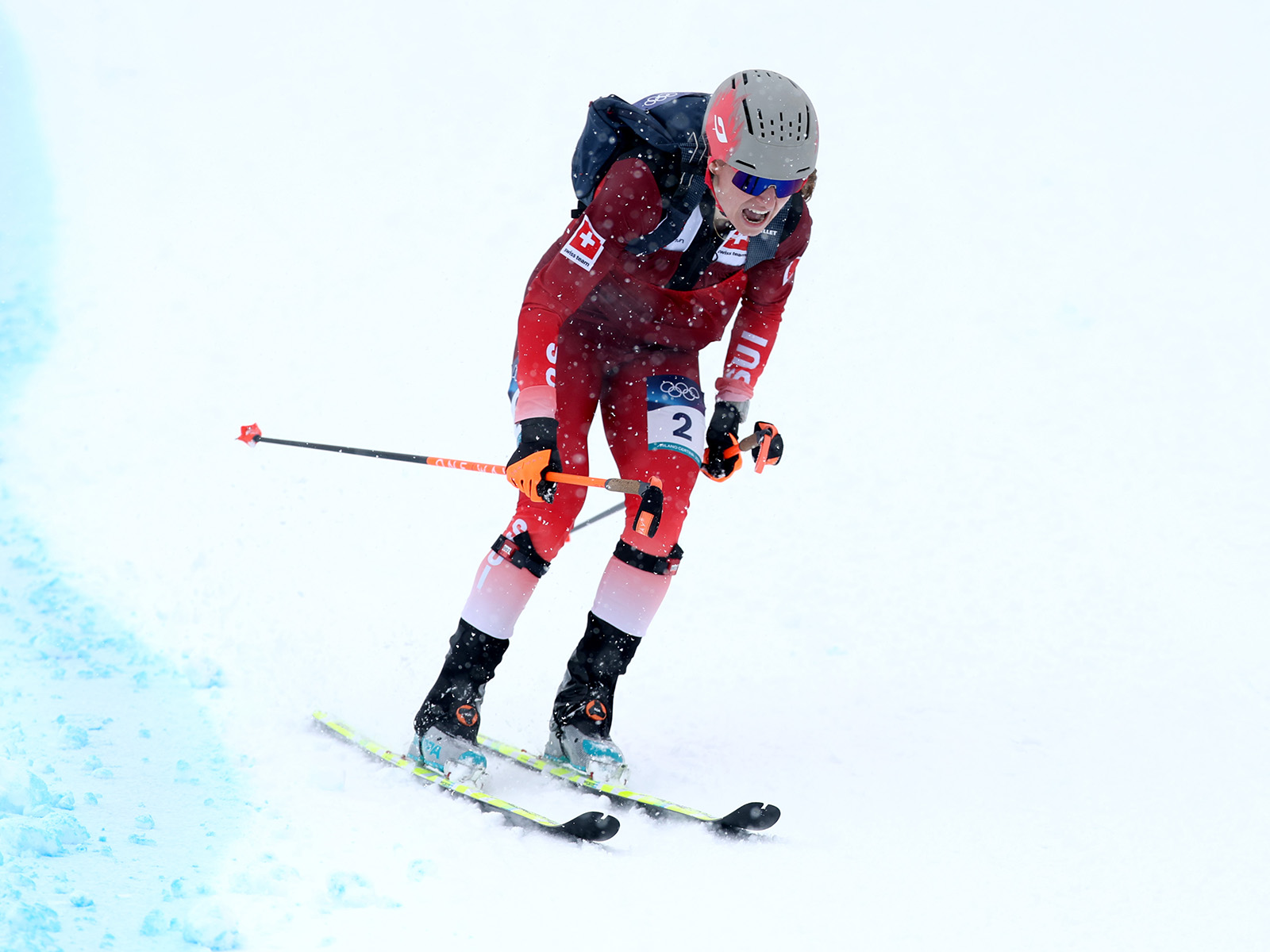
Skis are short, skinny, and stiff, built almost entirely from carbon to save weight while holding an edge at speed. Many race skis measure around 64 to 65 millimeters underfoot (centimeters narrower than most all-mountain alpine skis) and come in lengths far shorter than what most Colorado skiers would ever choose for a powder day.
And then there are the skins, the unsung hero of skimo racing. These sticky carpets attach to the bottom of skis, providing traction on the uphill. But, it’s also important they glide during the flatter sections. Olympic athletes overwhelmingly favor 100-percent mohair skins for maximum glide. “If you’ve got really good glide, you almost Nordic ski across the flats,” Henderson says.
Even those spandex outfits serve a purpose beyond aerodynamics. “The inside of the race suit is like a command center,” Henderson says. “There are pockets for your hydration, pockets for your water, pockets for your beacon, pockets for all of your safety precautions. Everything that you might need for a skimo race actually goes into the suit itself.”
How Will Skimo Work at the Olympics?
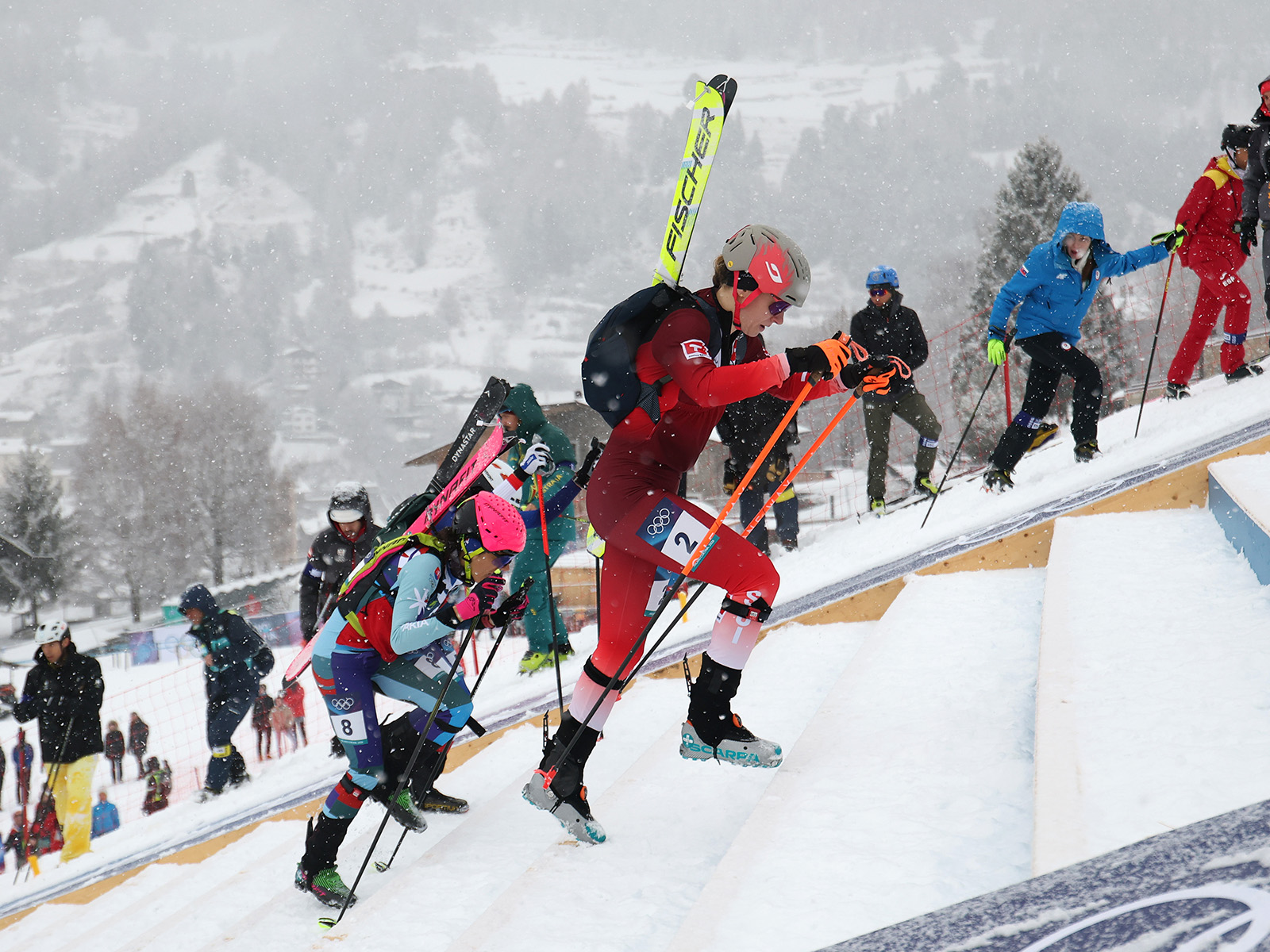
Skimo’s Olympic debut will feature two event formats: the sprint and the mixed relay.
Men and women will compete individually in the sprint, racing head-to-head through multiple rounds on a short, looped course. Each round is decided by a single lap, with the fastest athletes advancing until a final race determines the medalists. The sprint is short, explosive, and absolutely brutal. Mistakes in transitions or on the descent are nearly impossible to overcome.
The mixed relay is longer and a bit more tactical. Teams consist of one male and one female athlete, with each skier completing two laps for a total of four. Each lap consists of an uphill ski, bootpacking (running uphill in ski boots), and a ski descent. All teams follow the same order: woman, man, woman, man. Then, the final skier sprints to the finish. “The transition is critical,” Henderson says, referencing the point in the race when athletes rip their skins and switch their gear from uphill to downhill mode. “That’s where you’re going to really make up those fractions of seconds.”
Because the courses are compact and repeated, spectators can see nearly the entire race unfold. Traditional, long-distance skimo events disappear deep into the mountains for hours, so this format is atypical—something that didn’t go unnoticed by skimo purists. But, it’s also intentional. Quick, fast races make the sport more spectator friendly and much more exciting to watch on television at home. Henderson likens the viewing experience to speed skating. “It’s going to be fast and furious,” he says. “You’re getting to see the competitors the whole time.”
American Skimo Athletes to Watch at the Olympics
For most of the Olympic qualification cycle, the United States wasn’t expected to heavily factor into the skimo debut. With just one mixed relay spot available to all of North America, earning a place in the Games was far from guaranteed (and most assumed it was going to Canada). That changed in early December at the World Cup Ski Mountaineering mixed relay race in Utah, when the USA’s Cam Smith and Anna Gibson surged mid-race and won by more than 50 seconds. This secured the 12th and last Olympic berth, sending another Coloradan to Italy.
Cam Smith
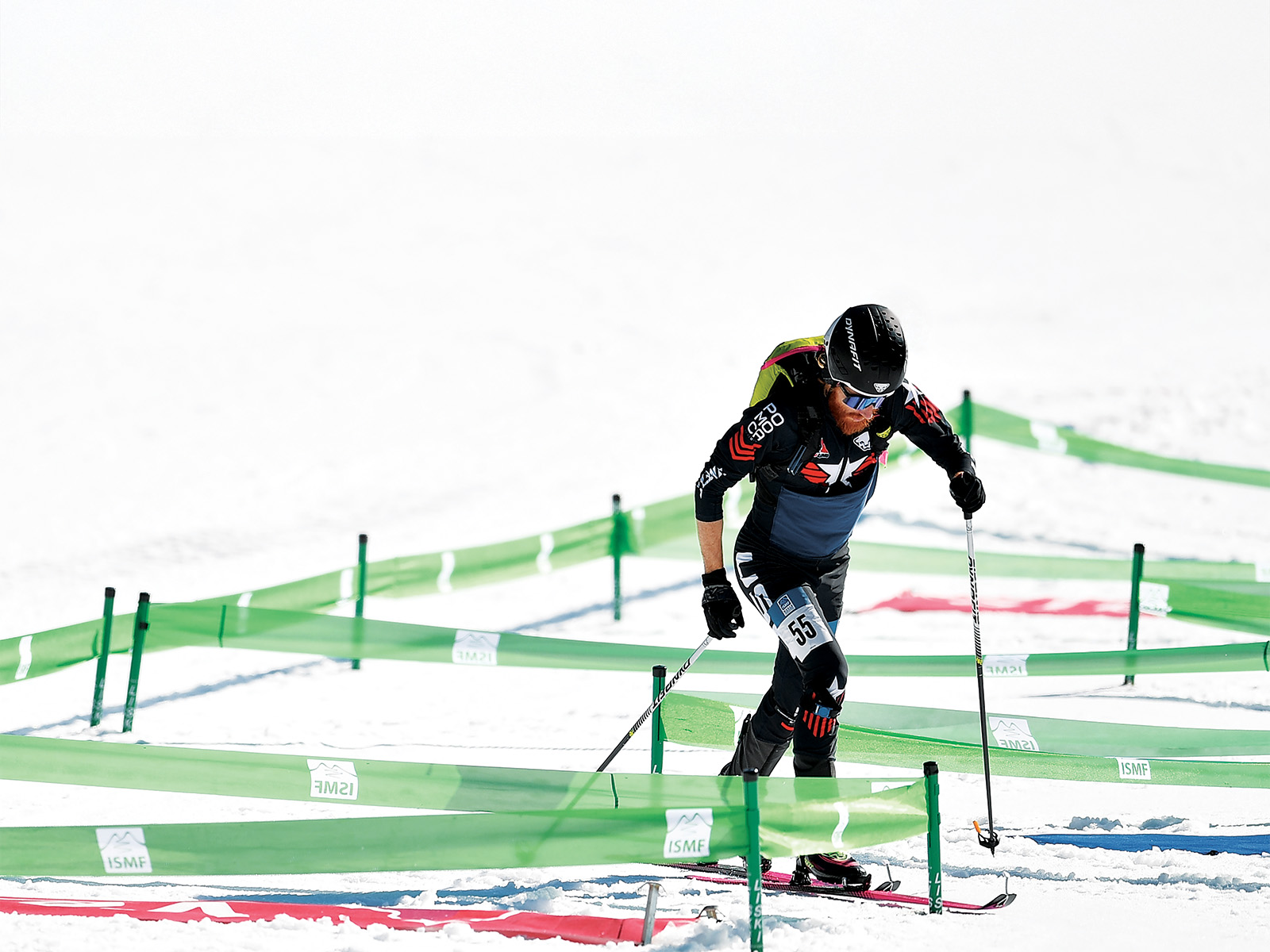
A Crested Butte–based athlete with deep Colorado roots, Cam Smith has built one of the most dominant résumés in North American ski mountaineering, winning multiple national titles and setting course records in the Grand Traverse, Power of Four, and Gothic Mountain Tour races.
According to Henderson, Smith’s recent leap forward came from a shift in how he trains. “Over the past couple years, he changed his training routine to be more in line with a mountain athlete,” Henderson says. “More time in the gym, a little bit more weight training. That has really exploded his performance.”
Smith has long had the aerobic engine required for skimo, but Henderson says his newfound explosiveness has made him especially dangerous in Olympic-style formats. Smith placed 10th (out of 12) in the men’s sprint semifinals.
Anna Gibson
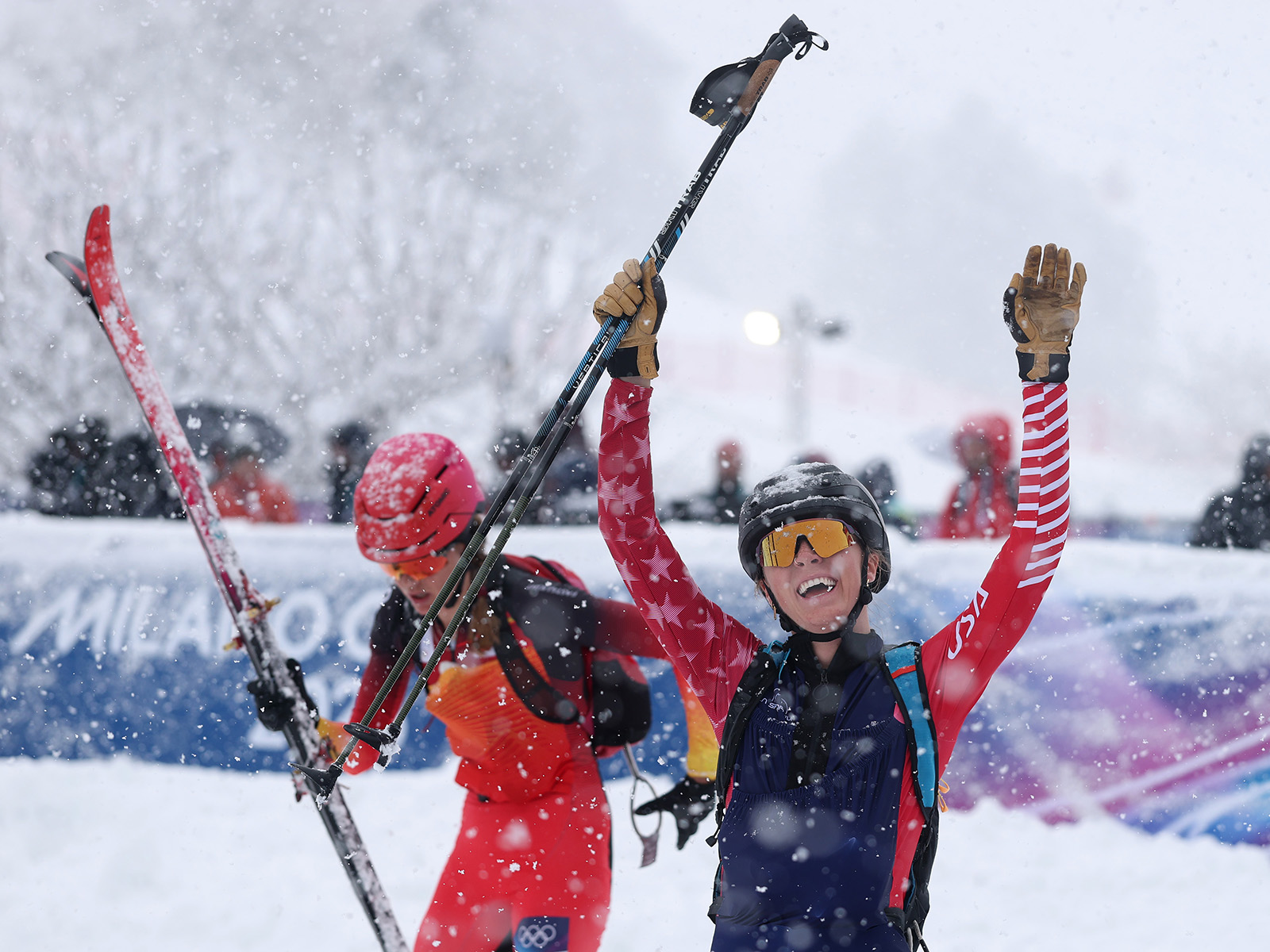
A former collegiate track athlete turned elite trail runner, Anna Gibson grew up skiing in Jackson Hole and brings a blend of endurance and downhill ability to the sport. “She was a collegiate track runner,” Henderson says. “She grew up skiing, so she’s got a ripping downhill, and then she’s got this lung.”
That combination matters more than many people realize. While skimo looks like an uphill sufferfest, Henderson says races are often decided on the descent and in transitions. “If your transition is fast and you can ski downhill, that’s where you see separation,” he says. Gibson’s ability to pair endurance with technical skiing helped her earn ninth place (out of 12) in the women’s sprint semifinals.
The ski mountaineering mixed relay will take place on Saturday, February 21 at 5:30 a.m. Watch it live on Peacock.