


The Local newsletter is your free, daily guide to life in Colorado. For locals, by locals.
You need only take a spin around the city to see that pickleball isn’t just a passing trend. Every week, it seems like there’s a new court cropping up in a city park or a trendy indoor facility with burgers and a full bar breaking ground. And as the number of pickleball courts in America approaches 16,000, manufacturers are churning out more balls to sustain the fever—roughly 500 million each year. But as any pickleball player with a mean overhead smash knows, those neon green orbs don’t last forever.
Some 77 million pounds of discarded pickleballs wind up in landfills annually. And since they’re typically composed of plastic compounds like polyethylene, they take more than 100 years to decompose.

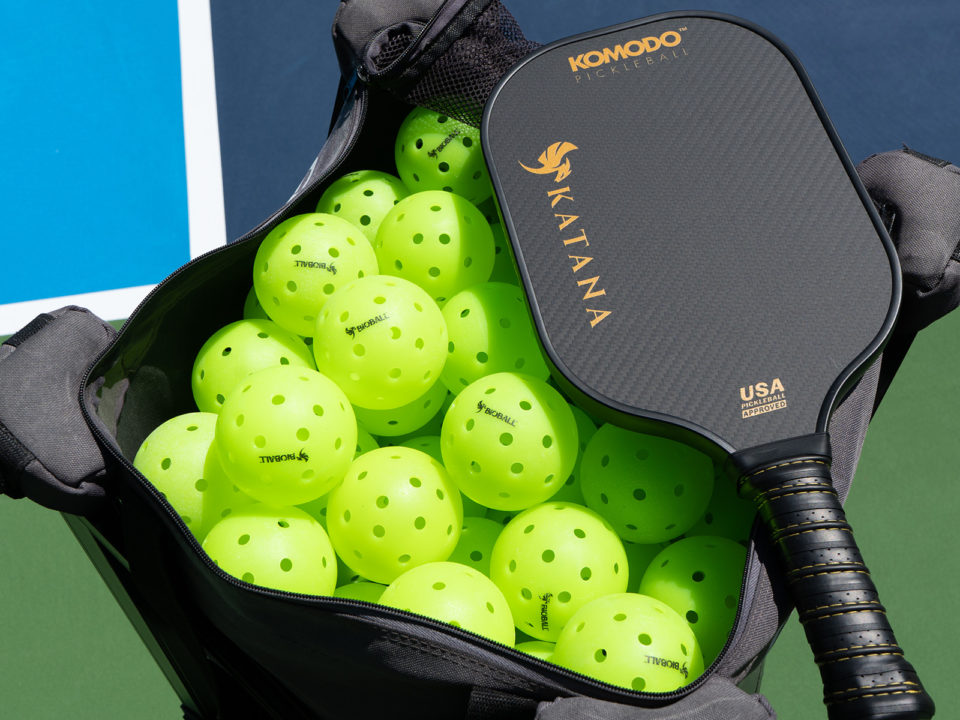
Grand Junction’s Komodo Pickleball doesn’t want your pandemic obsession to become your great-great-grandchildren’s problem, which is why it developed the BioBall. According to founder Dave Milo, the BioBall—made with biodegradable materials and a proprietary additive that enzymes already present in landfills eat—breaks down completely in just three to five years.
The BioBall looks no different than a traditional pickleball. With 40 small holes for stable flight and reliable bounce, the highlighter green ball is designed to play well both inside and outside. A pack of four retails for $20 on Amazon, or you can buy them direct from Komodo’s website and score a bag of eight for $29. (For comparison, a 12-pack of Selkirks on Amazon is $35.)
Milo came to pickleball through the tennis pipeline; nearly everybody in his hometown of Santa Barbara, California, grew up mastering their moonballs. After Milo moved his family to Grand Junction in 2007, he opened a tennis racket and stringing facility while also playing the sport competitively from 2015 through 2021.
But during the pandemic, the entrepreneur watched as tennis was usurped by a new darling of the racket sports world: pickleball. “With tennis kind of flatlining, it was a smart move to launch into pickleball,” he says.
He did just that in 2020 with a line of paddles followed by traditional balls, bags, and apparel. By the end of 2021, he had completely phased out the company’s tennis products and shifted entirely to pickleball gear. But as Milo watched the sport explode, he grew frustrated that nobody was developing products that played nice with the Earth. So, he teamed up with one of his longtime tennis mentors and owner of Babalot USA, who was tinkering with an eco-friendly tennis ball during his pandemic-unlocked free time to see if the same could be done for pickleball.
“First, my mentor and I started with finding the right manufacturer—someone who has been in the [ball sports] industry a while,” Milo says. “Then, testing took place with the formula several times to get the perfect ball that would withstand various climates and elevations.” By November 2024, Komodo’s first BioBalls were ready to volley.
One of the trickiest aspects of creating a sustainable pickleball was not sacrificing play for the planet. After all, what good is an eco-friendly ball if players go through double the amount due to cracks, deformities, and general wear and tear? While a traditional ball will last roughly 10 casual games (or one to three for more aggressive play), a BioBall can withstand a whopping 60 matches, Milo says. That’s because Komodo’s ball is made via rotomolding (heating and rotating plastic resin into a desired shape) rather than injection molding (injecting hot plastic resin into a mold and letting it cool). Most mass-produced pickleballs are made through injection molding, but rotomolding produces a more durable ball with even thickness. Komodo adds its proprietary sustainable additive during the heating and molding process, which doesn’t affect the ball’s performance, Milo says. During the BioBall’s test trials, not a single one cracked or lost its shape.
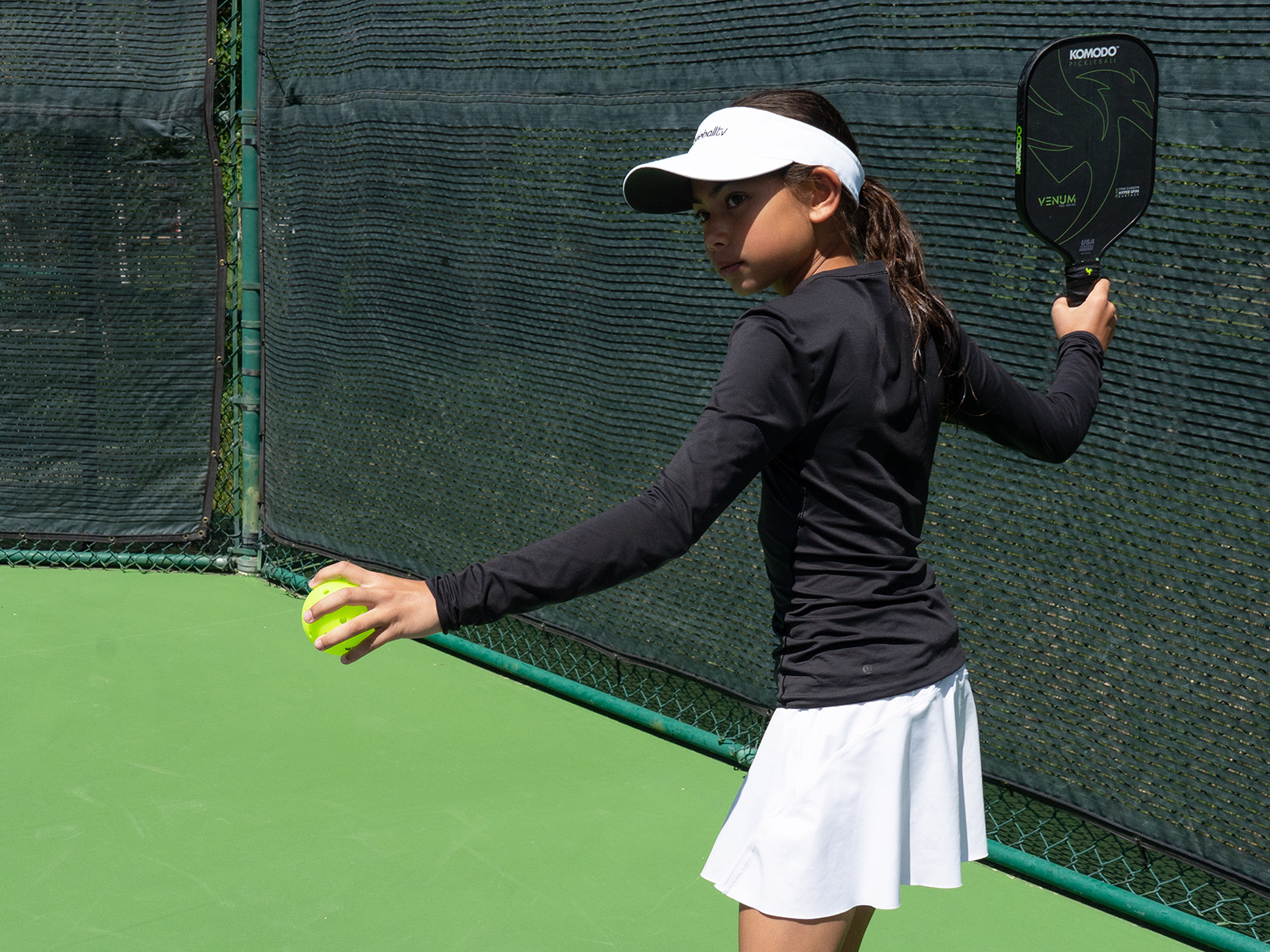
They’re also designed to play with a softer touch at higher altitudes—a detail Colorado pickleball clubs are keen on. Alex Rebeiz, owner and executive director of Cascades Tennis Group at Aspen Meadow Resorts, was one of the first to offer the new BioBall on his courts. “It’s a no-brainer,” Rebeiz says. “We were thrilled to bring it in and push it with our youth pickleball program. We want to start the next generation playing at their peak performance and peak mindset of the environment, so we just started teaching all our junior programs with the BioBall. We are excited to transition with our other leagues.”
The Sonnenalp Club in Edwards, which just invested in six brand-new, fenced tournament pickleball courts, is also carrying Komodo’s BioBall. “We are a state-of-the-art facility and look to match that in our equipment,” says club pickleball pro Holly Traut. “We were definitely drawn to how sustainable it is—and we’ve also noticed it’s great for kids and beginners as well as advanced players. It’s a high-altitude ball for sure.”
The Centennial State isn’t the only area digging Komodo’s innovation. Although it’s only been in production for seven months, the BioBall is already available in Europe, South America, Australia, and New Zealand, Milo says. Denverites can find them on shelves at local retailers like Game-Set-Match, in addition to online, meaning that starting today, your drop shots and dinks don’t have to damage the environment any longer.