
The Local newsletter is your free, daily guide to life in Colorado. For locals, by locals.
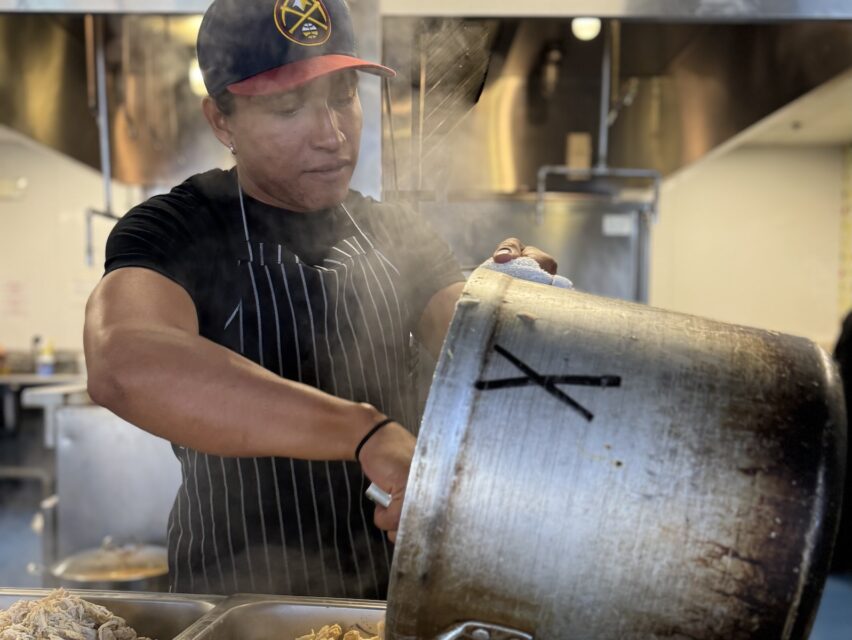
Byron Gomez arrived in the United States from Costa Rica when he was eight. As a teenager in New York City, he discovered a passion for cooking and steadily climbed the ranks of the finest kitchens, including Cafe Bouloud and Eleven Madison Park. He came to Colorado in 2019 and eventually became executive chef of Denver’s Michelin-starred Brutø in 2024. Over the years, Gomez’s perseverance has landed him a spot on Bravo’s Top Chef, numerous awards, and even an audience with Congress regarding Deferred Action for Childhood Arrivals (DACA). “Food has given me all of that. And now I give back,” he writes in a new cookbook featuring many immigrant chefs in Colorado.
Gomez’s immigration story is one of dozens shared in the pages of Sazón & Liberation, a new cookbook from the Cocina Libre team. Led by Julia Roncoroni, an associate professor of counseling psychology at the University of Denver, Cocina Libre is a collective determined to educate the public, strengthen community ties, and open doors for emerging immigrant chefs. Cocina Libre’s latest project, Sazón & Liberation, a collection of recipes and personal stories from 17 professional and burgeoning chefs from across Latin America and Ethiopia, hit shelves last month.
With funding from the University of Denver and the participation of several graduate and undergraduate students (who helped with production, event coordination, research, web design, and social media management), Roncoroni has also developed a forthcoming podcast and a documentary called Cocina Libre 2, which features five of the chefs who contributed to the new cookbook.
Some of Denver’s top culinary talents contributed to Sazón & Liberation, including Gomez, Manny Barella of Riot BBQ, René González Méndez of Xiquita, Edwin Sandoval of Xatrucho, and Dana Rodriguez of Work & Class, Carne, and Casa Bonita. The forward was penned by Xiquita chef and co-owner Erasmo “Ras” Casiano.
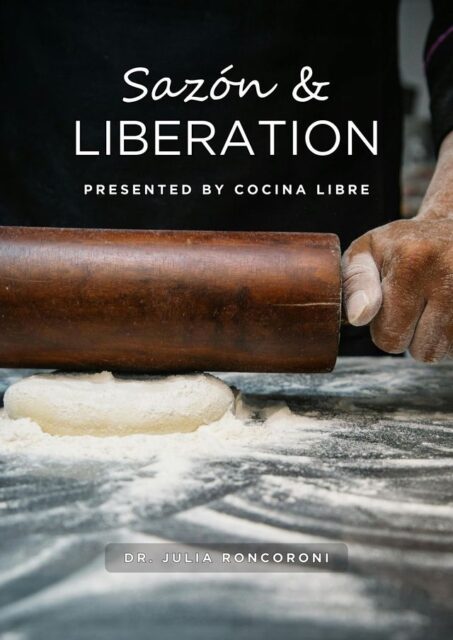
In the introduction to Sazón & Liberation, Roncoroni writes, “Recipes in this book are paired with chefs’ stories—not to romanticize or exoticize struggle, but to honor the people behind the food.” She notes that even efforts to empower immigrants can feel like an oversimplification. “Immigrant people crossed a jungle. They got on a train for five days not knowing if they were going to fall off the train. They didn’t have food for days. They’re pretty empowered already, so maybe what we’re here to do is learn from them and build community and a sense of belonging for all.”
The book is divided into four parts, each of which includes personal anecdotes as well as expert recipes for tacos, sopes, tlayudas, soups, pupusas, cocktails, and many other regional specialties. For example, Shiro on the Go chef Kidist Woldemariam shares her recipe for shiro wot, an Ethiopian chickpea stew that brings the heat through berbere, a traditional blend of chiles, coriander, garlic, ginger, and other spices. “I’m a little bit feisty, so when you get a little bit of berbere, it shows you my personality,” she writes.
Carlos Blanca, Salvadoran chef-owner of the Delicious Baruc food truck, faces a January 2026 deportation hearing, which he has been fighting since 2011. “People hear El Salvador and think about gangs, think bad things. But there are hardworking people, good people there, with talent,” he writes in Sazón & Liberation. “We just need to be given a chance. We just need the opportunity to show who we are.”
While sales of the first cookbook helped raise funds for the Colorado Immigrant Rights Coalition, Cocina Libre will use revenue from its engagements and the new book to fund professional culinary training and licensing for immigrant chefs via the Mi Casa Resource Center. “Civil rights without economic rights don’t mean very much. And so our goal here is also (to facilitate) that financial empowerment and financial freedom,” Roncoroni says.
Cocina Libre, as with any social movement, thrives as a group effort. “I think that the legacy of Cocina Libre lives in the collective,” Roncoroni says. “It lives in the relationships that are built between the chefs. It lives in the training of the undergraduate and graduate students who will hopefully continue to do community participatory work. It lives in the financial empowerment of chefs who are now able to open their businesses and are able to enter conversations saying, ‘No, you’re going to pay for my time if you want me to show up.’ And it lives in our children.”
Sazón & Liberation is available in English and Spanish on the Cocina Libre website and Amazon, and in local bookstores such as Boulder Bookstore and Tattered Cover. The companion podcast launches November 5 and episodes will be released every other week on the Cocina Libre YouTube channel and other podcast platforms.