
The Local newsletter is your free, daily guide to life in Colorado. For locals, by locals.
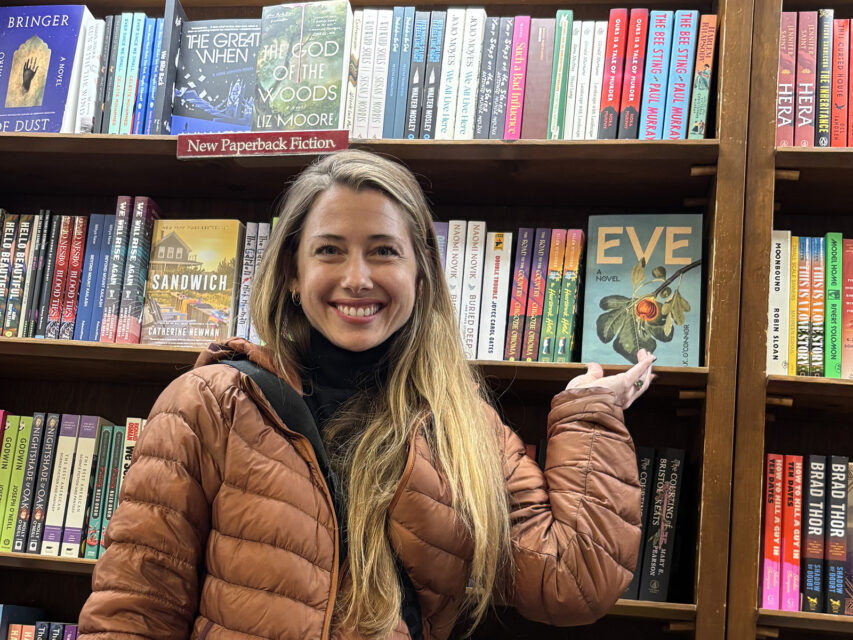
For longtime travel writer turned fiction author B.K. O’Connor, stories have never been meant for passive consumption. Instead, she believes they are designed for interaction; things to question, unravel, and maybe even reimagine. The Boulder-based schoolteacher and mom has spent years chasing stories, contributing to outlets like Backpacker, Fodor’s Travel, and Unearth Women. But her debut novel marks a more personal expedition: a return to Paradise Lost by John Milton, and the controversial biblical narrative that inspired it.
O’Connor’s relationship with the story of Adam and Eve is anything but distant. “I grew up in a multifaith household,” she says. “My mom was a Midwestern Christian woman, and my dad was an Israeli Jew. They divorced because of religion. My brothers and I were younger, so I had been exploring and [eventually became an evangelical Christian].”
When O’Connor encountered John Milton’s work in college, she began questioning and doubting the faith she had grown up with. Paradise Lost recounts Adam and Eve’s temptation and expulsion from Eden–crafted to examine free will, obedience, and the nature of good and evil. Milton’s portrayal of the first woman as less of a villain and more of a hero exposed O’Connor to a new way of understanding the story; an idea she couldn’t abandon.
These ideas followed her into early adulthood. “Working in ministry undid everything,” she says. Stepping away from her more rigid Christian beliefs at 21 allowed her to repair strained relationships with her Jewish family, and she is now at ease with her questions and discovering new ideas on her own.
That tension drives Eve, a bold retelling of the Bible’s Eve that reexamines a narrative long used to define women’s roles. Drawing on thinkers like Margot Adler, who argued that the story of Adam and Eve has profoundly shaped the subjugation of women in Western history, O’Connor challenges readers to reconsider what they’ve been taught about the fall of humanity. In doing so, she invites them into the same act of curiosity that has defined her: to question, to seek, and perhaps, to take the fruit for themselves.
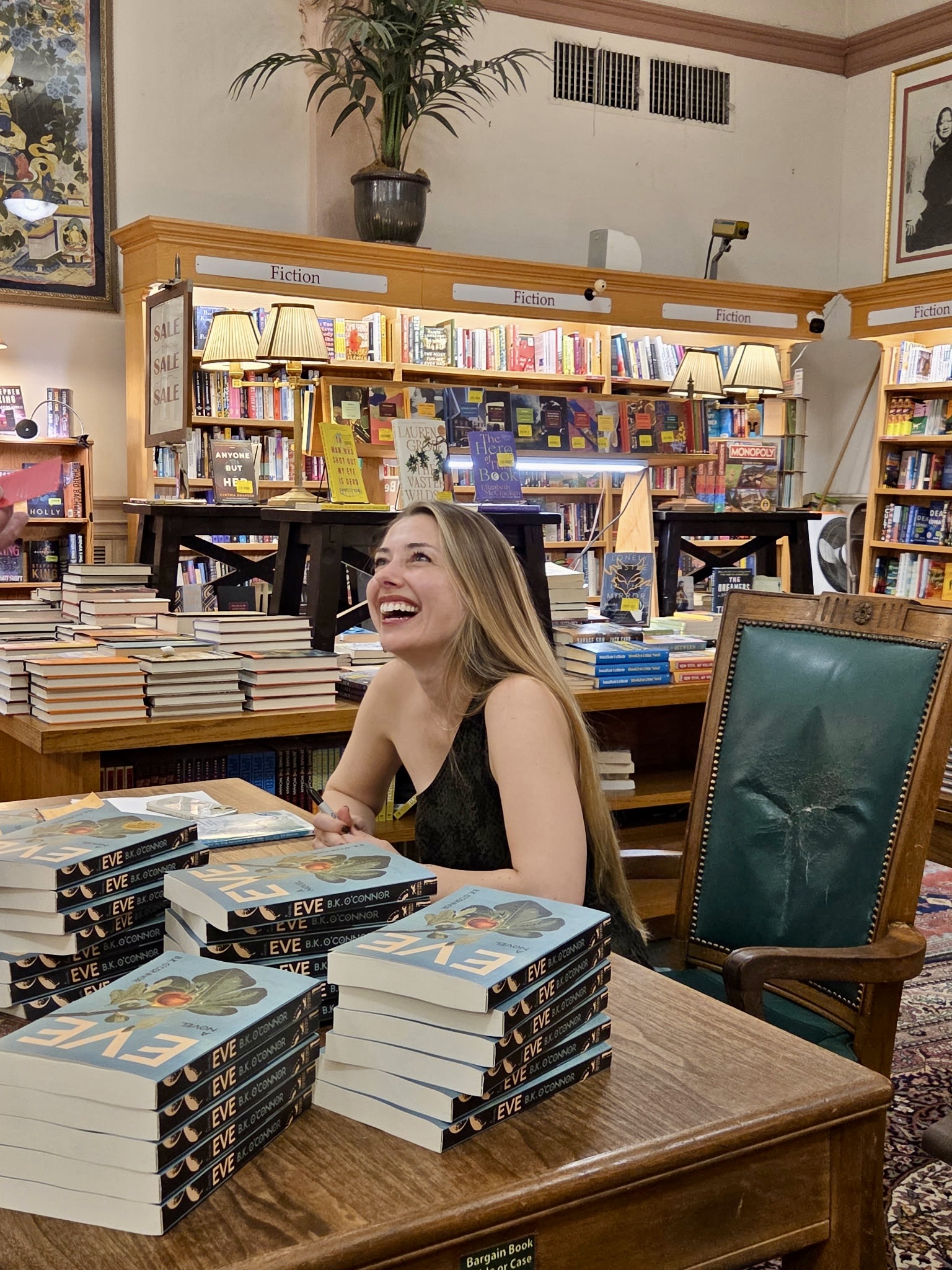
Editor’s note: The following conversation has been edited for length and clarity.
5280: How did you come up with the idea to rewrite Eve’s journey from Paradise Lost?
B.K. O’Connor: I took an undergraduate course about John Milton at the University of Texas at Austin. To satisfy the requirements for the English degree, you either had to take a Shakespeare course or a John Milton course. I had read plenty of Shakespeare in high school, and I had no idea who John Milton was, so I signed up for the course. It was life-changing. I had to memorize 90 lines, broken into two nine-week sections—45 lines each. I chose to memorize the part of Paradise Lost right before Eve took the forbidden fruit. The way Milton wrote those lines made it logically infallible for Eve to make that decision. It was a reasoned, discerned, morally correct decision to take the fruit because the fruit symbolizes the birth of human consciousness without knowing. I memorized those lines, and I spent a lot of time really playing those lines over and over again in my head with different intonations. They really became a part of my story.
My middle schoolers and I spend weekends at the library writing together, and so I imagined Eve, this fantastic superhero, who, when you viewed her with this power, glowed. This [novel] is a less fantastic version of that.
As you were writing this version and analyzing Eve’s character, do you feel like there was something missing in the original story?
In Genesis, all we know is that she ate the fruit, and later she had Cain and Abel, and that’s all we hear of her. Genesis and our Abrahamic reinterpretations of stories do have these gendered, moralized reinterpretations of those earlier ancient Sumerian stories. So the story of Genesis isn’t originally reliable. It’s actually a rewrite of this ancient Sumerian myth where a goddess comes down and offers fruits from the tree of knowledge of good and evil to mankind. It didn’t originally have this negative connotation that we attribute to them today.
So throughout time, we all began to blame women for this transgression. We have all of these calcified understandings of women as inferior to men from this story, which doesn’t even say that much. So in my book, I really wanted to humanize her and almost go back in time and undo some of the subjugation that women have experienced historically because of this narrative.
I was really angry at Eve for a long time too; it seems like she ruined everything. That’s the way that we are hearing the story is that she took something that was beautiful and she ruined it because she was curious. But that’s such an egregious misinterpretation of the story, because she didn’t have knowledge of good or evil. There was no context, and especially in Milton’s interpretation, before she even takes the fruit she has these questions. She has this hunger. It was in her nature.
Did any of Eve’s curiosity stem from your own life?
I think Eve’s questions were my questions. I think anyone who does find beauty in the context of religion does want to keep it, but then once you understand some of the nonnegotiable doctrines inside religion that you have to stomach to get your faith, that’s where you have to make a choice: digging deeper and seeking truth or blind allegiance. I chose digging deeper and seeking truth. If you think about it from the lens of a creator, my entry point here is being a mother, and I would never, ever give my children this manipulative test without an actual way to succeed. I would explain and I would be there with them.
What was the most challenging part about writing Eve?
I thought I was done when Adam and Eve were exiled, because I was just doing the retelling, and that’s how it ends. So then I was like, “This is only 40,000 words, and I think a novel is supposed to be 60,000.” So I started doing some research. I read this amazing book, The Rise and Fall of Adam and Eve by Stephen Greenblatt. He renders a lot of historical nonfiction texts relevant to biblical topics. I remembered he had a quote: “Well, Adam and Eve, they would have left, and they would have found Mesopotamia.”
This story is just beginning. And so of course, if you think about the non-biblical history, there would have been Mesopotamia, and Eden is kind of set in the same geographical region of the Tigris and Euphrates rivers. And so I rendered Eden as this fictional island in the northern Persian Gulf.
What was your thought process in publishing this book, knowing how deeply personal and often polarizing conversations around faith and gender can be?
I think in the beginning, like every author, I thought I was totally original. I thought no one had ever redeemed Eve before, and I will change the pathways that women experience. But I was relieved and humbled to know that this conversation far precedes me. Phyllis Trible was one of my favorite discoveries in this process, and her work reminded me so much of the lines Milton wrote. Before Eve took the fruit, she ate with discernment. She was the leader. She did not console her husband. She took the fruit, and she was the hero of humanity. She was saving humanity from an eternity of ignorance. In seeing the way that so many women before me have found that heroism in Eve, I didn’t feel as if I was some blasphemous heretic at the stake for my beliefs. I was actually just entering into this beautiful, heroic, pre-existing discourse about Eve.
Today, the story is more important than ever because of our political climate. I was on a podcast interview with this amazing woman, Meghan Tschanz, and in some of her research, she’s finding modern-day women disbelieving in their own ability to vote because they couldn’t trust their own discernment. This is our dominant political narrative, and we need to really understand and reinterpret this foundational narrative in order to change things.
Does this go anywhere? Is there another novel or more writing that you would want to do in this format?
So I actually have three other manuscripts totally done, because I never stopped writing with my students on the weekend. Milton has this short play called A Mask Presented at Ludlow Castle, and he was hired to write it to defend the purity of a family who was involved in a scandal, so I subvert that story entirely.
John Milton also did Samson Agonistes, which details the imprisonment of the once-mighty warrior Samson. I rewrote Samson as a female.
And then the last one is a rewrite of The Book of Thel by William Blake. I really love making literary analysis with the fiction I write. That’s where I am every morning because after that, I’m a mother of two small children and in school, so that’s where I get to exist. Joseph Campbell says everyone needs a space to create, and that’s where I exist as myself before I then exist for the rest of my waking hours.
What do you hope readers gain most from this story, whether they’re religious or not?
Eve’s battle is understanding what her limits actually are, and the heart of the story is that they don’t exist. Limits are social constructs built to control and oppress people, women and men, and that’s what she’s trying to discern. She’s the lioness who bares her teeth at monogamy, sexuality, God, morality. What I think a narrative like this can do is empower the reconsideration of these foundational texts and the way dominant narratives hold their powers by those who believe in it.
I hope readers understand that we need to rip this apart and rework it in a way that honors the humanity of all of us in an egalitarian way. That’s my teacher heart, it’s my mom heart.