
The Local newsletter is your free, daily guide to life in Colorado. For locals, by locals.
At one of the 20-some Denver March Powwows he has emceed, Lawrence Baker recognized a man among the crowd of 1,500 American Indian dancers and the throng of spectators. “Hey, Ronnie!” he shouted, before asking the man if his wife had ever forgiven him for driving off without her after a road-trip bathroom break. Once the laughter died down, Baker followed up: “So, what’s the lesson? Always check on everyone.”
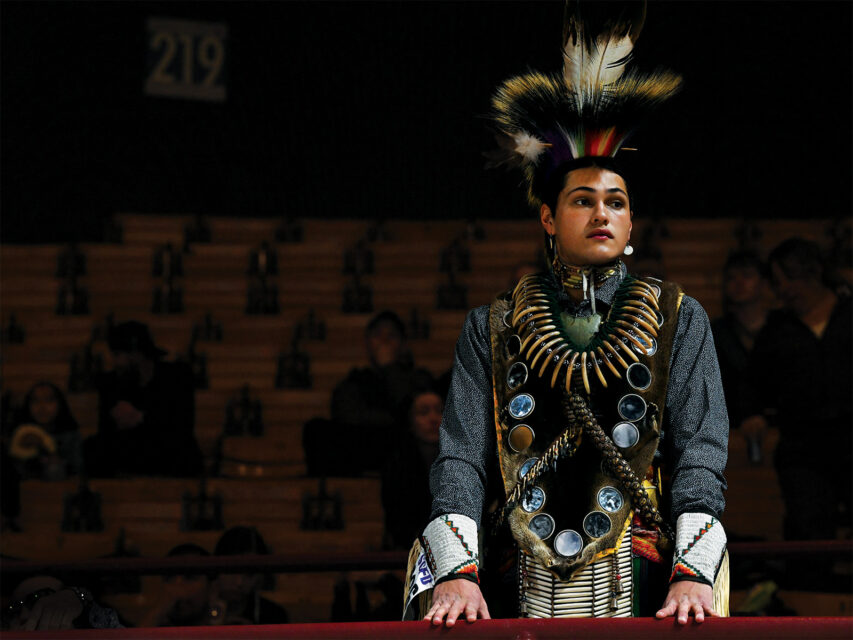
It’s this kind of comedian-style crowd work, mixed with neighborly familiarity and colloquial wisdom, that makes Baker, 58, of Four Bears Village, North Dakota, the ideal announcer for the March powwow, which celebrates its 50th installment this year. (It began in 1974 but skipped two years during the COVID-19 pandemic.) The powwow—which draws representatives from 100 tribes in 38 states and three Canadian provinces to the Denver Coliseum—marks the unofficial opening of the competitive tribal-dancing circuit, which stops everywhere from Pullman, Washington, to Pickett, South Carolina, and runs through November.

“It’s a major family gathering,” says Chico Her Many Horses, 73, of Lander, Wyoming, a powwow arena director who won his first dance contest at 13 and attended Denver’s inaugural event. “A lot of tribes view this as a homecoming. Denver March is the one big event that has that feeling, that oneness.”
The powwow (March 20 to 22) features a variety of performers, including jingle dancers, fancy dancers, traditional dancers, grass dancers, and chicken dancers. Baker clarifies that their outfits are not costumes. “ ‘Costume’ implies I’m going to put a Batman costume on for Halloween: ‘I put this costume on and become,’ ” Baker says. “I’m always Indian. Always Native American. Always Indigenous.”
Read More: Classic Denver
The Denver March Powwow traces its roots to an informal gathering in 1972, near the end of the U.S. government’s Urban Relocation Program, which encouraged 150,000 Native people across the country to leave reservations and assimilate into American cities. The difficult transition often led to unemployment, extreme poverty, and discrimination. In Denver, the nonprofit Indian Center helped families by organizing dance, fashion, and singing programs that evolved into the powwow. “The relocation program’s participants came from all over the United States, and a lot of them stayed here,” says Grace Gillette, the powwow’s 36-year executive director, who moved to Denver from Oklahoma City around the time of the first event.
A key voice will be missing from this year’s powwow. Chris Eagle Hawk, Baker’s co-emcee for a dozen years, died in December, at 78, near his South Dakota home. Whereas Baker’s style centers on jokes and stories drawn from life experience, Eagle Hawk was a longtime counselor who spoke with gravitas. “He was a major part of everybody’s life,” Her Many Horses says. “It’s going to take a while for us to work through all that stuff.”
Read More: The Feather
If you go: Tickets are $7 per day ($20 for the weekend) for ages seven to 59 and $3 per day ($9 for the weekend) for ages 60 and older; kids age six and younger are free.