


The Local newsletter is your free, daily guide to life in Colorado. For locals, by locals.
“That’s my jaaaaam!” Samuel Ramsey says into his mouthpiece as the room erupts into applause and laughter. He stops the YouTube video—of himself, belting out pop lyrics in Thai—playing on the big screen behind him and turns back to his audience with a little bow. Clad in a black blazer over a white hoodie, his hair bleached at the tips, Ramsey has the look of a captivating entertainer. Or maybe a singer or comedian. Few would guess this dynamic raconteur is a world-renowned entomologist.
Ramsey leads the Boulder Bee Lab at the University of Colorado Boulder, where he’s an endowed assistant professor of ecology and evolutionary biology. He’s also the founder and director of the Ramsey Research Foundation, a nonprofit that works with the lab on pollinator research initiatives around the globe. This July performance, held at a posh retirement community in Boulder, is a fundraiser for the National Geographic Society, which made Ramsey a National Geographic Explorer in 2022. The society honored him with its Wayfinder award for visionary scientists that same year.

Ramsey pulls up a black-and-white portrait of himself on the screen. The full-page photo appeared in National Geographic. “I went from a kid reading all these magazines in a fort to literally being in the magazine,” he says. “When I tell you I lost it when they told me, ‘The photographer who did Obama’s pictures is going to be doing yours….’ ” He raises his voice to be heard over the audience’s chuckles: “I was like, ‘Oh my…OK…uh…let me just get my poses together!’ ” He deleted the first email about receiving the Wayfinder award because he thought it was spam.
The decline of the western honeybee is making headlines these days, and for good reason: Its falling numbers threaten America’s ability to feed itself. Ramsey’s work to save the bees has made him a star in the global entomology community, but his ability to bring their plight to Instagram feeds, magazine spreads, and YouTube screens is what makes Dr. Buggs, as he’s known to his many admirers, such a rare specimen.
Ramsey wasn’t always so keen on bees. As a child growing up in Washington, D.C., he’d lie awake at night, imagining spiders and centipedes creeping through his walls and floor. He dreaded recess because it was outside—where the bugs lived. His parents intervened and took him to the local library, hoping that facts would cut through their son’s irrational fear. “I read this book and found out that these insects had the same motivations in life that I had,” Ramsey said on an episode of PBS Nature’s Going Wild podcast. “Crickets, katydids, chirping insects are out there making all of that noise because they are lonely. That hit me so hard as a kid.”
The more he read, the more he came to see insects as kindred spirits. Bees, for example, demonstrate cognitive abilities that vastly outsize their tiny bodies, yet they are feared, misunderstood, and undervalued. “I was always the smallest,” Ramsey says. “The littlest person in my family, and in all of my classes in elementary school. When you see these tiny little organisms, you recognize they’re pretty much the smallest animals out here. And they run the world.”
From then on, Ramsey’s direction in life was clear, but the road was not. Both of his parents were pastors and raised Ramsey to follow their church’s beliefs, prominent among them the view that homosexuality is blasphemous. While Ramsey flourished academically, he struggled to accept that he was gay; as a teenager, he sought out exorcisms to try to expel homosexuality from his body. It wasn’t until college at Cornell University that he finally realized his sexuality wasn’t something he could change. “I was still terrified, doctrinally, about: What if it is evil to be gay? And what if that means I’ll go to hell if I kiss a dude?” Ramsey says. While he was in graduate school at the University of Maryland, College Park, his church decided to re-evaluate its traditional stance on homosexuality. “They still determined, ‘No, we’re too uncomfortable with having a gay person,’ ” remembers Ramsey, who says he was excommunicated from the congregation.
At about the same time, in 2014, Ramsey’s graduate adviser kicked him out of his Ph.D. program. Her primary explanation? Ramsey wasn’t “doctoral material.” “As a gay Black man, I have spent a lot of time code-switching for people,” Ramsey says. “I was too gay for the Christians, too Christian for the gays. I have a lot of experience in very fundamentalist church settings just being too much for people. As a scientist, it seemed like there was something about the way I presented myself that was too much for the scientists.”
A nine-month appeals process saw him reinstated to the program, and the break proved serendipitous: To keep his wits sharp, Ramsey learned Thai (“because it sounded pretty,” he says), an asset that helped him land his first research project in Thailand before getting his Ph.D. in 2018. Ramsey also performed in a band called 24-7 with friends he met through a Queer Christian Fellowship Conference—where his mother now speaks annually. It took some very long, very hard conversations, Ramsey says, but both of his parents have changed their beliefs. Now, he just has to convince the world to care about honeybees.
Last winter, American beekeepers reported a loss of 62 percent of their commercial honeybee colonies. That followed a 55 percent loss the year before. The trend is potentially devastating, considering western honeybees propagate up to $15 billion worth of America’s crops, according to the U.S. Department of Agriculture. Research indicates that farms in the United States and Canada are already seeing lower yields because of the reduced bee population. Climate change and loss of habitat are big contributors to the decline, but the number one killer of honeybees are tiny, eight-legged pests called mites. “The average person wouldn’t know anything about these parasites,” says Madison Sankovitz, a postdoctoral associate at the Boulder Bee Lab, “but it has the potential to affect our entire food system in a very serious way.”
The Varroa destructor mite has plagued beekeepers for about 40 years. In grad school, Ramsey made a name for himself by writing a dissertation on the mite that upended conventional thinking about how the parasite feeds on honeybees. He found that rather than gorging themselves on blood, like ticks, the mites feed on bees’ fat body tissue, which functions like a liver to keep them healthy. The discovery opened new avenues for research into control measures, such as chemical miticides that are fat-soluble, to kill the mites before they replicate in colonies.
His dissertation, along with his newfound fluency in Thai, attracted the notice of the USDA’s Bee Research Laboratory, which in 2018 invited him to go to Thailand to study a new menace: a mite called Tropilaelaps mercedesae that is spreading across colonies in Asia at an alarming pace. Tropi is similar to Varroa but is smaller, harder to detect, and a faster breeder. The mite hasn’t been found in the United States yet, but the beekeeping community and other agricultural stakeholders are extremely nervous. “We should be more worried about Tropi,” says MiKayla Henry, lab manager at the Boulder Bee Lab. “I think it’s worse than the Varroa problem.”
The pandemic curtailed Ramsey’s research in Thailand in 2020, at which point CU offered him a professorship at the multidisciplinary BioFrontiers Institute. He had other offers, but CU sweetened the deal. “They jumped in and made it a part of my offer letter that my science communication is a part of my scholarly work,” Ramsey says. “Along with the research and the students I am teaching, I’ll be evaluated on the interviews I’ve been doing, presentations I’ve been giving, and the outreach I do at local schools as part of my scholarly work. I love that.”
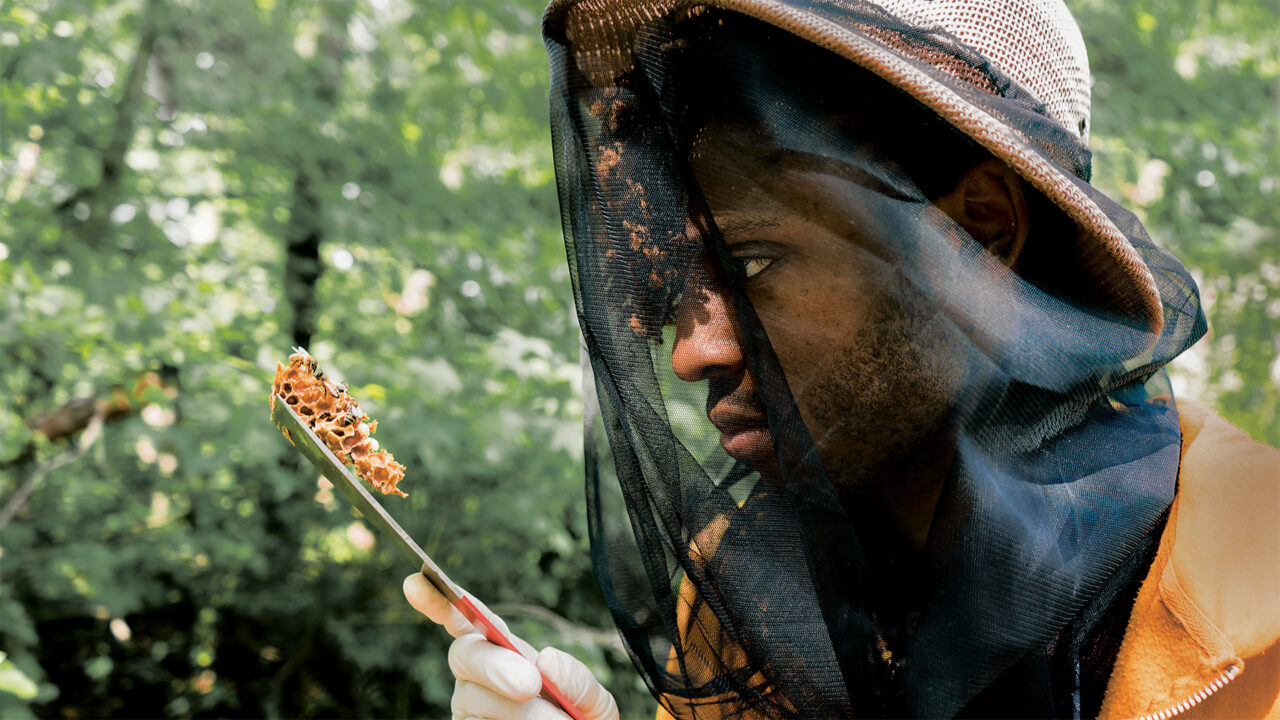
Founded in 2022, Ramsey’s Boulder Bee Lab looks like you’d think it would: There are microscopes and projector screens, shelves full of test tubes and specimen vials, cabinets crammed with bee suits, and stainless steel tables strewn with utensils. Just a few minutes’ walk away, 50,000 bees live in an outdoor hive. Without a doubt, Henry says, there are mites present in that colony, as well as in almost every other colony in this country. “The more you know about a pest like that—its life cycle and what it requires to live—the more you can tailor effective solutions to dealing with it,” Henry says.
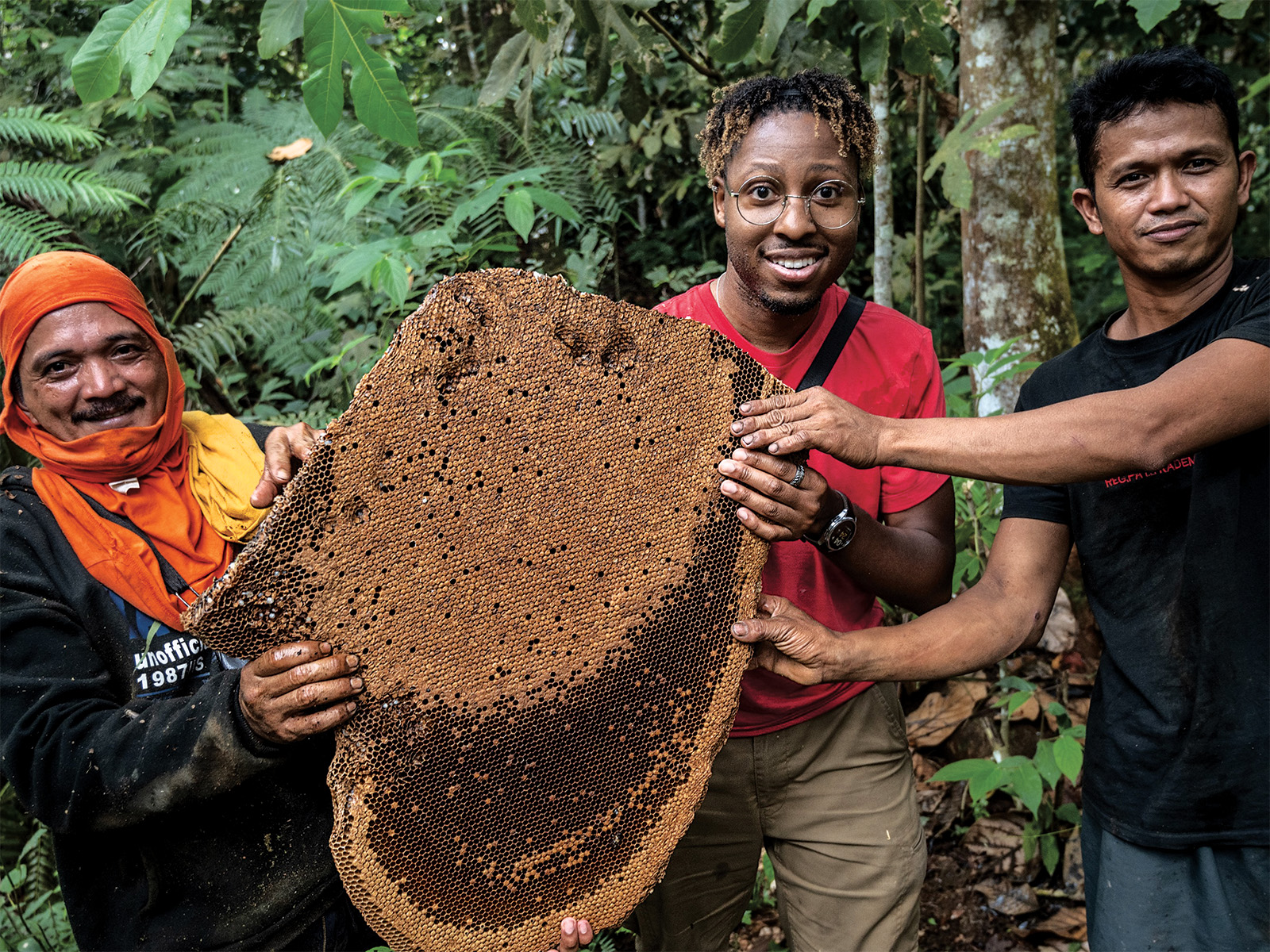
To that end, over the past couple of years, Ramsey and his students have been traveling across Southeast Asia to collect honeybees—and their parasites—as part of an initiative called the Honey Bee-nome Project. The goal is to gather every known honeybee species—there are 11, according to the Boulder Bee Lab’s criteria, all of which can be found in Southeast Asia—and bring them back to CU, where Ramsey and his team will sequence their DNA and RNA. These efforts will ultimately yield detailed genetic blueprints that illustrate how Tropi has evolved in Southeast Asia so that American beekeepers can have appropriate management protocols ready when the pests reach the United States.
Ramsey and his team have traveled to Taiwan, Mongolia, Singapore, Thailand, the Philippines, and Bangladesh, among other places. They hope to capture the final four species on their list by 2027. “Having this genetic data for all of these organisms will allow us to create this diagnostic system that can be used not just to look for Tropi,” Ramsey says, “but for all of the different viruses and parasites that we know bees have.” In theory, scientists across the world will be able to access and update the data, Ramsey says, so “we don’t have to worry every five to 10 years that a new bee apocalypse or pollinator pandemic is right around the corner.”

After clicking past his National Geographic spread, Ramsey talks the room through photos of his bee-finding escapades in various jungles—sheltering from the rain under giant banana leaves, enraging a colony of bees with a camera flash. He points out his students and colleagues in the audience.
Ramsey met one of them, Kathryn Naherny, on a trip to Thailand. A Ph.D. student and one of Ramsey’s advisees in the Bee Lab, Naherny has watched Ramsey give plenty of public presentations like this, from fundraisers to starring in an episode of Hulu’s Your Attention Please, a docuseries celebrating Black culture, science, artistry, and vision.
The publicity isn’t part of a grand plan to turn Ramsey into a superstar, Naherny says, but it is essential to his work. “The science isn’t finished until it’s been communicated,” she says, citing a mantra Ramsey often uses. “Seeing how Sammy can connect his personal story to the science really opens up a lot of doors for people who wouldn’t otherwise see themselves as researchers or scientists.”
His background also shapes other aspects of his work—the bits that don’t appear on YouTube. Sankovitz recalls a trip to a remote village in Thailand. Their driver prepared a meal for them consisting of “lots of meat that wasn’t really cooked,” Sankovitz says. Ramsey has a sensitive stomach but made sure to finish his plate. “Even at the most inconvenient moments…he makes sure people feel seen,” Sankovitz says, “and makes sure we are representing ourselves well abroad.”
Even if bees might benefit, Ramsey refuses to sacrifice his moral code. Collecting species from other countries entails lots of red tape. Before one expedition, Ramsey’s local contact suggested smuggling samples over a border and possibly bribing local officials. Ramsey canceled the trip. “When you start saying ‘the ends justify the means’ as a way of getting research done, it can take you down a really problematic path,” he says. “If you can’t do it by the law, then that’s not a project you can do.”
It’s taken Ramsey a long time to reconcile all the facets of who he is. But embracing his full self has only strengthened his professional life. “What’s allowed me to be so successful in the work I do is that I bring all that to the table in the lab,” he says. “It helps me make discoveries. It allows me to ask different questions and to pursue questions in a different way.” A decade ago, he was drowning in the nuances of existing simultaneously in so many spaces. Today, Ramsey embraces his complexity. “I am a multi-hyphenate minority, and that means that there is a lot going on with my identity,” he says. And the bees? They’re here for it.