

The Local newsletter is your free, daily guide to life in Colorado. For locals, by locals.
Back in the early 1990s—when Pat Craig began looking around northern Colorado for a piece of property that could accommodate his rapidly expanding menagerie of lions, tigers, and bears—space was the priority. Most of his charges had been rescued from private zoos, breeding mills, and squalid roadside attractions. Craig, the founder and executive director of the Wild Animal Sanctuary, was determined to provide them with room to roam and comfortable dens for the rest of their lives.
He found what he was looking for a mere 40 miles from Denver, outside the Weld County town of Keenesburg: cheap land, a rolling prairie surrounded by an ocean of wheat. “It was like The Wizard of Oz,” Craig recalls. “There were no power lines anywhere, no fences on the road.” And almost no people.

Over the past 30 years, Craig has built his nonprofit into the largest carnivore sanctuary in the world. By acquiring parcels of adjoining land as they became available, he’s transformed his original 160-acre spread into a 1,450-acre refuge sheltering more than 550 tigers, lions, bears, wolves, leopards, lynx, bobcats, coyotes, and other exotic animals (including the occasional camel and water buffalo) in species-specific habitats. But as the operation grew, so did the human population surrounding it. These days, the wheat fields flanking the sanctuary are only a few minutes’ drive from new housing developments sprouting like spurge on the outskirts of Keenesburg and Hudson.
In some instances, the qualities that drew Craig to this part of Colorado are the same ones that attracted his new neighbors. Jerry Springer, a longtime resident of southern Weld County, moved to a 10-acre property bordering the Wild Animal Sanctuary in 2013. “Every time a county or a city or a state wanted to pave the road in front of my house, I moved,” Springer says. “I would much rather hear a lion roar at night than an interstate highway.”
An attorney for the sanctuary recently described the place as “effectively the real-world equivalent of Jurassic Park.” None of its neighbors have ended up on the menu, but living across the road from hundreds of large, carnivorous critters is not without its challenges. Staff and volunteers feed the animals 110,000 pounds of meat, fruit, and vegetables every week, generating tons of beastly poo. On warm days, the stench puts the county’s dairy farms and cheese plants to shame. Thousands of seagulls, along with bald eagles, starlings, and other birds, snatch the leftover food and drop it on adjoining properties, resulting in sporadic rains of chicken carcasses and tomatoes as well as barn roofs coated with seagull excrement.
The sanctuary spends $20,000 a month during the summers just to combat flies. “You can keep killing flies every day, and you’ll never run out of flies,” Craig says. “It’s not like we’re not trying to mitigate this stuff. But without a glass bowl over this property, there’s no way to control all the wildlife.”
Springer found Craig and his maintenance crew to be quite responsive during the 10 years he lived next to the sanctuary. (He sold the property to Craig in 2023.) “Whenever I had an issue, I brought it to his attention, and he took care of it immediately,” Springer says. “I hold him in a real high regard, both as a neighbor and a friend.”
But not all the interactions between the sanctuary and those living nearby have been so genial. Craig has plenty of beefs of his own with loud, unruly, and, he says, “unrealistic” neighbors. He has skirmished with the occupants of a short-term rental who he says held hard-drinking bonfire parties well into the night, harassed the animals with flashlights and loud music, and hurled beer bottles into a bear habitat. That property was later acquired by a firearm enthusiast who invited friends over for target practice, creating a racket loud enough to frighten sanctuary visitors and send bears galumphing to their dens.
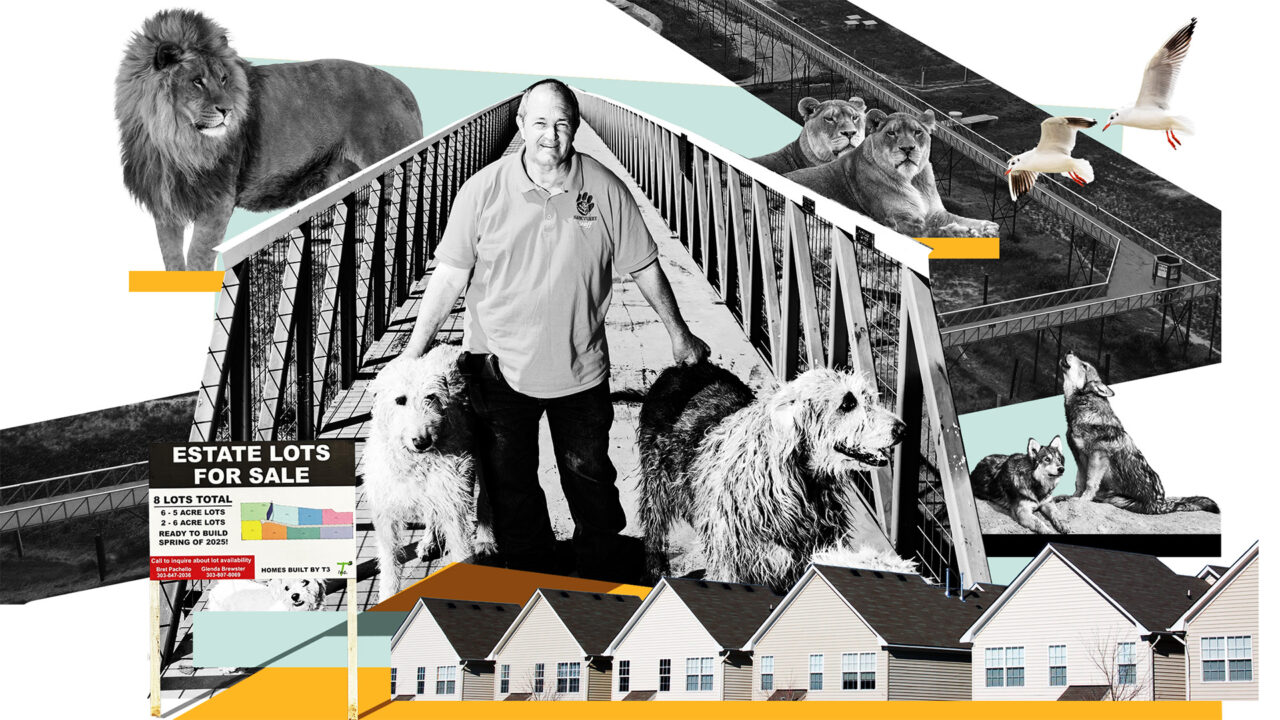
Yet the greatest threat to his sanctuary, Craig says, comes from a 42-acre plot along its back end that’s slated to become an eight-home subdivision. Fifteen years ago, the Wild Animal Sanctuary and the property owners reached an agreement on how the development would proceed. But nothing happened—not until early 2025, when signs appeared advertising lots for sale. The developers made it clear, Craig says, that they would not honor the earlier contract. The sanctuary took them to court this past fall.
The dispute has added urgency to Craig’s efforts to create a buffer zone encircling the Wild Animal Sanctuary, even as exurban growth reshapes the landscape along the booming I-76 corridor. Weld now ranks as the fastest-growing county in the state. What was once the middle of nowhere is suddenly the edge of somewhere, a transformation Craig has dreaded for some time. “We know we’re going to be surrounded,” he says.
There are people in Weld County who believe Craig has exaggerated the threat to boost donations and direct the formidable wrath of animal lovers at those who oppose him. “It is no secret that Pat Craig has a distaste for neighbors over whom he has no control,” an attorney for the developers wrote in one court brief.
Craig insists he’s worked diligently over the past three decades to forge good relationships in the community but admits he’s not about to surrender the safety of his sanctuary to the whims of a homeowners association. “If I truly didn’t believe that we were going to have trouble, I would never have gone this far with any of this stuff,” Craig says. “But I am absolutely convinced that this will be a major problem if we can’t get a resolution.”
Craig stumbled upon what would become his life’s work shortly after graduating from high school. It was 1979, and Craig, who grew up on a farm north of Boulder, had taken a trip to South Carolina, where a friend who worked at a zoo introduced him to the place’s “surplus” big cats. Because of overbreeding or aggression, the animals had been deemed unsuitable for exhibition and were confined to small cages, awaiting euthanasia or placement elsewhere.
Craig was haunted by their bored, defeated gazes—stunned that such magnificent creatures were living in tiny boxes and waiting for death. He figured he might be able to save a few.
Only 19, Craig obtained licenses to operate a rescue facility for carnivores on his family’s farm. He read what he could about exotic animal welfare from books he checked out at the local library, but much of his training came from hands-on experience. Not content to simply accept zoo surplus, Craig started working with wildlife officials to shut down illegal breeders and hoarders, retrieving sickly, traumatized, or simply unwanted exotics from mobile homes, basements, crawl spaces, and other cramped quarters.
The Wild Animal Sanctuary outgrew the farm after about five years and moved to leased land near Lyons before relocating to its current home in Keenesburg in 1994. Operating on a shoestring, Craig found innovative ways to supply his burgeoning pride with food and medical care. He took in donated perishables from grocery suppliers and operates his own fleet of refrigerated trucks that collects discards from about 125 Walmarts across the country. He used concrete conduits salvaged from highway projects to create dens, providing shade and shelter. He recruited volunteers eager to keep the habitats in shape and serve up truckloads of melons, fish, and frozen turkeys.
Supporters urged Craig to open the sanctuary to visitors. They argued letting the public in would broaden the donor base and put the nonprofit on sound financial footing as well as help educate the public about the captive wildlife crisis. Craig resisted at first, mindful of how strangers might upset his furry friends. But he reluctantly unlocked the doors in 2001—only after posting signs warning that the sanctuary is “a home for animals, not a zoo for people.” The Wild Animal Sanctuary later constructed a 1.5-mile walkway 35 feet above the habitats that allows visitors to observe sunbathing animals at a respectful distance.
Opening to the public proved to be the turning point in the sanctuary’s struggle to survive. Before long, the place was drawing close to 200,000 visitors a year. It was so popular that management raised the price of admission from $15 to $30 to now $50 ($30 for a child), a decision Craig says helped weed out an ill-behaving “zoo crowd,” encouraged serious visitors to stay longer, and boosted revenue.
Eighteen years ago, Craig’s quixotic nonprofit had a $1.3 million annual budget. By 2024, its yearly revenue had grown to $36.4 million. It now has more than 100 full-time employees, including several veterinarians. Craig, who declined to collect a paycheck during the sanctuary’s early years, receives a salary of $270,000 (the organization’s board of directors determines his pay). The financial success has allowed the Wild Animal Sanctuary to tackle projects that its founder could not have imagined a decade ago: rescuing bears whose bile was being harvested for herbal medicines in South Korea, relocating dozens of big cats stranded by the collapse of Joe Exotic’s grim private zoo in Oklahoma, and finding good homes for four-legged survivors of a 2017 hurricane that demolished a Puerto Rican zoo.
Although landlocked in Weld County, the sanctuary has established two other facilities in more remote areas of the state in recent years. One is a 23,000-plus-acre wild horse refuge near Craig, a place for hundreds of mustangs that otherwise would end up in government pens thanks to a controversial federal plan to sharply reduce the size of the herds on overgrazed public lands. The other is a 9,700-acre expanse in southeastern Colorado that offers wide-ranging habitats for animals that require less care than those in the original sanctuary. (It is not open to the public.) The nonprofit has also spent millions of dollars buying up properties adjoining the Keenesburg facility—no easy feat, given the increasing market pressures on developable land along the I-76 corridor.
Between 2020 and 2024, Weld County added 40,759 new residents, more than any other county in Colorado. Oil and gas and manufacturing jobs have been part of the story, but the major driver of population growth has been an influx of commuters searching for housing that’s more affordable than what’s available near Denver. “We have less red tape, less hoops people have to jump through in order to build homes,” says county commissioner Kevin Ross. “It’s kind of the urban sprawl, but they’re choosing Weld County because of less intrusive government and things of that nature, is what they’re telling us.” The county’s current population of around 375,000 is projected to almost double in the next 20 years.
Weld has a Right-to-Farm Statement in its code ordinances, informing newcomers that they might encounter disagreeable noises, smells, and other impacts from nearby agricultural operations. Technically, the Wild Animal Sanctuary qualifies as one of those we-were-here-first enterprises, since state and federal agriculture agencies regulate the keeping of exotic animals. But Ross points out that locals also have a right to stop farming and sell their land to developers if they choose. That option has been a popular one in the Keenesburg area, where four-bedroom houses priced at less than $500,000 huddle in spanking new subdivisions with names like Vista West that advertise a “quick move-in,” “rural charm,” and “close proximity to Fort Lupton, Brighton, The Wild Animal Sanctuary, and Denver International Airport.” Keenesburg’s motto is “Home of 500 Happy People and a Few Soreheads.” But its current population is now around 2,000, with twice as many new residents expected if various proposed annexations and additions come to fruition.
Differing expectations of what “rural charm” might involve has doubtless contributed to the tensions between the sanctuary and its neighbors. After years of living in a trailer with his German shepherd, Vancil McAninch bought a house in Fort Lupton before realizing he needed more space. He purchased a five-acre property next to the Wild Animal Sanctuary in 2023. Vancil took advantage of the relative remoteness of his new home to host target-practice sessions with friends. He says he didn’t realize anyone had a problem with the gunfire until sheriff’s deputies showed up at his door in 2024 in response to a complaint from Craig.
An officer inspected Vancil’s weapons and targets and told him they were perfectly legal. Nevertheless, Vancil reflected on how loud and disruptive the sessions could be and decided to curtail them. Amy McAninch, whom Vancil married in 2025, confirms the shooting parties ended before their nuptials. Still, that summer, Craig aired complaints about McAninch in the sanctuary’s newsletter, which, the couple says, led to them being vilified on social media. “Granted, before I moved into that property, those boys were a little buck wild,” Amy says. “But the biggest problem is just the false accusations right now.”
Neither Vancil nor Amy has ever spoken to Craig. “I’ve never even seen the guy,” Vancil says. “At this point, I would just really like to understand what he would like from me, for him to be comfortable with me living here. Because I’m not trying to be, like, that guy. But this is also my own property, too. I got to stand my ground somewhere.”
This past May, the Wild Animal Sanctuary posted an “urgent call for help” on its Facebook page. The long-anticipated subdivision was finally moving forward, but the developers were “ignoring all of our efforts to contact and work with them,” the message said. As a result, the sanctuary was “in dire need of an attorney that can help protect the animals.”
The developers in question were former Weld County residents Sherry Wigaard and VeLois Smith. In 2010, they had agreed to certain conditions sought by the sanctuary, including construction of an eight-foot privacy fence and setbacks separating the properties, in exchange for gaining support from the Wild Animal Sanctuary as the project went through the county approval process. They had also agreed to give the nonprofit’s executive director—Craig—a seat on the homeowners association board. Now, according to Craig, they would not comply with the contract.
Supporters of the Wild Animal Sanctuary responded with offers of legal representation and hisses for the developers, who were denounced as “monsters,” “simply greedy,” and “money grubbing.” Wigaard and Smith, who moved to Florida several years ago, claim the social media onslaught resulted in death threats. (Amy McAninch says sanctuary supporters have also threatened to pour gasoline into the subdivision’s well, which serves the McAninch property.) In a court filing challenging the validity of the agreement, the developers’ attorney lamented “years of Pat Craig’s constant beratement and mistreatment” of his “legally unsophisticated” clients. (Craig denies ever being less than cordial in his conversations with Wigaard and Smith.)
Last fall, the parties reached an agreement. The contract would be enforced. Craig will join the HOA board until every owner has moved into the subdivision; after that, the sanctuary will send an adviser to the board. Prospective buyers at Wigaard Smith Estates will be required to take a physical tour of the property and sign a disclaimer stating that they “are fully aware and in complete acceptance of the sounds, smells, dangers and other potential issues that may exist with a wild animal sanctuary being located adjacent to the Subdivision they are choosing to move into.”
The deal that was struck will allow the project to proceed while insulating the sanctuary from nuisance lawsuits. “The sanctuary’s only concern was making sure the development took place without negatively impacting the animals,” says J. Kirk McGill, an attorney for the Wild Animal Sanctuary. “There are no bad actors in this arrangement.”
The attorney for Wigaard and Smith, whose subdivision has yet to begin construction, declined to comment, other than to second McGill’s description of the outcome as a reasonable one for both sides. Craig says he’s tried several times to buy the property, including a recent offer of $2.8 million (about $67,000 per acre), only to be rebuffed. The median price of an acre in Weld is around $17,000, but what the sanctuary can afford to pay for raw land falls short of what the property is worth with roads, sewer lines, and other improvements.
Craig remains hopeful. “I think the controversy alone will slow down sales, and at that point there’s more motivation for them to sell to us,” Craig says. “I don’t mind if people moved in and were just absolutely realistic. It wouldn’t bother me a bit. But they never are. There’s always somebody that complained. Always.”
Read More: At Home on the Range