

The Local newsletter is your free, daily guide to life in Colorado. For locals, by locals.
For more than a century—aside from an occasionally fierce football rivalry—Colorado and Nebraska have been friendly neighbors. But in recent months, the amicable relationship has turned sour, with the source of acrimony being a resource every western state desperately needs: water.
The South Platte River Compact has governed the rights and uses of water between Colorado and Nebraska since 1923, and that legal document has been enough to stave off major disputes between the two states for more than 100 years. But this neighborly bliss ended in July, when Nebraska sued Colorado, claiming the Centennial State is interfering with its plans to build the Perkins County Canal—a conduit that would siphon water from the South Platte River near Ovid, Colorado, and send it to the Cornhusker State.
Nebraska’s right to build the canal is written into the original compact, though state officials have never pursued it. But after a drought in 2022, they began reexploring the canal project and discussing the logistics with Colorado officials. In the lawsuit, which is being reviewed by the United States Supreme Court, Nebraska accuses Colorado of “diverting water rightfully belonging to Nebraska.”
In a response brief to the Supreme Court earlier this month, Colorado Attorney General Phil Weiser called the claims “unripe and premature,” arguing the court shouldn’t bother taking the case because Nebraska hasn’t engaged in “earnest discussions” with Colorado about its concerns. In a press release, Governor Jared Polis offered his own assessment, referring to Nebraska’s complaint as “a meritless lawsuit that threatens Colorado’s precious water resources, our robust agriculture industry, and our rural communities in northeastern Colorado.”
So, how did we get here? And what happens now? Ultimately, the Supreme Court will decide, but we examined the South Platte River Compact and the history of the canal project to better understand how good neighbors became so entrenched in a legal standoff.
What Is the South Platte River Compact?
The agreements that govern the Western states’ water are nearly as vast and complex as the river systems themselves. When Colorado and Nebraska lawmakers inked the South Platte River Compact in 1923—an agreement ratified by the U.S. Congress—they laid a framework for managing the 439-mile waterway that begins in the Mosquito Range west of South Park and flows into western Nebraska before joining the North Platte River.
The compact exists to answer questions of who gets water and, critically, when they get it. During the irrigation season (April 1 to October 15), the compact states that if water is flowing across the state line at a rate lower than 120 cubic feet per second, Colorado must curtail water use to guarantee higher flows into Nebraska. Sounds simple? It’s not.
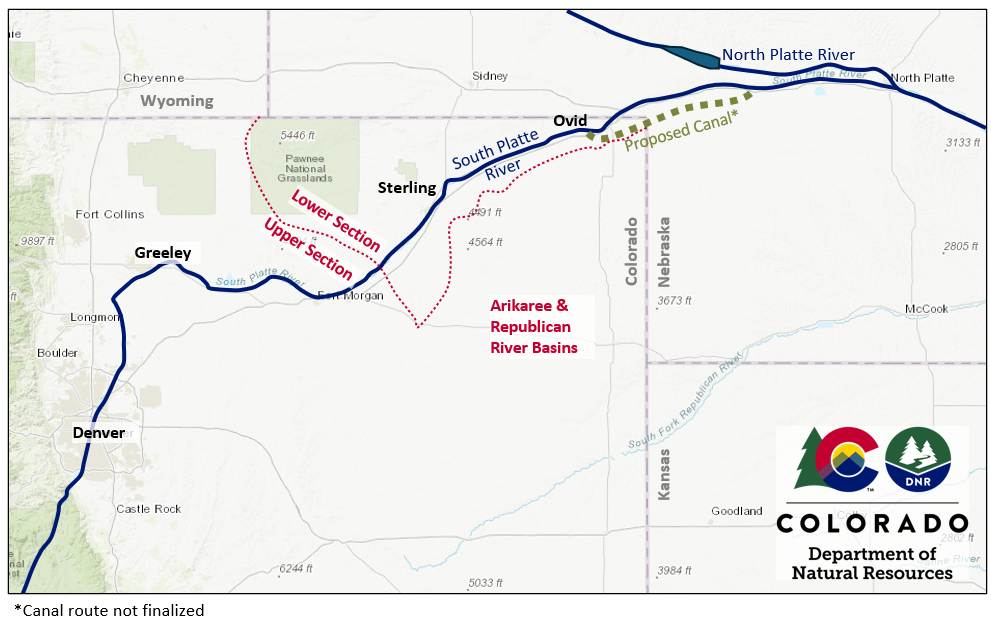
First, the South Platte is divided into “upper” and “lower” sections via the compact. The upper section—which refers to all water in the mountains of Colorado, the metro Denver area, and everything west of the Washington and Morgan county lines—can never be restricted, even if flows are lower than 120 cubic feet per second. In other words, the compact governs the river’s lower section.
Within the lower section, water rights are determined by a prior appropriation system. Essentially, whoever diverts water from the South Platte (and goes to court to confirm their use), has “priority,” making them a “senior right” holder. Users—which can be states, citizens, water districts, or businesses—with the earliest appropriation dates have senior rights over junior users, and river compacts exist to ensure those rights are respected.
Agricultural users and water districts along the South Platte obtained rights at varying dates—many of which predate the South Platte River Compact. But according to the compact, Colorado users who acquired their water rights after June 14, 1897 must curtail their usage during the irrigation season. Why that date? Because the Western Canal, in Nebraska, acquired South Platte water rights in 1897. The compact also allows Nebraska to condemn land in Colorado and build a canal to access more water during winter months, which is precisely what set off today’s controversy.
Where Did the Canal Project Come From?
Though it’s fueling a legal battle today, the concept of the Perkins County Canal is hardly new. In fact, it’s written into Article VI of the South Platte River Compact, which allows Nebraska to use eminent domain to acquire private land in Colorado, construct a canal, and divert flows of 500 cubic feet per second into Nebraska during the winter. The first 13 miles of the canal would be in Colorado, with about 50 additional miles running to undetermined reservoirs in Nebraska.
But even if Nebraska does build the Perkins County Canal, it doesn’t guarantee the state an eternal spring. The water rights date for that canal, should it be built, is December 17, 1921 (the year Nebraska officials first considered building a canal), meaning some water users in Colorado would still have a senior priority and could divert water before the canal does. Moreover, if the canal were to be built, it would trigger a clause in the compact guaranteeing Colorado an additional 35,000 acre-feet of water to be stored in a new reservoir or existing recharge ponds. So, before Nebraska could divert any water through a canal, it would have to get in line behind Coloradans.
That’s one reason the canal has not been built in the past century. The other reasons have to do with significant logistical and financial hurdles. According to a story from the North Platte Telegraph, Nebraska’s natural resource planners explored building the canal again in the early 1980s, but “the big issue facing the project [was] financing.”
Jim Yahn, a Logan County commissioner and former member of the Colorado Water Conservation Board, says there wasn’t much discussion of the Perkins County Canal until 2022—a year of severe drought in both Colorado and Nebraska. Around that time, Yahn says, Colorado water managers were updating the Colorado Water Plan, which included proposals for several large-scale projects. Some of those—like a plan to divert water from the South Platte near Sterling for Douglas County suburbanites and northeastern Colorado farmers—are specifically mentioned in Nebraska’s lawsuit.
“We felt the drought just as much as they did,” says Yahn, who manages the North Sterling and Prewitt Reservoirs. “We were coming up with big ideas, and Nebraska got spooked.”
With agricultural users struggling on both sides of the state line in 2022, Nebraska lawmakers revived the canal idea. Officials from Nebraska’s Department of Natural Resources did not respond to 5280’s request for comment, but according to Yahn: “Nebraska was looking at it saying, ‘If we have the ability to build this canal and demand some water from Colorado, we should probably do that.’”
In the years since, Nebraska’s state legislature has approved more than $600 million in funding to build the canal, but they’d only just begun the planning process when negotiations halted and the state sued Colorado.
Did Colorado Break the South Platte River Compact?
If you ask state officials about the matter, Colorado has been nothing but a good partner to its northeastern neighbor.
“Colorado has not interfered with Nebraska’s ability to build the Perkins County Canal—in fact, Nebraska hasn’t taken any steps toward building the canal that we could obstruct,” says Jason Ullmann, Colorado’s state engineer and director of the Division of Water Resources. “On the contrary, we were engaged in discussions about how Nebraska might build the canal as contemplated in the compact when Nebraska surprised us with this premature filing with the Supreme Court.”
In its filing, Nebraska alleges Colorado is trying to disrupt its efforts by threatening legal action if Nebraska were to condemn land in eastern Colorado for the canal. Nebraska began the process of acquiring land in January when it sent letters to six Colorado landowners offering to buy their properties or else use eminent domain, and Attorney General Weiser responded by promising legal action against Nebraska if it followed through. These land deals never came to fruition and no Colorado property has been seized for the canal, but to Nebraska, Weiser’s legal threat amounted to obstruction.
The filing also accuses Colorado of illegally diverting and reducing what water might be available if Nebraska successfully constructs a canal—a charge Colorado also denies. “Despite Nebraska’s assertions in their filing, for over 100 years the Colorado State Engineer’s Office has worked with Nebraska and performed the hard work of ensuring Colorado meets its compact obligations on the South Platte River,” Ullman says.
What Happens Next?
The Supreme Court has until the end of its term—late June or early July in 2026—to decide whether or not to hear Nebraska’s case against Colorado. If it decides not to take the case, as Colorado is urging, the two states will have to work with each other to reach a resolution in the near term. That would likely lead to renewed negotiations between the states about the Perkins County Canal project, but until the Supreme Court makes a decision on hearing the case, they won’t be speaking about it.
If the Supreme Court does hear the case, as Nebraska has asked, things will get even more complicated. Typically, the court appoints a special master to hear a case that involves interstate water compacts, and it can be many years before it is ever resolved. (A recent case in which Texas sued New Mexico and Colorado over the Rio Grande River Compact lasted 12 years before a settlement was reached in August 2025.)
Colorado officials hope it never comes to that because the process will be lengthy and expensive and could result in a revised South Platte River Compact that favors Nebraska. In the state’s response brief to the Supreme Court, Weiser wrote: “Nebraska seeks advisory opinions from the court before it has developed underlying facts, identified an actual problem, or engaged in earnest discussions with Colorado about how to address any such concerns.”