

The Local newsletter is your free, daily guide to life in Colorado. For locals, by locals.
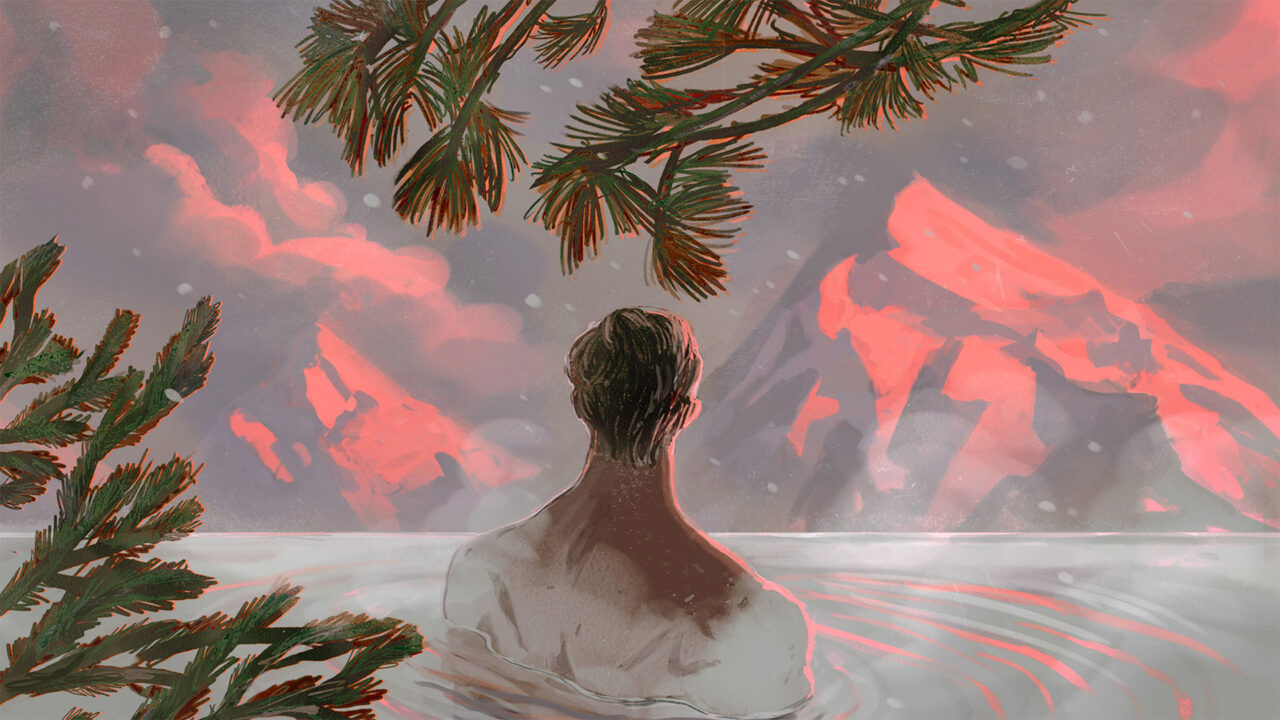
It’s a Saturday evening in November, and I’m deep in southern Colorado’s San Juan National Forest, lounging in a 102-degree natural hot spring and watching the surrounding peaks turn bright red at sunset. Steam rises around me, filling my lungs with dewy vapor. Other than rustling leaves, it’s completely silent. This, dear reader, is what serious scientific research looks like.
A few months ago, I turned 50. About a year before that—despite a healthy diet and an exercise regimen that includes mountain biking, skiing (alpine, backcountry, and cross-country), and a tennis habit that sometimes gets in the way of work—I was diagnosed with high blood pressure, around 130/85. Normal is 120/80. More than half of all Americans over 40 have hypertension, a major risk factor for heart attack and stroke. Researchers point to sedentary lifestyles or high sodium intakes as significant factors, but there are outliers like me, who are cursed with one potentially fatal flaw: bad genes.

Suddenly, I worried that I might drop dead of a stroke while out on a ride. During an early-morning tennis match this past summer, I got lightheaded and my heart began to race. Turns out, I was just dehydrated.
According to my doctor, I’m more likely to worry myself to death than die of a coronary event. But left unchecked, hypertension might kill me earlier than I’d prefer to go. Most people in my shoes would jump on medication, which is safe and effective but can have some nasty side effects, like muscle aches and fatigue. As an athlete, that bothers me. So, late one night, not long after my diagnosis, I found myself going down the Google rabbit hole, trying to find alternative cures for my malady. One potential remedy stood out: hot springs.
At first, I was skeptical: Could lounging in hot water really lower my blood pressure as successfully as medicine? But the science was surprisingly encouraging. A massive Japanese study showed that people who soaked almost every day were roughly 30 percent less likely to develop heart disease or have a stroke than those who rarely did. In shorter experiments, researchers found that even one 20- to 40-minute dip in 97- to 104-degree water could lower systolic blood pressure—the measurement of how hard your blood pushes against your artery walls when the heart beats—by six or seven points. Not even drugs work that quickly.
The Greeks, including Hippocrates, the “father of medicine,” prescribed bathing in and drinking spring water for ailments such as various skin diseases, fevers, and joint pain as early as 500 B.C.E. The Romans expanded on this practice, building elaborate public bathhouses, which served as vital social and medical centers, around natural springs across their empire. Japan’s onsen tradition dates back to at least the eighth century; in the 15th and 16th centuries, samurai frequented springs to heal wounds and recover from fatigue. It remains a significant part of Japanese culture today.
In Colorado, the history of using hot springs for physical and spiritual healing is deeply rooted in the practices of Native American tribes, particularly the Ute people, who called the mineral-rich waters yampah, meaning “big medicine.” Since geothermal heat is key to the formation of precious metals, miners—who began settling in Colorado in the 19th century—ended up establishing towns around hot springs and quickly began bathing in the warm waters to soothe stiff joints and muscles. What early Coloradans understood anecdotally, modern health care providers are now beginning to confirm with a growing body of scientific research.
In Italy, balneotherapy (soaking in hot springs for medicinal benefit) is such a well-accepted form of treatment for arthritis and several skin conditions that physicians there prescribe long stays at hot springs resorts to their patients—and its National Health System often pays for at least half the cost of the visits. Americans still live under a health care system that’s beholden to big pharma and bigger insurance, but while scrolling, I was able to track down Marcus Coplin, a naturopathic doctor who prescribes dips in the springs for certain ailments. “It’s not just relaxation, and it’s not placebo effect,” says Coplin, who serves as the medical director at the Springs Resort in Pagosa Springs. According to Coplin, exposure to hot springs enhances circulation and regulates immunity and inflation.
Coplin told me about a patient of his, a woman in her late 60s with rheumatoid arthritis and chronic pain. Before she headed to Palm Springs, California, for the winter, he laid out a routine she could follow on her own: regular soaking, gentle movement in warm water, and gradual exposure to different temperatures. The results were impressive. She experienced fewer flare-ups, steadier mobility, less pain, and longer stretches between needing more aggressive treatment. “Most people feel significant effects within one course of treatment,” Coplin says. And when people continue to soak regularly, “those effects typically last six months to a year,” he adds.
A few studies I read supported the idea that balneotherapy reduces inflammation, lessening the symptoms of arthritis. Fortunately for me, research has been more comprehensive in proving the health benefits of hot water on hypertension. “The immediate reason your blood pressure drops while you’re in the hot water is that the body is trying to dissipate heat by routing blood away from your warm core to the skin,” says Vienna Brunt, an assistant professor of renal diseases and hypertension at the University of Colorado Anschutz Medical Campus. When blood spreads to the extremities, the heart doesn’t have as much to pump, which naturally lowers pressure. The higher your body temperature gets during a soak, the more this happens (and staying immersed longer generally results in larger reductions).
“If you come back later, we can still see that your blood pressure is lower,” Brunt says. Her studies, of people in their early 20s, have shown that a 90-minute session four to five times per week in 104-degree heat can reduce blood pressure by up to three points over two weeks.
Results from long-term bathing yield even more impressive outcomes. When blood flow repeatedly rushes past vessel walls, it causes “shear stress,” which signals the arteries to become less stiff and more flexible. A similar effect can occur in tiny blood vessels. “Think of it like a river that widens in a section,” Brunt says. “The water can spread out more, so the force and pressure in any given spot is reduced.”
In a study of 60-plus-year-olds with elevated blood pressures that Brunt and her colleagues plan to publish soon, they discovered that 12 weeks of immersing in 104-degree water for an hour three to four days a week yielded a pressure drop of nine points. For many, including me, that’s the difference between having to take medication and not having to take medication.
Any source of heat will do the trick: Similar studies on hot tubs and saunas have shown positive results. But I live in Colorado, where natural hot springs are plentiful (there are almost 100 of them) and the views from them sublime. So I resolved to find out whether hot spring hopping could change my numbers.
First up: Pagosa Hot Springs. Last winter, I made the nearly 300-mile drive from my home in Basalt to the small southern Colorado town. For three days, I soaked away sore and tired muscles along the banks of the San Juan River, even jumping into the frigid water to dabble in contrast therapy. (I was later told by Brunt that cold therapy on its own has almost no benefits, but evidence suggests contrast therapy could be effective.) While there, I also tried a yoga class held in one of the springs. With my muscles loose from the hot water, I found it easy to stretch my chronically tight hamstrings, bending into positions I no longer thought possible. I was still limber several days later.
Over the course of several months, I visited Avalanche Ranch’s collection of terraced, rock-lined pools set among cottonwoods near Carbondale; Glenwood Hot Springs, which is about 40 minutes from my house; and Orvis Hot Springs, in the wide-open ranch country outside Ridgway.
After leaving Orvis, a handful of pools tucked into a quiet, clothing-optional compound, I felt particularly euphoric. I assumed that was because Orvis is thought to have the state’s highest levels of lithium, which, in pill form, has long been used to treat depression. All hot springs tout mineral absorption as part of their health benefits, so I figured I’d soaked long enough to reach a new level of bliss.
I was wrong. The skin, scientists say, isn’t porous enough to let dissolved minerals in. Only negligible amounts slip through—far below any threshold that could alter mood or physiology. That doesn’t mean I was imagining my high. “We know there are sensory systems that relay heat signals from the skin and body to the brain, and those pathways can trigger an antidepressant response,” says Christopher Lowry, a professor of integrative physiology at the University of Colorado Boulder. Lowry has conducted several studies into how heat therapy affects mood and says “just one heating session that was about two hours long had antidepressant effects that lasted at least six weeks.” No wonder the Finns, who are known for their love of saunas, are consistently named the happiest people on earth.
As cliché as it sounds, I’d soaked my worries away. During those hot water immersions, it’s also possible that I’d normalized my blood pressure. But without a regimented protocol, it’s also likely that it would shoot right back up again after a day or two. A return visit to the doctor’s office confirmed that my numbers were still elevated. My physician, seeming a bit more concerned, recommended I pick up a blood pressure cuff to monitor my hypertension at home.
I wasn’t entirely surprised, but the news still made me feel worried and depressed. If hot springs were really going to heal me, I needed to visit a place where the only thing more elevated than the temperature of the waters is the layers of comfort built into the indulgences. The extra pampering would buoy my spirits and encourage me to figure out a structured heat-therapy protocol. At least, that’s what I told my editor, who promptly approved the $366 nightly rate for me to visit Dunton Hot Springs.
Dunton sits at about 8,900 feet in a restored 1880s mining town in the San Juan Mountains, where original log cabins, a one-time general store, and the old saloon line a narrow, forested valley. Christoph Henkel and his wife, Katrin Bellinger, bought the property, which had been a ghost town for decades, in 1994. They spent seven years rebuilding each structure, keeping the historical bones but adding just enough comfort that you can now go from a candlelit dinner of celeriac bisque and rosemary-crusted lamb to a massage in the spa to a late dip in the bathhouse where miners once used to soak their tired bones.
“This was the original general store and mercantile when it was a mining town,” activities director Lee Pillaro says as we walk past its weathered logs. Inside the saloon, he points out the faint scratch of “Butch Cassidy” etched into the original bar. “It’s really hard to see because it’s about 150 years old,” he says. As Pillaro shows me around the grounds, a few people mill about in green bathrobes, eventually disappearing into the steamy pools. “You can pretty much go anywhere you’d like in your robes,” he says. “We just ask you don’t come to meals in them.”
It’s not long until I, too, am robed and heading toward the hot springs. After just one soak in the bathhouse—a room with timber beams, natural stone floors, large windows looking out toward alpine meadows, and a fireplace—my blood pressure drops from 131/86 to 122/81. Nearly normal. The rest of the day, I go from a soak to a hike to a soak to a delicious duck and white bean lunch to another soak before dinner. When I wake up the next morning, my blood pressure is even lower: 119/79.
My last day at Dunton, I’m up at seven in the morning and find about four inches of snow on the ground, the first of the season. I throw on my robe and stomp past frosted cabins and drooping pine boughs. I make my way to a pitlike tub. The basin is the source spring, and according to Pillaro, it’s been used for tens of thousands of years as healing waters. As I soak in the 106-degree pool, light snowflakes fall on my head and tickle the back of my neck. I descend into a perfectly blissful state for half an hour. My blood pressure back in the cabin? 118/78, the lowest I’ve recorded since my initial diagnosis.
The results are encouraging. The reality isn’t: I live 40 minutes from the nearest spring, which makes a daily Dunton-level soak about as practical as buying the place. But it turns out there are ways to hack it, even without buying a hot tub or home sauna. Insulated tub covers and small at-home heaters exist precisely for people like me, the ones trying to re-create a spa treatment in a normal bathroom without spending resort money. It’s not as romantic as soaking in hot springs, but maybe it will help stave off meds for a little longer. As scientific studies often say: More research is needed. But if experimenting feels anything like this, I’m willing to put in the time.