



The Local newsletter is your free, daily guide to life in Colorado. For locals, by locals.
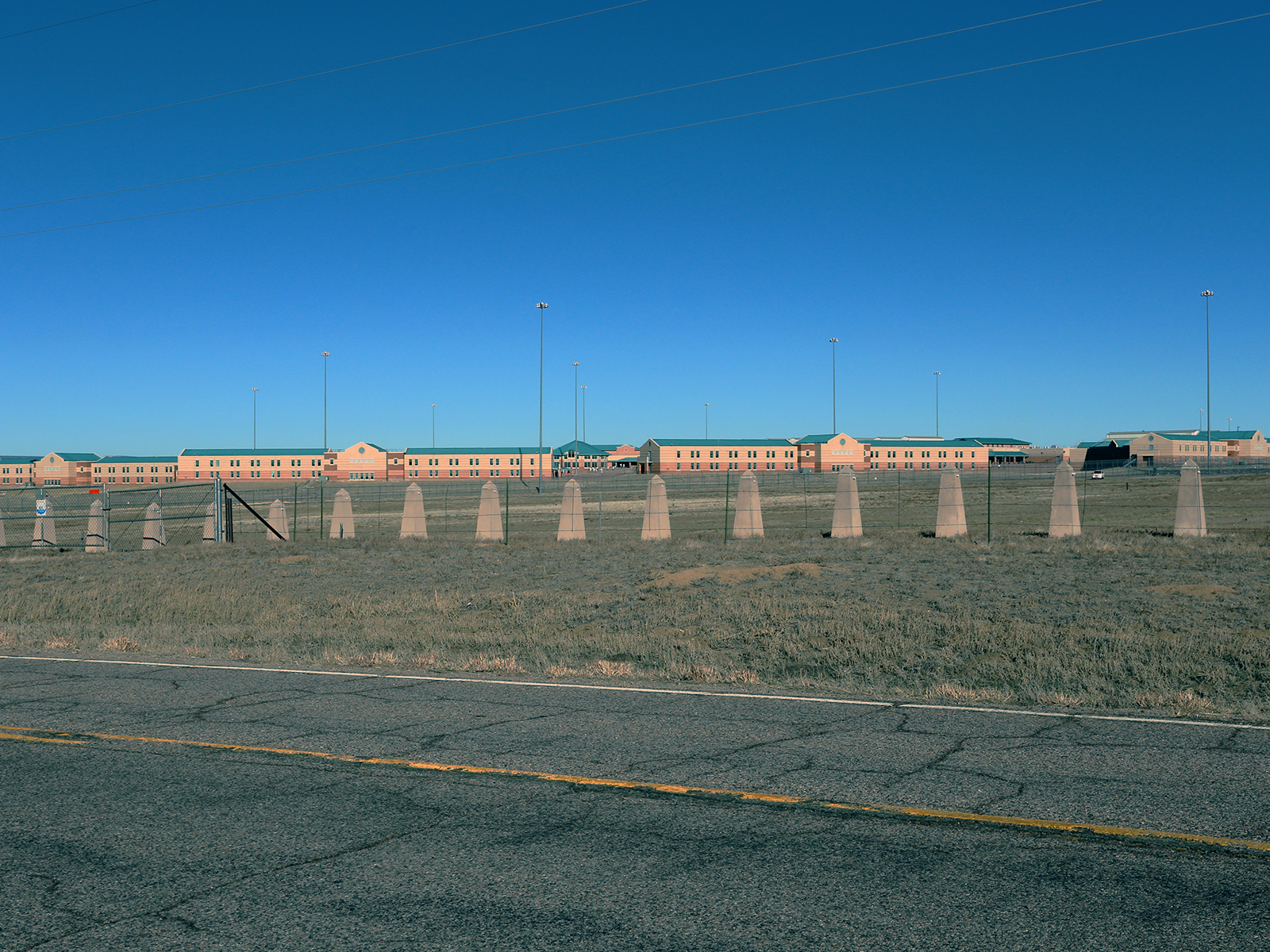
Tucked into the high plains of Fremont County, a two-hour drive southwest of Denver, is America’s highest-security prison: ADX Florence, the only federal prison with a Supermax designation. The facility is one of four federal penitentiaries at Florence’s 49-acre Federal Correctional Complex (FCC). More than 2,600 people are incarcerated at these prisons, which have earned Fremont County the title of “Colorado’s Correctional Capitol.”
If you’ve never heard of ADX, you’re not alone. Surprisingly few Coloradans are aware that the United States’ toughest prison is just over 110 miles south of Denver. ADX, which opened in 1994, houses some of the worst federal offenders, men deemed too dangerous or disruptive for other maximum-security facilities (think: Mexican drug lord El Chapo, the Oklahoma City bomber, and the Boston Marathon bomber).
As we reflect on its 30 years in operation, we wanted to know more about Colorado’s most severe and secretive penitentiary. Read on to learn about the history of America’s most controversial prison.
Supermax prisons are the legacy of Norman Carlson, a former director of the Federal Bureau of Prisons.
Understanding the history of the supermax prison in America and how ADX came to be requires going back to 1983, when two corrections officers were murdered by members of the Aryan Brotherhood prison gang at USP Marion in Illinois. Under the guidance of Norman Carlson, who was then director of the Bureau of Prisons (BOP), USP Marion was put on a permanent lockdown from 1983 until 2006. The federal prison operated as an “all-lockdown” facility, with inmates spending 23 or more hours per day in their cells. Their access to phone calls and visitors was also severely restricted.
USP Marion’s supermax period was the blueprint for ADX. Constructed with lessons from USP Marion and Carlson’s philosophy in mind, ADX cost about $60 million to build and began incarcerating inmates in November 1994.
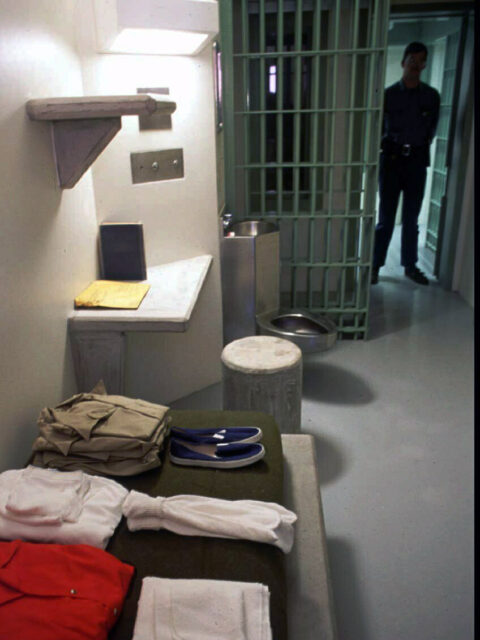
ADX is famous for its uniquely solitary conditions.
ADX has five general population units for inmates who pose the lowest security threat. Three other units—the control unit, special security unit, and range 13—have increasing levels of restriction and security.
Even within the general population, rules are more restrictive than most other penitentiaries. Inmates have limited contact with corrections officers and other inmates, but receive up to two hours of rec time per day, plus access to structured programming outside their cell, such as meeting with mental health professionals and group therapy, according to a BOP spokesperson.
ADX inmates are confined to a single soundproof, seven-by-12-foot concrete cell the other 22 hours of the day. Inside each cell is a single four-inch slit for a window and poured-concrete bed (equipped with four-point restraints), as well as a desk, stool, and stainless steel sink-and-toilet combo—all immovable, thus impossible to weaponize.
The control unit is where inmates are transferred after an infraction at another BOP facility; good behavior will eventually make them eligible for a step-down program to integrate into the general population.
ADX’s H unit is a special security unit for inmates placed under special administrative measures (SAMs), a BOP rule that permits a stricter level of control over a prisoner’s contact and communications. Generally speaking, SAMs are designed to mitigate the risk of the inmate continuing harm, as in the case of a mob boss who could continue to cause trouble from the confines of his cell. There are approximately 40 ADX inmates on SAMs as of June 2024, according to a BOP spokesperson.
Lastly, range 13—ADX’s most restrictive unit—is a four-cell wing where inmate meals are delivered without physical contact, cell doors can be opened remotely, and the cells are darkened and soundproofed, according to NBC reporting. A BOP spokesperson declined to provide more details.
The only ADX inmates we know to have been incarcerated on range 13 are Joaquín “El Chapo” Guzmán Loera, Thomas Silverstein, and Ramzi Yousef.
In 30 years, no one has ever escaped ADX Florence.
ADX is not just the United States’ most secure prison—it’s also one of the most secure edifices in the world.
The building is an unforgiving concrete structure immured by 12-foot razor wire fencing and a perimeter of watchtowers, sharpshooters, pressure pads, laser beams, and guard dogs. The facility is flush with technical security measures: about 1,400 steel doors, plus motion detectors and cameras, all monitored by remote high-tech control centers.
ADX is quiet and sterile. Robert Hood, a former warden of ADX, once described the fortress as a “clean version of hell.” In an interview with CNN, Hood said, “As soon as they come through the door…you see it in their faces. That’s when it really hits you. You’re looking at the beauty of the Rocky Mountains in the backdrop. When you get inside, that is the last time you will ever see it. The Supermax is life after death. It’s long term. In my opinion, it’s much worse than death.”
Despite these extreme security measures, an ADX inmate was murdered in 2005.
Manuel “Tati” Torrez was beaten to death by two other inmates in 2005. Torrez was serving time for crimes he committed as a leader of the Mexican Mafia, aka “La eMe.” Two other inmates, Silvestre “Chikali” Mayorqui-Rivera and Richard “Chuco” Santiago—both also known La eMe associates—killed Torrez while he was exercising in a rec area for ADX’s general population unit. Rivera claimed that he killed Torrez after learning that the 64-year-old had plans to kill him first.
Rivera, who reportedly only had about 15 years left to serve at the time he attacked Torrez, received a life sentence for the prison homicide. His accomplice Santiago, who was already serving life in prison, narrowly escaped the death penalty for his role in Torrez’s death and instead had another life term added to his sentence. Both Rivera and Santiago remain imprisoned at ADX.
9/11 co-conspirators would rather stay in Guantanamo Bay than be transferred to ADX.
Many terrorists detained in Guantanamo Bay, the U.S.-military run detention camp in Cuba, have yet to be convicted of a crime. But for Gitmo detainees eligible for transfer, ADX is on the short list. The Florence Supermax is already home to many high-profile terrorists, including the only person convicted in relation to the 9/11 terrorist attacks, Zacarias Moussaoui.
Sure, Guantanamo Bay has long been the center of controversies around torture and human rights violations, but it also offers freedoms that ADX would be unlikely to grant—the ability to pray and eat with other inmates, for example. In a 2016 NBC article, Bernard Kleinman, a New York defense attorney who represented clients at both Guantanamo and ADX, said that being imprisoned in Florence would be a “much, much greater punishment” than Gitmo.
The trials of five men—Khalid Sheikh Mohammed, Walid bin Attash, Mustafa al Hawsawi, Ammar al-Baluch, and Ramzi bin al-Shibh—have been postponed for years, due to plea deal negotiations, pandemic-related delays, and because Ramzi bin al-Shibh’s case had to be separated after he was found mentally incompetent. According to the New York Times, “guarantees that, even after their convictions, they would be able to eat and pray communally” have been a linchpin of the 9/11 co-conspirators’ plea-deal negotiations.
ADX was the center of a yearslong lawsuit alleging abuse and neglect of severely mentally ill inmates.
ADX was the center of the first-ever successful class-action lawsuit against BOP. In 2012, Cunningham v. Federal Bureau of Prisons was filed by 11 plaintiffs who were ADX prisoners at the time. They were represented pro bono by Arnold & Porter, a law firm with an office in Denver. The lawsuit alleged chronic abuse and neglect of severely mentally ill inmates at ADX, pointing out that the BOP was sued for breaking its own policy against placing mentally ill inmates in restrictive housing.
“It became clear very quickly in the first three or four visits that this wasn’t just a few guys who had fallen through the cracks,” says Ed Aro, one of the lawsuit’s main litigators. “ADX was basically a dumping ground for really, really sick people.”
The lawsuit details frightening self-harm and habitually destructive, disruptive behavior at ADX by inmates with severe diagnoses:
“Many prisoners at ADX interminably wailed, screamed, and banged on the walls of their cells. Some mutilated their bodies with razors, shards of glass, sharpened chicken bones, writing utensils, and whatever other objects they could obtain. A number swallowed razor blades, nail clippers, parts of radios and televisions, broken glass, and other dangerous objects. Others carried on delusional conversations with voices they heard in their heads, oblivious to reality and to the danger that such behavior might pose to themselves and anyone who interacts with them. Still others spread feces and other human waste and body fluids throughout their cells, threw it at the correctional staff, and otherwise created health hazards at ADX. Suicide attempts were common; many have been successful.”
The first-of-its-kind case was settled in late 2016 with terms and conditions including improved screening of prisoners’ psychiatric issues before being sent to ADX, enhanced mental health care at ADX—including group therapy, private counseling, and suicide prevention—and the transfer of severely mentally ill inmates to “step-down” units designed for mental health treatment at other prisons.
In 30 years, nine inmate suicides have been documented at ADX.
According to our reporting, there have been nine known instances of suicide at ADX as of June 2024. The nine men who killed themselves while imprisoned at ADX were:
- Kevin Lee Wilson, 1999
- Gregory Britt, 1999
- Lawrence Klaker, 2002
- Lance Vanderstappen, 2006
- John Frierson, 2008
- Jose Martin Vega, 2010
- Robert Gerald Knott, 2013
- Boyd Wallace Higginbotham, 2015
- Jamie Jarold McMahan, 2017
The fact that a suicide could happen at the Supermax is, in itself, notable. A fiery February 2024 DOJ audit investigated more than 340 inmate deaths at BOP facilities, zeroing in on “a combination of recurring policy violations and operational failures [that] contributed to inmate suicides.” The BOP’s chronic staffing shortages were also called out as a contributing factor to inmate deaths, which “hindered these institutions’ capacity to manage and address the needs of inmates in their custody.” The report highlighted areas for improvement that included inappropriate mental health care level assignments and restrictive housing environments. Almost half of the suicides that the DOJ reviewed happened in single-cell confinement.
ADX is famous for incarcerating the “worst of the worst.” But not every ADX inmate is a violent criminal.
Though some of the world’s most notorious criminals are at ADX—terrorists, mass murderers, serial killers, and mobsters—not all inmates are violent offenders. That’s true in the case of James “Jimmy” Sabatino, the Miami conman who just couldn’t stop swindling people even while imprisoned. A 20-year sentence for financial crimes in 2017 didn’t deter Sabatino from continuing to perpetrate financial cons, notably scamming Nextel out of $3 million in phones and service charges, from behind bars.
Sabatino is under SAMs in ADX’s H unit. In this case, the additional security measures and isolation aim to squash Sabatino’s seemingly insatiable need to swindle. He is only allowed to talk to his attorney and his elderly stepmother twice a month for 15 minutes, and all of his correspondence is monitored by the FBI, according to a January 2024 Westword article titled “Is Jimmy Sabatino America’s Loneliest Prisoner?”
Other notable nonviolent offenders at ADX have included Richard Lee McNair, an accomplished escape artist, and Robert P. Hanssen, a Soviet operative who died from cancer while imprisoned at ADX in 2023.
The Supermax is not immune to the BOP’s nationwide staffing crisis.
The Bureau of Prisons has been experiencing a well-publicized staffing crisis. Its workforce has dropped by nearly 20 percent in the last eight years. At a 2024 Senate Judiciary Committee hearing about BOP’s staffing crises, BOP director Colette S. Peters said the agency is “still faced with an inability to compete with the private sector and other law enforcement agencies.”
FCC Florence, the complex where ADX is located, was short around 200 correctional staff, according to a press release from Representative Brittany Pettersen, who represents Colorado’s 7th congressional district. “The employees at the Federal Correctional Complex in Florence have been overworked and faced severe understaffing issues for years. A prison that is fully-staffed is a safe one—otherwise, these conditions lead to forced overtime and dangerous conditions for the workers and the prisoners,” Pettersen said. “[We] have to keep working to improve conditions and morale at the nation’s only Supermax facility.”
Prison reform was a hot topic in 2024, bringing ADX into the spotlight once again.
Recent bipartisan motions to improve BOP conditions—including the July 2024 passage of the Federal Prison Oversight Act—seek to alleviate safety concerns for staff and inmates alike. Focal points include remediating the staffing crisis, improving institutional safety and security, enhancing mental health care provisions, overhauling restrictive housing practices, and reducing incarceration rates.
As dialogue around federal prison reform moves forward, ADX remains a bit of an anomaly. The one-of-a-kind facility is a last resort for criminals considered incapable of rehabilitation. But contrary to popular belief, many men incarcerated at ADX will leave via transfer to another facility and, in many cases, eventual release—so questions remain around solitary confinement, mental health support, rehabilitation, and recidivism.
As ADX turns 30, it’s worth noting that the lifespans of the Supermax designation for USP Marion, as well as its predecessor Alcatraz, were both about three decades. When asked about the longevity of the Supermax prison, a BOP spokesperson said “there are no plans to close any facility at the Federal Correctional Complex Florence.”