

The Local newsletter is your free, daily guide to life in Colorado. For locals, by locals.
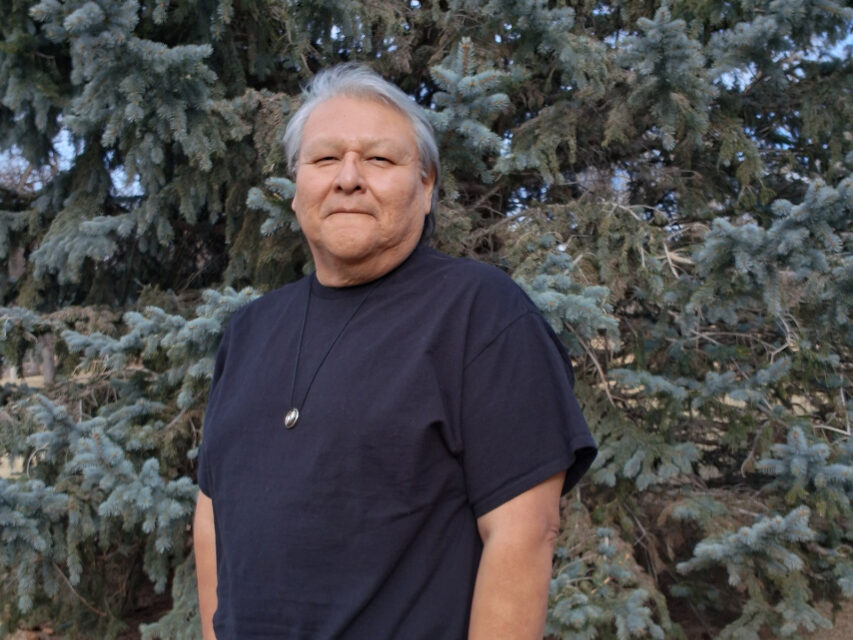
Crisosto Apache still remembers the exact moment poetry revealed itself as a potential calling. It was 1990, midway through Apache’s first semester at the Institute of American Indian Arts, where Apache had enrolled as a 2D design major thanks to an art scholarship. That’s when Apache first met famed American poet Arthur Sze.
“He was teaching at the institute at the time,” Apache says. “He influenced me to switch my major to creative writing and taught me everything I needed to know about poetry.”

Apache had filled notebooks with poetry in high school and read it voraciously, but it was Sze’s encouragement that transformed this quiet passion into Apache’s life’s work. More than 35 years later on January 28, Governor Jared Polis announced Apache as Colorado’s 11th poet laureate.
Originally from New Mexico, the Mescalero Apache, Chiricahua Apache, and Diné (Navajo) poet is an associate professor in liberal arts at Rocky Mountain College of Art and Design. Apache also succeeds the late Andrea Gibson, who served as Colorado’s poet laureate from 2023 until their death in July 2025. For the next two years, Apache will serve as Colorado’s ambassador for poetry, with a special emphasis on honoring the state’s 150th anniversary and the country’s 250th anniversary through creative writing.
Ahead of Apache’s two-year term, we sat down with the author of poetry books GENESIS, Ghostword, and (is)ness to discuss their vision for honoring Indigenous voices and reflecting on Colorado’s history.
Editor’s note: The following conversation has been edited for length and clarity.
5280: What does the writing process look like for you?
Crisosto Apache: My writing process is pretty open, there’s no real schedule to it. But one thing that’s consistent is that I have several projects that I’m working on at once. That feeds the momentum of my writing because I have a scope of what I’m working toward. Right now I’m working on two poetry manuscripts that are in an epic style, so they’re these booklength sets of poems that tell a story. The first one is called Swift Cinder and the second is called American Accessory.
As far as the actual process goes, poems happen whenever they happen. Sometimes I’ll be driving and lines come to me, so I’ll pull over and turn on my recorder. Sometimes I wake up in the middle of the night with lines in my head and go to turn on my computer. There’s no set time when I sit down and write, it just happens.
You’re stepping into this role during two major anniversaries for both the U.S. and Colorado. How do you feel that poems can help us engage with history?
Colorado is a perfect example of how complex and layered history can be. One thing I want to focus on during the 150th anniversary of statehood is mixing Indigenous history with the history of settlers who came here. Colorado has a very rich and diverse history, and it also has a diverse population today. I’m interested in how to incorporate that diversity into events I partake in over the next couple of years. The environment is also a big part of it. Colorado has the Rocky Mountains, and that landscape holds a lot of meaning. Poetry can help us reflect on both the human and environmental histories that shape this place.
When Governor Polis announced you as Colorado’s newest poet laureate, you said you wanted to “write from a landscape that teaches us how to listen.” What does that mean?
Poetry is really about listening to the nuances of the places that you inhabit. It’s about thinking about the presence of a location and how you’re interacting with that space. Colorado holds many types of landscapes—urban, rural, mountains, plains—and it’s important to be cognizant of the histories behind them. Listening means being aware of how people interact with those spaces, how history lives in them, and how that differs from town to town. That awareness will guide how I approach this role over the next couple of years.
Do current events influence your work?
That’s a complex question, because the climate in the United States is really sensitive right now, and it impacts all of us. I recently participated in an event in Boulder’s East Window Gallery where the theme was “resistance.” The focus was how people are responding to what’s happening nationally, and I was able to bring it closer to Colorado and the historical context here. We can’t escape these conversations, they’re a part of our reality. But I don’t think I’ll make them the sole focus of my work as laureate. I want to stay grounded in the broader theme of history, place, and community, especially given the significance of anniversaries happening during my term.
As an Indigenous person, I’m also in a unique position. I’ve gotten questions from the Indigenous community about what it means to celebrate the founding of the United States, given the history involved. Those tensions are real, and I hope to acknowledge them in my poetry.
You’ve said you want to guide young and emerging writers. What advice would you give to someone starting to write?
I would encourage people to network with established writers. A lot of writers are very generous with their knowledge, especially when it comes to poetry. If you know someone who writes, don’t be afraid to get to know them and learn from them. That kind of mentorship can really help shape your direction. Never be afraid to ask questions and learn from people who have helped lead the way.
When you experience writer’s block, what helps you return to your work?
I read. Engaging in what others are doing in the craft of writing helps facilitate those moments when I’m unable to focus on the poetry.
You’re stepping into this role after Andrea Gibson, someone who left a profound mark on Colorado’s poetry community. What does their work as poet laureate mean to you?
I’ve always been inspired by both Andrea Gibson and Bobby LeFebre, two really important writers who came before me in this role. They both did a great job at getting poetry in front of a greater number of people, and so I’ve been thinking a lot about what poetry means to Coloradans.
A lot of people don’t understand what a poet laureate is or why there’s one for Colorado. The previous laureates did a great job at spreading awareness and love for poetry, and that’s going to be a main focus for me. If young people can find a voice through poetry, it can leave a lasting impact on how they view the world. Poetry has been around for centuries and gets people to think about life and experience, but Andrea Gibson was able to get poetry in front of so many new people. I want to continue that momentum.
If someone is unfamiliar with your work, where should they start?
I usually tell people to go to the Poetry Foundation or the American Academy of Poets and search my name. They’ll find poems from all three of my books there. A lot of my work is also available through literary journals and anthologies. Honestly, Googling my name is a pretty easy way to find my poems. One thing I should probably say, though, is that my publisher just informed me that after my announcement as laureate, there was a large influx of new orders on my books. That’s definitely not a bad thing, but I’d encourage people to be patient with my publisher as they restock my books; they should be back in stock soon.